

📣 Create Blog for Traders!
Stop Watching news - Start Making it.
START



The Great Reset: Bitcoin Mining Difficulty Plummets 11.16% in Largest Adjustment Since 2021
In a historic recalibration of the world's most secure decentralized network, Bitcoin mining difficulty has dropped by 11.16% at block height 935,429. This downward adjustment - the 10th largest in Bitcoin's history - marks the most aggressive easing of mining conditions since the systemic industry shifts following China's mining ban in July 2021.
Risk Disclosure: Significant difficulty drops often correlate with periods of extreme "miner capitulation" or physical infrastructure disruptions. While easier difficulty aids profitable miners, it highlights systemic vulnerabilities in the network's current hashrate distribution. This is not financial advice.
The 11.16% reduction was not triggered by a single factor, but by a combination of economic and environmental pressures:
- Winter Storm Fern: A severe arctic front in the United States forced major mining pools, including Foundry USA, to temporarily curtail power to stabilize the electrical grid. Foundry reportedly lost up to 60% of its hashing power during the peak of the storm.
- The $0.03 Hashprice Wall: With Bitcoin trading nearly 45% below its 2025 highs, mining revenue (Hashprice) fell to a record low of $0.03/TH/day. This forced high-cost operators to switch off unprofitable rigs indefinitely.
- AI Pivot: Analysts at CoinMetrics report that a portion of the hashrate is not "off," but has been reallocated to AI and High-Performance Computing (HPC) data centers, which currently offer higher margins than Bitcoin mining.
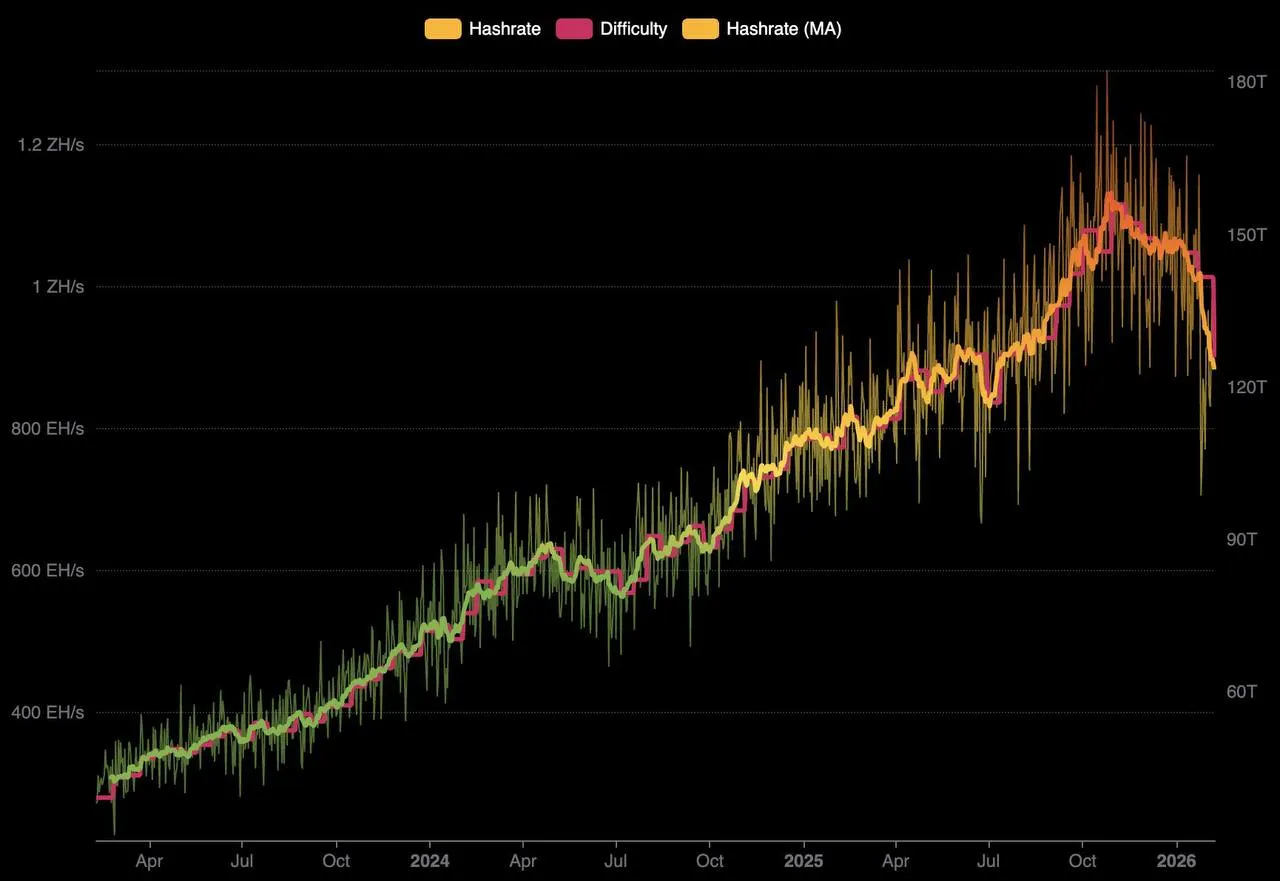
Featured Snippet Answer: On February 8, 2026, Bitcoin mining difficulty decreased by 11.16%, dropping to 125.86 T. This is the largest negative adjustment since the 2021 China mining ban. The drop was caused by a 20% decline in network hashrate due to Winter Storm Fern in the U.S. and a record-low hashprice of $0.03/TH, which forced unprofitable miners to disconnect. This adjustment makes it easier for remaining miners to find blocks, providing short-term relief to the industry.
While the 2021 drop was driven by regulatory force (the China ban), the 2026 drop is driven by market and weather forces.
- July 2021: Difficulty dropped by 27.9% as 50% of the world's miners went offline.
- February 2026: The 11.16% drop reflects a more localized but intense disruption in the U.S., which now controls nearly 40% of the global hashrate.
The Bitcoin protocol is already responding to the easier conditions. As of February 9, average block times have tightened to 9.47 minutes. Consequently, CoinWarz estimates that the next adjustment on February 20 could see a partial rebound, with difficulty rising by approximately 5.63% to 132.96 T.
Experience Note: "I’ve monitored every major difficulty drop since 2013, and this one feels different," says a lead researcher at TradingView. "In 2021, we were looking for a new home for the machines. In 2026, we are looking for a new price for the power. The network is essentially healing itself from an over-concentration of hashrate in regions vulnerable to extreme weather."
- Binance Square: Largest Difficulty Drop Since 2021: https://www.binance.com/en/square/hashtag/BTCMiningDifficultyDrop — Real-time network statistics.
- TradingView News: Bitcoin difficulty falls 11%: https://www.tradingview.com/news/cointelegraph... — Market impact and block time data.
- Coinpaper: Mining Plunges After US Storm: https://coinpaper.com/14394/bitcoin-price-today-as-mining-difficulty-plunges-11-after-us-storm — Details on Winter Storm Fern.
- MEXC News: Mining Viability and Power Outages: https://www.mexc.co/news/663251 — Analysis of institutional mining shutdowns.
Q: Does a lower difficulty make Bitcoin less secure? A: Technically, a lower hashrate means less energy is required to attack the network. However, at 125 T, Bitcoin remains orders of magnitude more secure than any other proof-of-work blockchain.
Q: How does this affect my transaction fees? A: Initially, block times may stretch (slowing transactions), but once the difficulty resets downward (as it just did), block times return to 10 minutes, which usually helps stabilize and lower fees.
Q: Will mining difficulty continue to fall in 2026? A: That depends on the BTC price and energy costs. If Bitcoin remains below $75,000, we may see further "efficiency-driven" shutdowns as older machines are permanently retired.