

📣 Create Blog for Traders!
Stop Watching news - Start Making it.
START



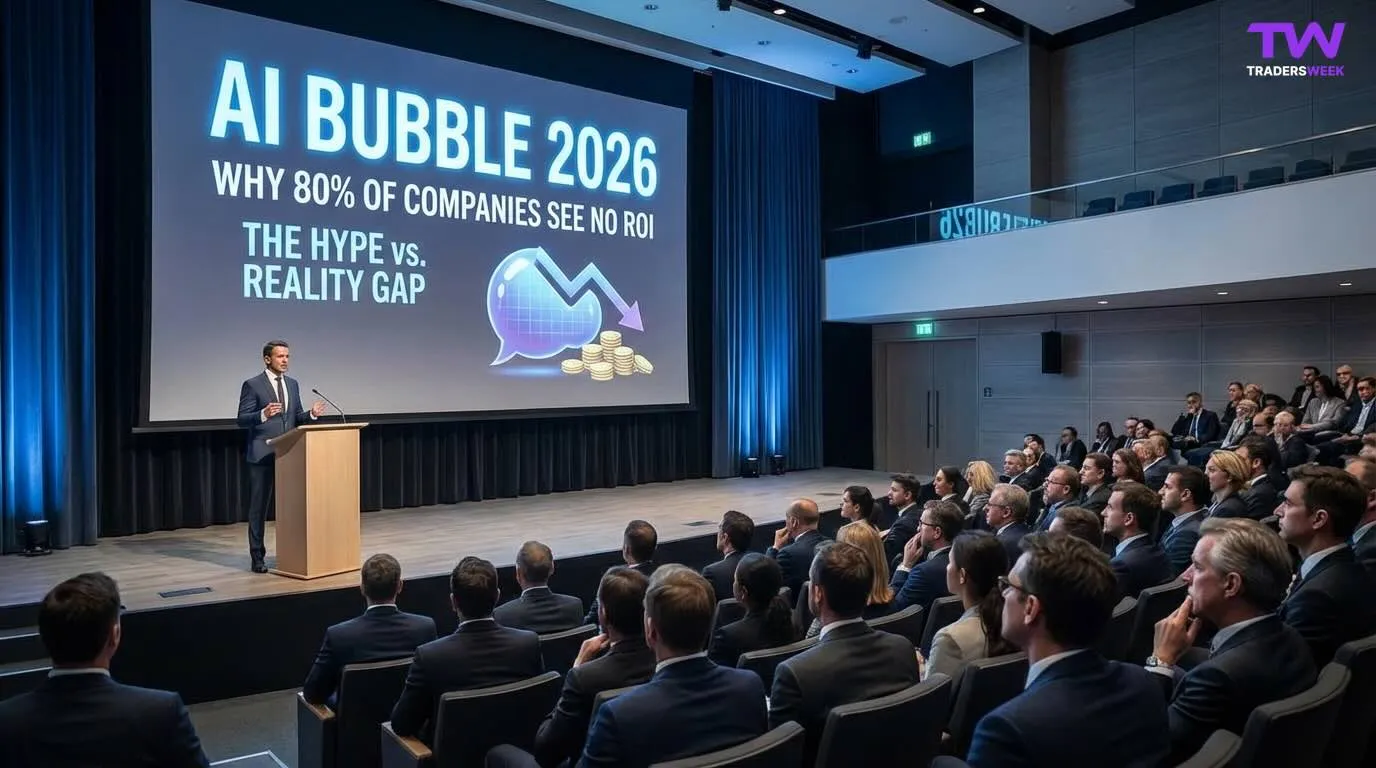
AI Bubble 2026: Why 80% of Companies See No ROI
By Macroeconomics & Tech Strategy Team | Last Updated: February 19, 2026
A massive disconnect has formed between the utopian promises of Silicon Valley and the cold, hard math of global corporate balance sheets. While tech conglomerates aggressively market artificial intelligence as the ultimate solution for labor efficiency, a groundbreaking joint study by the National Bureau of Economic Research (NBER), the Bank of England, and the German Bundesbank has revealed a sobering reality: 80% of companies investing in AI have found zero measurable benefit.
As we stand in early 2026, the global economy is witnessing the ultimate "Productivity Paradox." The narrative that AI will seamlessly replace the middle class and eliminate white-collar jobs is aggressively colliding with the fact that most corporations cannot even use it to marginally increase daily output.
Risk Disclosure: Investing in highly valued AI startups or mega-cap technology stocks based on future AI revenue projections carries extreme financial risk. If the corporate sector halts AI software spending due to a lack of Return on Investment (ROI), a sudden deflation of the "AI Bubble" could trigger a severe stock market correction.
Featured Snippet Answer: According to a 2026 NBER and Bank of England study surveying 6,000 corporate executives, while 70% of companies have integrated AI into their workflows, 80% report no measurable financial benefit. Only 11% of these corporations experienced actual productivity growth, defined as a tangible increase in revenue per employee.
To understand the depth of this failure, we must look at the specific data points gathered from over 6,000 C-level executives (CEOs, CFOs) across the US and Europe:
- The Adoption Rate (70%): The vast majority of corporations succumbed to FOMO (Fear Of Missing Out) and purchased enterprise AI licenses.
- The Subjective Illusion (20%): Only one-fifth of executives felt that neural networks improved subordinate efficiency. This is often an illusion created by faster email drafting, not core business acceleration.
- The Hard Truth (11%): The only metric that matters in macroeconomics is Revenue Per Employee (RPE). A mere 11% of companies managed to translate AI usage into actual financial growth.
Why is the technology failing to deliver on the ground floor? The answer lies in the friction of implementation.
Having analyzed numerous corporate AI rollouts, the failure points are remarkably consistent:
- The "Wrapper" Problem: Companies buy expensive AI tools but overlay them on broken, legacy data architectures. AI cannot optimize a process if the underlying corporate data is disorganized.
- The Hallucination Tax: While AI can generate a report in 5 seconds, a middle-management employee often has to spend 45 minutes fact-checking the output for "hallucinations" (confident but incorrect data) and regulatory compliance. The net time saved is zero.
- Lack of Fundamental Workflow Shift: Giving an employee an AI chatbot does not change the core business model. It simply automates the easiest parts of the job, leaving the complex, time-consuming bottlenecks untouched.
The most alarming aspect of this economic cycle is the widening gap between the sellers of the technology and the macroeconomic regulators.
AI developers are doubling down on aggressive timelines:
- Anthropic's Deadline: Last year, Anthropic's CEO famously predicted that by March 2026—which is right now—neural networks would completely replace human programmers, writing 100% of the code.
- Microsoft's Warning: Similarly, leaders at Microsoft AI projected that by the end of 2027, AI would execute all white-collar office tasks, effectively rendering traditional middle-class office work obsolete.
In stark contrast, those managing national economies are preparing for fallout.
- The Bank of England's Stance: Months ago, the Bank of England issued a direct warning to institutional investors: prepare for a deep, systemic recession. Their models suggest that if corporate buyers realize they will never see a return on their multi-million dollar AI investments, they will abruptly cancel contracts. This would cause a rapid collapse in the valuations of AI infrastructure companies, leading to a bursting of the tech bubble.
The narrative that AI will effortlessly automate the economy is currently a highly successful marketing campaign, not a macroeconomic reality. While the 11% of companies that successfully restructured their entire business models around AI are seeing gains, the remaining 89% are simply burning capital on software subscriptions. Investors and corporate boards must transition from asking "Are we using AI?" to demanding rigorous proof of "Is this AI actually increasing our revenue?"
Q: What is the "Productivity Paradox"? A: Originally applied to the adoption of computers in the 1980s, the productivity paradox occurs when massive investments in new technology fail to show up as measurable increases in national or corporate productivity statistics.
Q: Why does the Bank of England care about an AI bubble? A: Central banks monitor systemic risks. Because tech companies make up a disproportionately large percentage of global stock market indices (like the S&P 500), a collapse in their valuations due to an "AI bubble" bursting would destroy trillions in wealth, triggering a global recession.
Q: Does this mean AI is useless for business? A: No. It means that simply buying AI tools is insufficient. The 11% of companies seeing success are those that completely re-engineered their data pipelines and workflows to leverage the technology, rather than just using it as a digital assistant.
- Primary Economic Data: NBER Working Paper - AI Corporate Adoption
- Silicon Valley Forecasts: Business Insider - Anthropic CEO Code Prediction & Fortune - Microsoft White-Collar Jobs
- Macroeconomic Warnings: Bank of England Systemic Risk Reports
- Economic Theory: Investopedia - The Productivity Paradox