

📣 Create Blog for Traders!
Stop Watching news - Start Making it.
START



US Copper Stockpiles 2026: The Macro AI Squeeze
By Macro & Commodities Strategy Desk | Last Updated: February 23, 2026
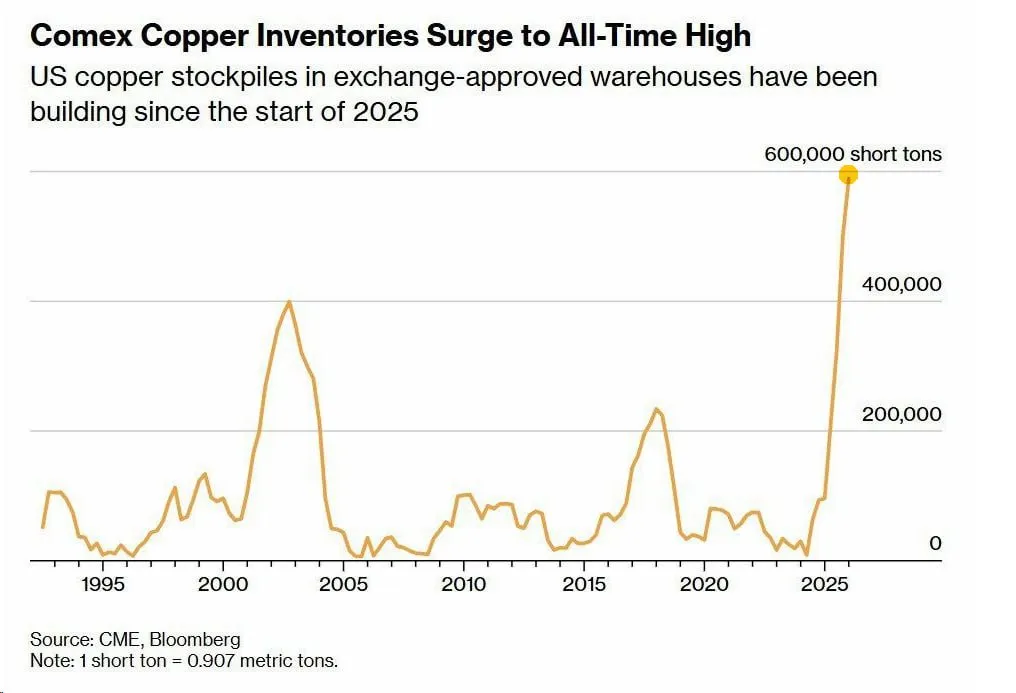
On Wall Street, there is an old adage that the base metal holds a Ph.D. in economics, earning it the moniker "Doctor Copper." Because it is heavily utilized across virtually every industrial sector, its inventory levels and price action are unparalleled leading indicators of global economic health. Recent data from the Chicago Mercantile Exchange (CME) and Bloomberg indicates a massive macroeconomic shift: the United States is stockpiling copper at a record-breaking pace.
In early 2026, warehouse inventories of copper across the US have surged dramatically. While amateur traders might view rising inventories as a bearish signal of oversupply, institutional commodity strategists see a different reality. This aggressive accumulation is a strategic, national-level preparation for the largest infrastructure and electrification boom of the century.
Risk Disclosure: Trading physical commodities and futures contracts involves a high degree of leverage and extreme risk of capital loss. Commodity markets are subject to sudden supply shocks, geopolitical events, and severe volatility. The SEC and CFTC strongly advise retail investors to fully understand margin requirements before entering the commodities market.
Featured Snippet Answer: According to CME and Bloomberg data, the US is stockpiling copper at record paces in 2026 primarily to support the massive infrastructure demands of Artificial Intelligence (AI) data centers, the modernization of the national power grid, and the transition to electric vehicles (EVs). Copper is the essential conductive metal required for this sweeping electrification mega-trend.
To understand the sudden rush for physical metal, we must look beyond traditional construction and housing metrics. The 2026 demand shock is driven by three specific pillars:
- The AI Infrastructure Boom: Artificial intelligence data centers consume exponentially more power than traditional server farms. The electrical infrastructure required to power and cool these facilities—specifically transformers, heavy-duty cabling, and generators—requires thousands of tons of high-grade copper.
- Grid Modernization: To deliver power to these new data centers and support the growing fleet of EVs, the US is heavily investing in upgrading its aging electrical grid, a process completely dependent on copper wiring.
- Geopolitical Hedging: The US government and heavy industry are acutely aware of supply chain vulnerabilities. With major copper mines located in politically volatile regions globally, aggressively accumulating physical reserves on domestic soil acts as a strategic hedge against future supply shocks.
When analysts mention "CME/BBG data," they are primarily referring to the inventory levels held in COMEX-approved warehouses across the United States.
- The Stockpile Metric: The data tracks the total tonnage of copper eligible for delivery against the widely traded HG (High Grade) Copper futures contract.
- The Contango Reality: Currently, the market dynamics often incentivize producers to store physical copper rather than sell it immediately on the spot market, leading to rapidly rising inventory levels. This hoarding behavior signals that major industrial players believe the future value of the metal vastly outweighs the cost of storing it today.
For a deeper dive into how commodity storage impacts futures pricing, Investopedia's explanation of the Futures Market provides excellent foundational knowledge.
From a commodities trading desk perspective, the current setup is highly complex and dangerous for uneducated participants.
The Short Squeeze Scenario:
- The Setup: Retail traders see headlines about "record high inventories" and immediately open short positions on copper futures, assuming an oversupply will crash the price.
- The Trap: They fail to realize that these stockpiles are often already earmarked for massive corporate buyers (like tech conglomerates building AI data centers) and are not actually available for the open spot market.
- The Squeeze: When a major infrastructure project suddenly demands physical delivery, the "available" supply dries up instantly. The price spikes violently, triggering margin calls and forcing the short-sellers to buy back their positions at massive losses. This exact dynamic caught many traders off guard during previous industrial super-cycles.
The record pace of copper stockpiling in the United States is not a sign of economic stagnation; it is the physical manifestation of the AI and electrification arms race. As we progress through 2026, "Doctor Copper" is signaling that the infrastructure build-out is accelerating. Investors monitoring the macroeconomic landscape should keep a close eye on CME inventory data, as it serves as a reliable barometer for the future demands of the global technology sector.
Q: What is Doctor Copper? A: "Doctor Copper" is a market slang term for the base metal. Because copper is used in construction, technology, and manufacturing, its price and inventory trends are considered reliable indicators of global economic health.
Q: How can retail investors gain exposure to copper? A: Retail investors typically avoid physical delivery and instead invest in copper mining stocks, copper-focused ETFs, or, for the more experienced, copper futures contracts on exchanges like the CME.
Q: Why does AI require so much copper? A: AI models require massive clusters of specialized GPUs, which draw immense amounts of electricity. The data centers housing these GPUs need heavy-duty electrical infrastructure (transformers, busbars, and thick cabling) to handle the power load, all of which are made from copper.
- Commodity Data: CME Group - Copper Futures and Options
- Regulatory Education: CFTC.gov - Commodity Trading Advisories
- Financial Concepts: Investopedia - Futures Market Definition