

📣 Create Blog for Traders!
Stop Watching news - Start Making it.
START



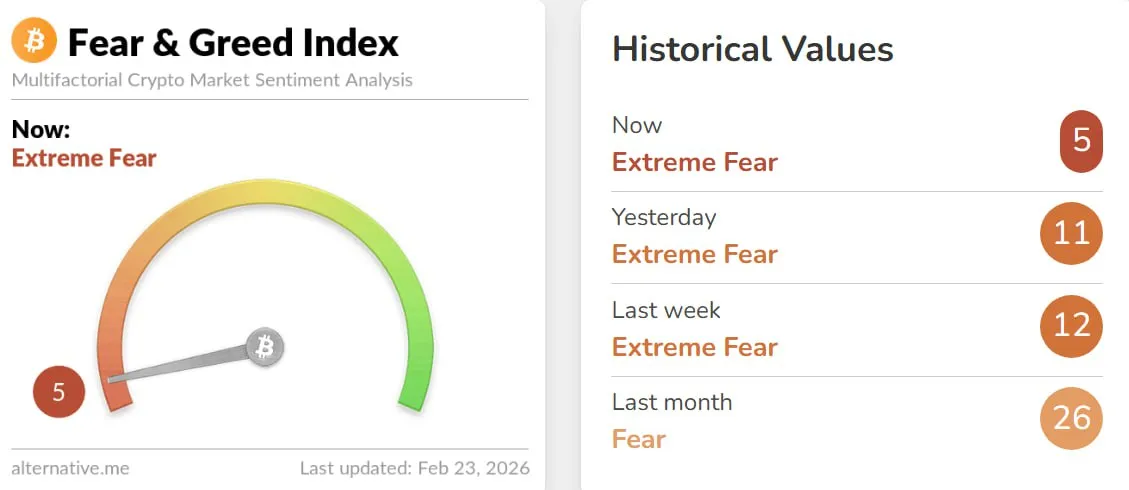
Crypto Fear and Greed Index: Extreme Fear in 2026
By Market Psychology & Trading Strategy Desk | Last Updated: February 23, 2026
Market sentiment is a pendulum that constantly swings between irrational exuberance and unjustified panic. In late February 2026, driven by a perfect storm of institutional ETF outflows, miner capitulation, and regulatory FUD, the cryptocurrency market's psychological pendulum has slammed hard into the red zone. The widely tracked Crypto Fear and Greed Index is officially threatening to break its historical floor.
When the index plunges into "Extreme Fear," it indicates that the majority of retail investors are panic-selling their portfolios at a loss. However, for veteran traders and institutional algorithms, blood in the streets is historically viewed as the ultimate buy signal. Understanding how to interpret this metric is the difference between surviving a market crash and becoming exit liquidity for the "Smart Money."
Risk Disclosure: Contrarian trading—buying assets when the broader market is in a state of extreme fear—carries massive financial risk. The index hitting "rock bottom" does not guarantee an immediate price reversal. Markets can remain in a state of irrational panic far longer than retail traders can remain solvent. The SEC constantly reminds investors to avoid making emotionally driven financial decisions.
Featured Snippet Answer: When the Crypto Fear and Greed Index drops below a score of 20 out of 100, the market enters "Extreme Fear." This psychological state means investors are overly worried and aggressively liquidating assets. Historically, Extreme Fear creates a contrarian buying opportunity, signaling that the asset is oversold and a localized price bottom may be forming.
To trade this indicator successfully, you must understand that it is not simply an internet poll. The index, originally popularized by Alternative.me, is a complex algorithmic aggregate of multiple real-time data points:
- Volatility (25% Weight): Measures current Bitcoin price fluctuations and maximum drawdowns against 30-day and 90-day historical averages. Spiking volatility triggers fear.
- Market Momentum & Volume (25% Weight): High selling volume combined with negative market momentum strongly drives the index downward.
- Social Media Sentiment (15% Weight): An algorithm analyzes specific hashtags and mentions across X (Twitter) and Reddit to gauge retail panic.
- Bitcoin Dominance (10% Weight): When fear rises, capital flees highly volatile altcoins and seeks safety in Bitcoin, causing BTC market dominance to spike.
- Google Trends (10% Weight): Surges in search queries like "Bitcoin crash" or "Sell crypto" directly lower the index score.
Legendary investor Warren Buffett coined the ultimate contrarian mantra: "Be fearful when others are greedy, and greedy when others are fearful." But how does this apply to the hyper-volatile crypto markets of 2026?
The Psychology of the Bottom:
- The Retail Trap: The average retail trader buys when the index is above 80 ("Extreme Greed") because the news is overwhelmingly positive and prices are hitting all-time highs. They sell when the index hits 10 because social media is predicting the death of the asset class. They consistently buy high and sell low.
- The Institutional Play: Smart money operates inversely. They use the Fear and Greed Index as a gauge of supply exhaustion. If the index is at 10, it means the "weak hands" have already sold everything they own. Without sellers left to push the price down, market makers step in to accumulate assets at a steep discount.
For an in-depth look at how market psychology drives financial bubbles and crashes, Investopedia's guide to Behavioral Finance is highly recommended.
If you are staring at a portfolio deep in the red while the index screams "Extreme Fear," professional risk managers suggest the following protocols:
- Do Not Panic Sell: If you have high-conviction assets (like BTC or ETH) and you do not need the fiat currency for immediate life expenses, selling during Extreme Fear simply locks in your permanent losses.
- Dollar-Cost Averaging (DCA): Do not try to catch the absolute bottom of the "falling knife." Instead, use a DCA strategy. Buy small, fixed amounts at regular intervals while the index remains in the Extreme Fear zone.
- Zoom Out: Daily fear is noisy. Look at the macroeconomic backdrop. Are the underlying fundamentals of the network failing, or is the market just reacting to temporary regulatory headlines?
The Crypto Fear and Greed Index threatening to "break the bottom" is a terrifying moment for the uninitiated, but a highly anticipated event for professional macro traders. It represents a psychological reset of the market. While buying into extreme fear requires iron discipline and strict risk management, historical data confirms that the most lucrative crypto investments are rarely made when the crowd is cheering; they are made when the crowd is capitulating.
Q: Can the Fear and Greed Index hit zero? A: Theoretically, yes. The index operates on a scale from 0 to 100. A score of zero would indicate absolute, unprecedented market terror, though historically, major market bottoms tend to form when the index drops into the low single digits (between 5 and 10).
Q: Should I buy a coin just because the index shows Extreme Fear? A: Absolutely not. The index is a gauge of overall market sentiment (heavily weighted toward Bitcoin). Individual altcoins can go to zero even if the broader market eventually recovers. Always conduct fundamental research on the specific asset.
Q: How often is the index updated? A: The most widely used indices, such as the one provided by Alternative.me, update their algorithmic score once every 24 hours.
- Financial Psychology: Investopedia - Behavioral Finance
- Risk Management Education: SEC.gov - Ten Things to Consider Before You Invest
- Index Data Reference: Alternative.me Crypto Fear and Greed Index (Contextual source of the methodology)
- Trading Strategies: Investopedia - Dollar-Cost Averaging (DCA)