

📣 Create Blog for Traders!
Stop Watching news - Start Making it.
START

AI Won't Pass Your Prop Firm Challenge (Here's Why)
A new study shows AI increases workload and kills focus. For a funded trader, this is a disaster. Here's my strategy to avoid the AI trap.
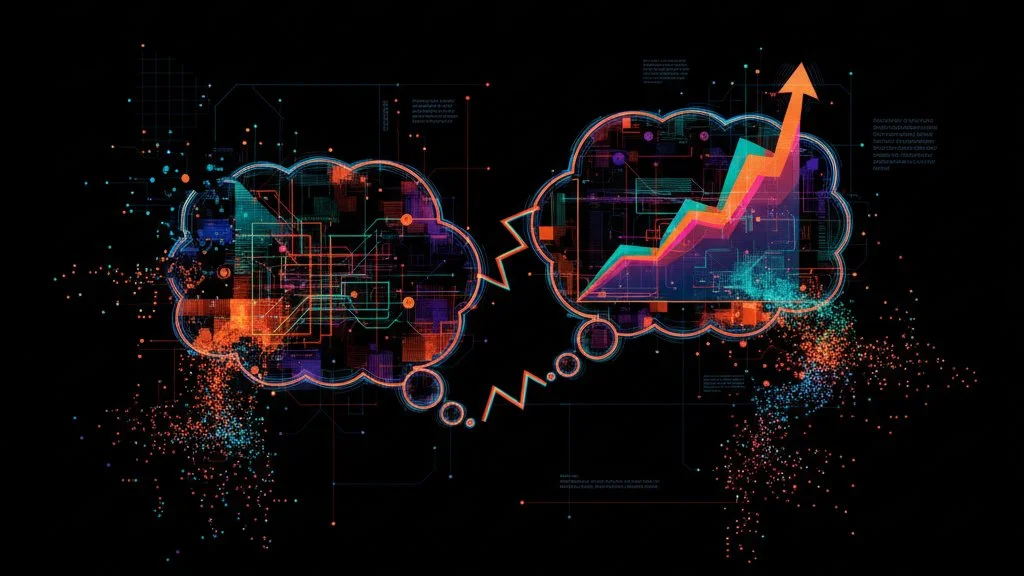
This Tuesday, I almost blew my funded account. Not because of a bad trade, but because of a new toy. I was testing an AI-powered sentiment analysis tool for EUR/USD. Before the London open, it had fired off over 50 alerts—'strong bullish momentum detected,' 'divergence forming,' 'institutional buying pressure.' It was a firehose of conflicting information. The noise almost convinced me to jump into a pre-market scalp, a clear violation of my own rules. I shut it down, took a walk, and stuck to my plan. This little experiment perfectly illustrates the findings of a new ActivTrak study I read this morning: implementing AI actually increased workloads and killed focused work by 9%.
The study is a bombshell for anyone in a performance-based field. Analysts looked at 443 million work hours and found that after AI was introduced, time spent on communications doubled and business system usage jumped 94%. Why? Because the time AI 'saves' you isn't free time. It gets immediately redirected to new tasks, more communication, more data to process. For a trader, this is the kiss of death.
I see this constantly with traders trying to get funded. They think the secret on how to pass prop firm challenge is to analyze more, trade more, and be 'busier.' They load up on AI signal bots, automated chart pattern scanners, and sentiment widgets. The result is exactly what the study found: they spend more time managing tools than managing trades. Their focused work—the deep, quiet analysis of price action—plummets. They end up taking B-grade setups just to feel like they're doing something. That's how you fail. I know, because I failed my first six challenges doing exactly that.
Every prop firm is a risk management test. The profit target is secondary. The real challenge is not violating the drawdown rules. My spreadsheet tracks over 30 firms, and the daily drawdown limit is almost always the account killer, typically around 5%. An AI tool, designed to find 'opportunities,' is fundamentally at odds with this rule. It encourages action, not patience.
Think about it. On a $100,000 FTMO account, your max daily loss is $5,000. Your AI tool gives you three 'high-probability' signals on GBP/JPY during a choppy Asian session. You risk 0.75% per trade. Two of them hit your stop-loss. You're already down $1,500. Now you're frustrated, the AI is feeding you another 'reversal' signal, and you're tempted to double your risk to make it back. Boom. You've just revenge-traded yourself into a 3% daily loss, and the pressure is immense. The AI created the problem by promoting over-activity in a market that demanded patience. It doesn't care about your psychological state; it only cares about pattern recognition.
My entire funded trader strategy is built on doing less, but doing it better. I've received over $180K in payouts not because I have a magic algorithm, but because I am ruthlessly disciplined. AI is the enemy of that discipline. My mornings aren't about firing up bots; they're about checking my max daily drawdown limit, marking maybe two key supply/demand levels on the 4-hour chart for EUR/USD and the E-minis (ES), and setting my hard max loss for the day. That's it.
- The Rule of One: One high-quality trade per session. If it wins, I'm done. If it loses, I'm done.
- The Risk Cap: I never risk more than 0.5% of my account capital on a single trade. No exceptions.
- The News Blackout: I'm flat 30 minutes before and after major red-folder news like NFP or CPI.
- The Hard Stop: If I lose two trades in a row, the platform is closed for the day. Period.
This framework is impossible to follow if you're listening to an AI spitting out dozens of signals. It forces you to be selective and patient. It's about protecting capital, which is the only real goal of a prop firm challenge. A good prop firm payout comparison isn't just about the profit split; it's about which firm has rules that best reward disciplined, low-frequency trading.
The real edge in this game isn't faster information; it's better judgment. I'd rather read one solid macro piece from Emma Blackwood to understand the weekly bias than have an AI tell me about a 5-minute scalp opportunity. I'll listen to Viktor Reyes's take on gold's institutional positioning to inform my swing trade on a funded account, but I won't let an algorithm dictate my entry. The 'why' matters more than the 'when'.
The challenge is about NOT losing, not about making money fast. AI is optimized for finding opportunities to 'win,' and that’s its fatal flaw for a prop trader.
The ActivTrak study is a warning sign for our entire industry. The pressure to adopt AI is immense, but it's leading to burnout, distraction, and, for traders, blown accounts. It encourages gambling disguised as high-frequency analysis. So, my question is this: are prop firms secretly thrilled about the rise of retail AI trading tools, knowing full well they'll just generate more failed challenges and repeat fees?