

📣 Create Blog for Traders!
Stop Watching news - Start Making it.
START


Fed Hike Odds Spike: My Prop Firm Strategy for High Inflation
US inflation is running hot even before the energy shock. Here’s how I’m adjusting my trading to protect my funded accounts and pass my next challenge.
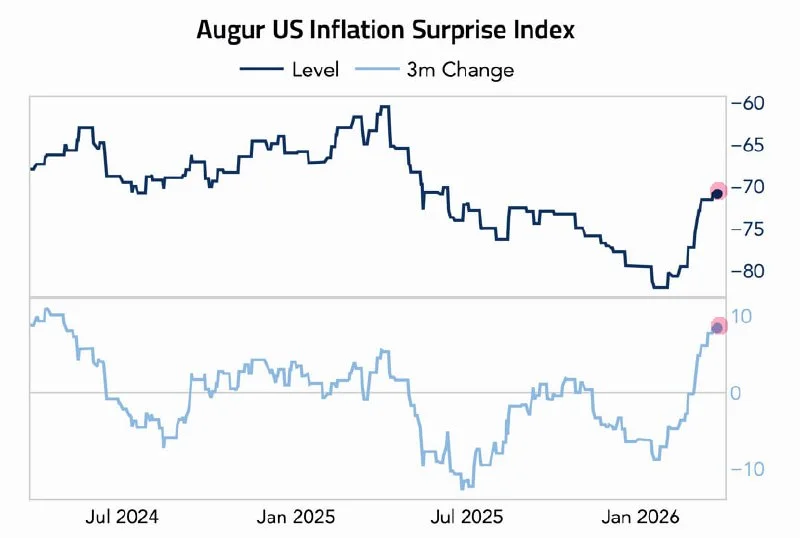
The market is finally waking up to the inflation problem that’s been brewing for months. Bloomberg analysts are reporting that traders have priced in a 50% probability of a Fed rate hike by October, and that was *before* the recent energy shock fully filtered through. For most retail traders, this is terrifying. For a prop firm trader like me, it's a minefield that can end a challenge in a single afternoon. I failed my first six challenges by ignoring macro shifts like this. Now, it’s the core of my strategy.
Let's be blunt. The #1 killer in any prop firm challenge is the daily drawdown limit. On a typical $100k account, that’s usually $5,000. When inflation data or Fed-speak hits the wires, a currency pair like EUR/USD can move 100 pips in minutes. If you're caught on the wrong side with standard 1% risk, you’re instantly down $1,000 and tilted. Do that twice, and you’re halfway to blowing the rule. This is why most 'gurus' fail. They sell you on profit targets, but the game is about survival. The only real prop firm challenge tips and tricks that matter are defensive.
The market gives you a dozen reasons to blow up your account every day. Your only job in a prop firm challenge is to find the one reason not to.
I've adapted my approach specifically for this environment. It's not about hitting home runs; it's about not striking out. After over 20 failed challenges, these are the rules that got me over $180K in payouts.
- Cut Position Size in Half. My standard risk on a funded account is 0.5% per trade. In this market, I've dropped it to 0.25%. Why? Because volatility requires wider stops. To keep my dollar risk the same, the position size must shrink. It feels wrong, but it's the only way to stay in the game.
- Trade the Reaction, Not the Event. I never, ever trade the first 15 minutes of a major news release like CPI. That initial spike is pure chaos and stop-hunting. I wait for the dust to settle, see which level holds, and trade the retest. The real move often starts 30 minutes later.
- Focus on One or Two Pairs. I’m only watching EUR/USD and Gold (XAU/USD). The inflation narrative makes both of these pure plays on the dollar's strength. I’ve been following Viktor Reyes's commodity calls, and his bullish gold thesis makes perfect sense as an inflation hedge. Trying to track five different pairs right now is a recipe for disaster.
This approach forces patience and completely removes the FOMO that kills most accounts. You're not chasing every move; you're waiting for a high-probability setup on a chart you know inside and out.
My bias is firmly bearish on EUR/USD. The Fed is hawkish, and the energy crisis is hitting Europe disproportionately hard. It’s a simple macro story. I’m not fighting it. While I always keep an eye on broader macro analysis from people like Emma Blackwood for a contrarian view, the path of least resistance for the Euro seems down.
- Key Resistance: The zone between 1.0850 and 1.0865. I am only looking for shorts while we are below this level.
- Entry Trigger: A rejection (like a pin bar or engulfing candle) off that resistance on the 4-hour chart, or a break-and-retest of a lower-timeframe support.
- Target: My first target is the weekly low around 1.0720.
- Invalidation: If we get a strong daily close above 1.0900, my bearish thesis is invalidated, and I'll stand aside.
The consensus is almost always wrong eventually. The big risk here is that the energy shock is so severe it actually breaks the US economy *before* the Fed can hike much further. If we see signs of rapid economic decline—a spike in jobless claims or a horrific PMI reading—the Fed could pivot dovish in a heartbeat. That would send the dollar tumbling and squeeze shorts like me out of the market. That's why my invalidation level at 1.0900 is non-negotiable.
Ultimately, every trader is betting on a narrative. The market is currently betting on a hawkish Fed crushing everything. But what if the bond market is right, and a recession is the bigger story? Are you positioned to trade the reversal if that narrative takes over?