

📣 Create Blog for Traders!
Stop Watching news - Start Making it.
START


Stripe Buying PayPal? I'm Fading the Hype with Options
The retail crowd is piling into PayPal calls on acquisition rumors. Here's why I'm taking the other side of that trade and selling the volatility.
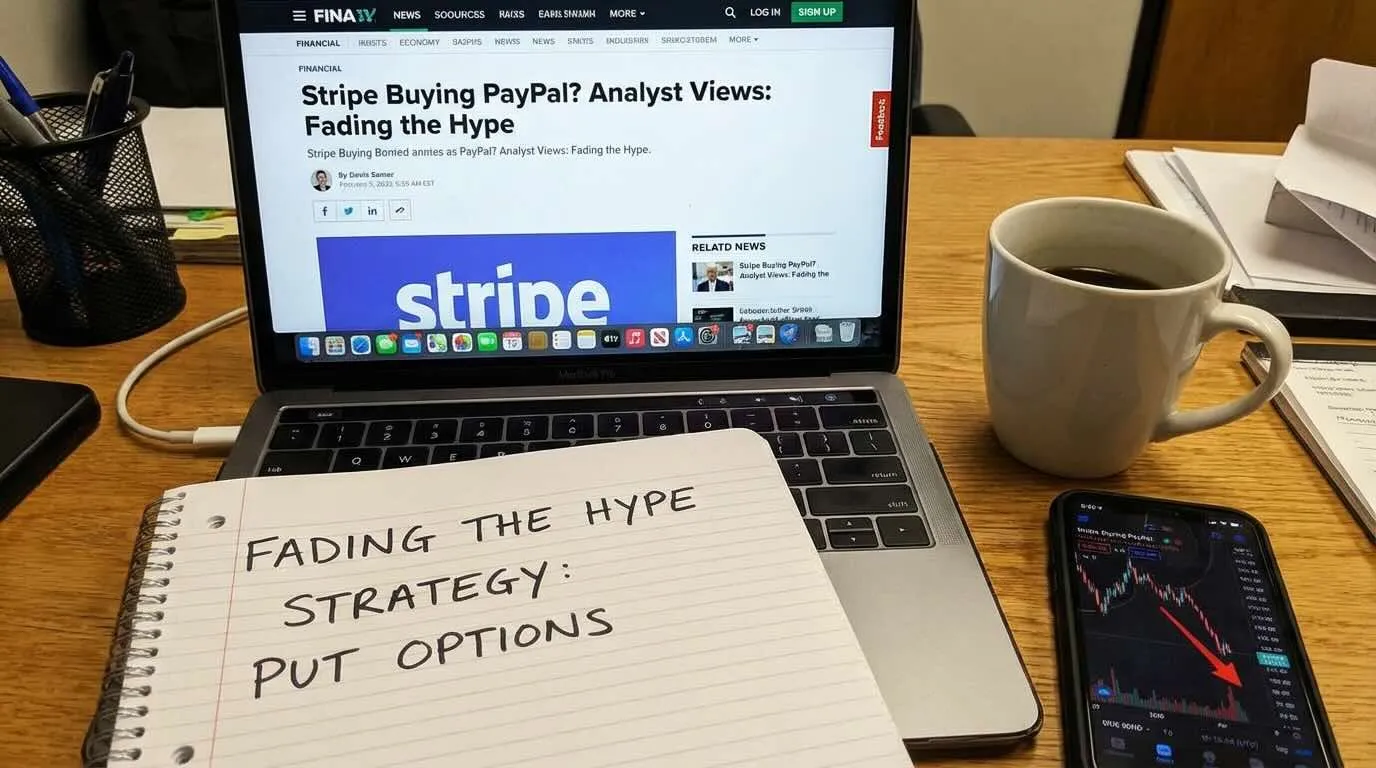
So the rumor mill is churning, and the hot story is that Stripe might be kicking the tires on PYPL. My phone lit up this morning with alerts. The immediate reaction from the peanut gallery? 'Buy calls! To the moon!' And that’s precisely why I’m looking at selling premium. When everyone is screaming to buy, my inner market maker wakes up. I learned options from the inside out on a prop desk in Chicago, and the first lesson was simple: the crowd is almost always paying too much for lottery tickets. This situation is no different.
Let’s be clear. I’m not making a call on the long-term fundamentals of PayPal. My colleague Sarah Chen does fantastic deep dives on payment processors, and her analysis is probably spot-on for a buy-and-hold investor. But I’m not an investor; I’m a trader. My game is played in the world of implied volatility (IV), and right now, the IV in PYPL is screaming. The market is pricing in a massive move based on a rumor. A rumor. These things fizzle out more often than not. And when they do, the air comes out of the options premiums so fast it’ll give you whiplash. That’s called IV crush.
People buying weekly calls on this news are essentially betting on two things: that the deal happens, and that it happens fast. That’s a low-probability bet with a terrible risk/reward profile. The professionals, the dealers, they're on the other side, selling those calls and collecting that juicy premium. They know that time decay, or theta, is the only edge that works every single day. It's the core of my portfolio, and it's the right play here.
This morning, I pulled up the PYPL options chain and the first thing I checked was its IV Rank. It’s sitting around the 85th percentile. That’s trader-speak for 'options are historically very expensive.' Buying options when IV is this high is like buying flood insurance during a hurricane. You’re too late. The real opportunity is to be the insurance salesman.
For a situation like this, where I believe the stock will likely stay within a range as the rumor dies down, a defined-risk strategy is perfect. For anyone looking for an iron condor strategy explained, this is a textbook case. An iron condor involves selling an out-of-the-money call spread and an out-of-the-money put spread at the same time. You get paid to bet that the stock will stay between your short strikes by expiration. It’s a fantastic way to let theta work for you.
- The Trade: Sell the January PYPL Iron Condor.
- Call Spread: Sell the $70 Call / Buy the $75 Call.
- Put Spread: Sell the $52.50 Put / Buy the $47.50 Put.
- Net Credit: Looking for around $1.35 (or $135 per contract).
This trade gives me a breakeven point up at $71.35 and down at $51.15. As long as PYPL stays within that roughly $20 range by January expiration, the position will be profitable. My maximum profit is the $135 I collect upfront, and my max loss is capped at $365. The probability of profit on a setup like this is north of 60%. I'll take those odds over buying a 10-delta weekly call any day of the week.
This is a classic example of a good options trading strategy for beginners to understand, not necessarily to trade, but to see the difference in mindset. The beginner sees the headline and thinks directionally. The pro sees the headline, looks at the volatility, and thinks probabilistically. We're not trying to predict the future; we're trying to find mispriced risk. The current risk of a massive move in PYPL is, in my opinion, wildly overstated by the options market. It's almost like the manic volatility we see in crypto, something Luna Park covers well. But unlike crypto, a single-stock equity has fundamentals that tend to anchor it.
The market sells lottery tickets to amateurs. Professionals sell the insurance. Right now, everyone is buying lottery tickets on PYPL, and I'm happy to be the insurance salesman.
Of course, no trade is without risk. I could be completely wrong. Stripe could announce a firm, all-cash offer for $85 a share tomorrow morning. If that happens, my short $70 call will be deep in-the-money, and I'll take a max loss on the position. That’s the risk. But that’s precisely why risk management is non-negotiable. This position will be a small, calculated piece of my portfolio. I’m risking a little to make a little on a high-probability bet. The people buying the calls are risking a lot to make a lot on a low-probability bet. I know which side I'd rather be on for the next ten years.
I'm not betting against PayPal as a company. I'm simply betting that the current frenzy priced into its options will subside, as it almost always does. So, instead of asking 'Will Stripe buy PayPal?', the better question for a trader is 'How much are you willing to pay to bet on it?' What's your price?