

📣 Create Blog for Traders!
Stop Watching news - Start Making it.
START


Trading Central Banks: Statement vs. Press Conference
Most traders get wiped out on central bank days. I'll show you how to trade the nuance, not the noise. The real edge is in the press conference.
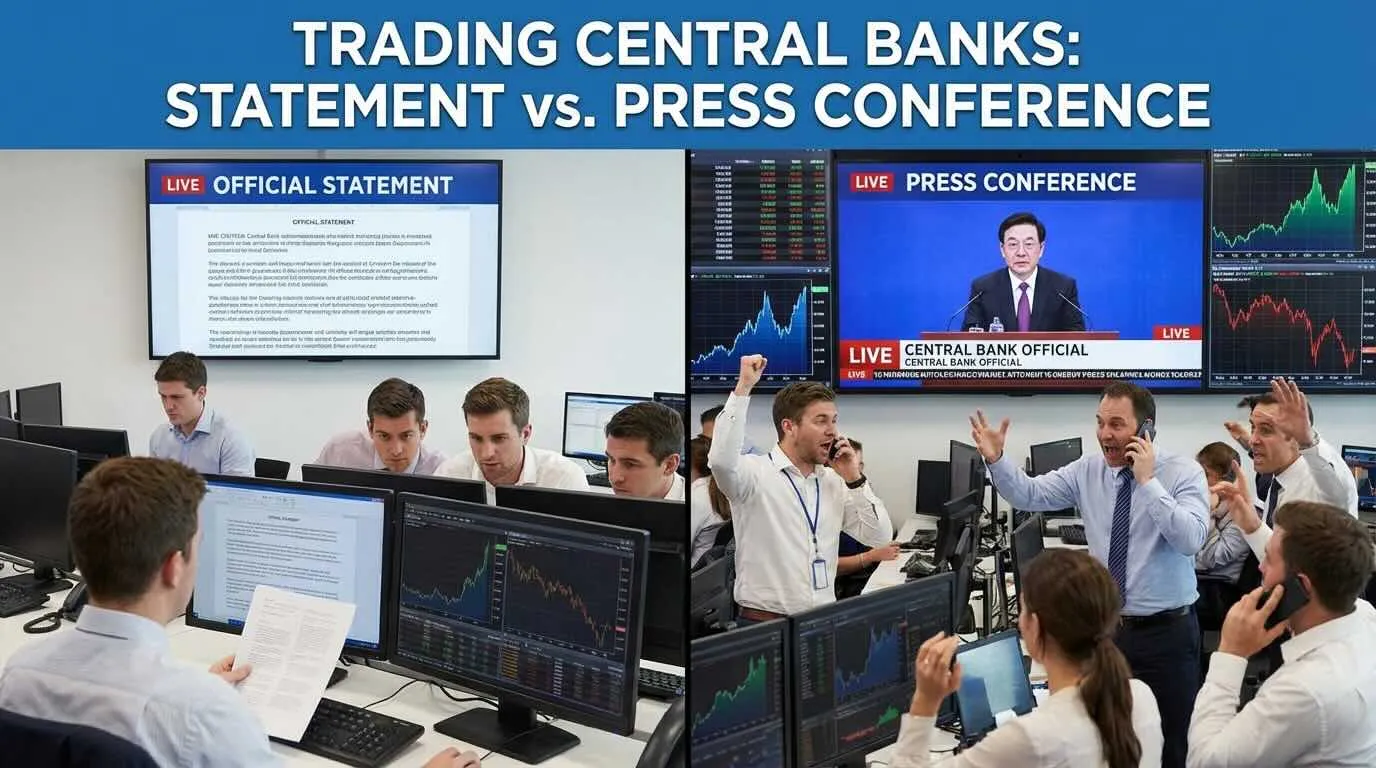
The real money is made 30 minutes after the central bank’s interest rate statement hits the wires. Everything before that is just noise designed to separate retail traders from their capital. I learned this the hard way early in my career, but my time at the ECB confirmed it. The headline number is a formality; the press conference is where the true central bank monetary policy is revealed, and it dictates the forex market outlook for weeks to come.
Let me break this down. The moment a rate decision is released—say, the Fed holds at 5.50%—the algorithms go wild. Price spikes 50 pips up, then 70 pips down, all in seconds. Spreads on a pair like EUR/USD can blow out from 0.1 pips to 10 or more. It’s pure chaos. Trying to trade this is not a strategy; it's a coin flip. You're betting on a binary outcome against machines that are infinitely faster than you.
I see traders try to scalp this initial reaction, and while some short-term momentum experts like Viktor Reyes might find an edge in volatility, for me, it's a negative-sum game. You're fighting insane slippage and a market that has zero real direction. The initial move is often a head-fake, a knee-jerk reaction to a single number without any context. And context is everything in this business.
This is where I get to work. Thirty minutes after the statement, the bank's governor or chair walks up to a podium. This is my entire focus. When I was a junior researcher at the ECB, I saw firsthand the painstaking effort that goes into every single word of the opening statement. (And trust me, they debate every single comma). But the real gold is in the Q&A session that follows.
This is where journalists ask the unscripted questions. This is where a policymaker's tone, hesitation, or choice of a specific word can signal a major policy shift. I’m listening for phrases like “we are discussing the pace of cuts” versus “it is premature to discuss cuts.” The first is dovish, the second is hawkish. The statement might have been neutral, but that one phrase in the presser sets the new trend for EUR/USD.
So, how do these two approaches stack up? It’s not even a fair fight.
- Clarity: The statement offers zero clarity, just a number. The press conference provides the crucial 'why' behind the number.
- Volatility: The statement is a chaotic, directionless spike. The press conference is where a clean, directional trend begins to form.
- Your Edge: Algorithms own the statement release. Your human brain and analytical skills are the edge in deciphering the press conference.
- Risk: Trading the statement is high risk with low probability. Waiting for the presser lowers your risk by letting the market show its hand.
This approach is similar to how my colleague Sarah Chen analyzes earnings reports. She looks past the headline EPS number to the forward guidance and management commentary. It's the same principle. The headline is the past; the guidance is the future. I apply that directly to my trading.
The winner is clear: trading the press conference is the only professional way to approach central bank days. I never have a position open during the statement release. It's just not worth the risk. My process involves waiting, listening, and analyzing. I'll often have the English, German, and French audio feeds open for the ECB presser to catch nuances lost in translation.
Once I have my directional bias from the press conference, I look for a low-risk entry on a 1-hour or 4-hour chart. For example, if Fed Chair Powell sounds unexpectedly hawkish in his Q&A, reinforcing a 'higher for longer' stance while the ECB sounds dovish, my primary trade is a short on EUR/USD. I’ll wait for a small rally to fail and then enter, placing my stop above the post-presser high. This isn't about guessing; it's about reacting to confirmed information.
Amateurs trade the headline. Professionals trade the nuance. The nuance is always, without fail, in the press conference.
By ignoring the initial spike, you avoid the chop and position yourself for the multi-day move that often follows. This is how you build a career in forex. So, my question to you is this: what is the single most important phrase or signal you listen for during a central bank press conference that tells you it's time to act?