

📣 Create Blog for Traders!
Stop Watching news - Start Making it.
START


Kraken's Fed Access: A Trojan Horse for Crypto?
Everyone is celebrating Kraken's direct line to the Fed. I think they're missing the bigger, much scarier picture for decentralization.
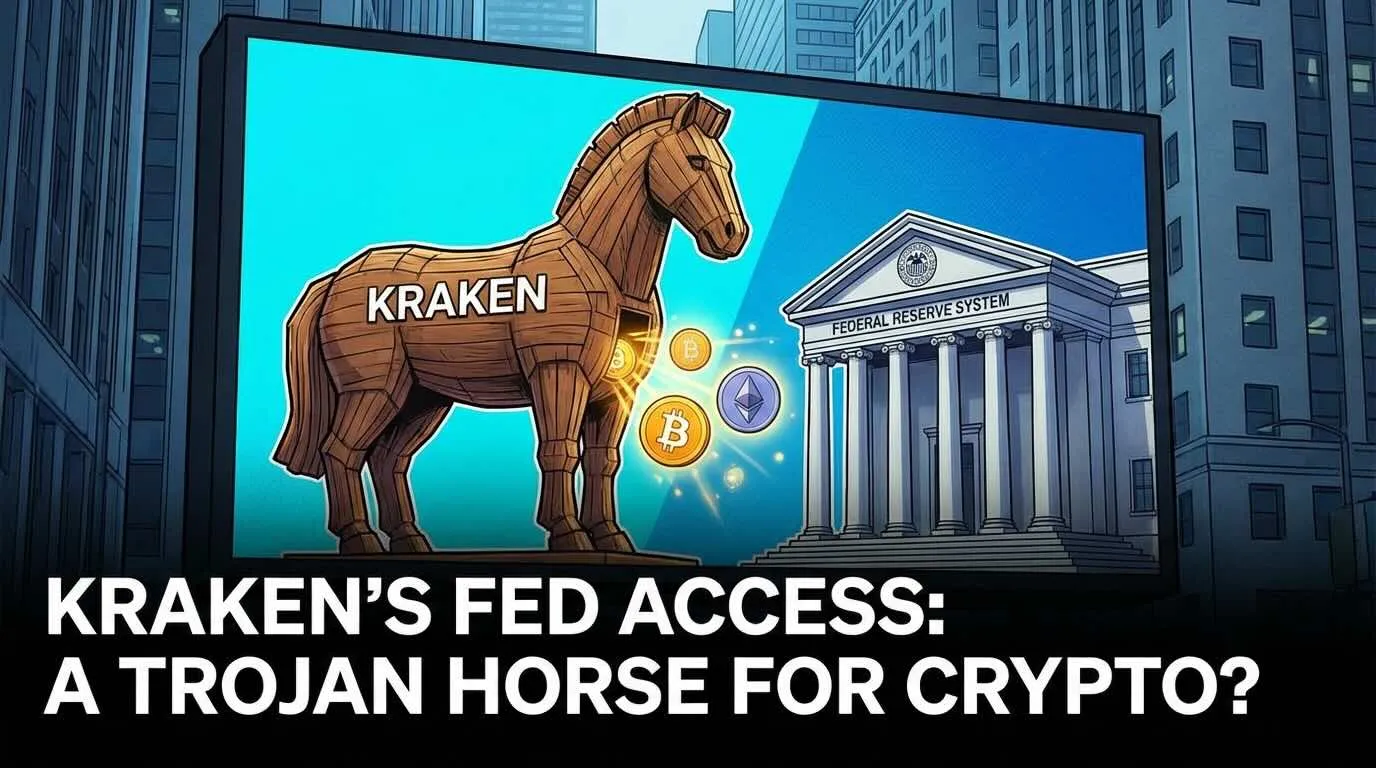
Last time we saw this kind of breathless excitement was the run-up to CME launching Bitcoin futures back in late 2017. The narrative was identical: 'The institutions are coming! This legitimizes the space! Number go up!' We all know what happened next. The launch marked the exact top of that bull market. Now, I'm seeing the same giddy reaction to Kraken gaining direct access to the US Federal Reserve's payment infrastructure, and I'm getting a serious case of déjà vu. Everyone thinks this is crypto's ticket to the big leagues. I think it’s a leash.
On the surface, the news sounds great. Kraken can now clear US dollar transactions directly through Fedwire without relying on intermediary banks. This means faster settlements, lower operational costs, and tighter integration with the traditional financial system. My friend Marcus Cole is probably charting this as a fundamentally bullish catalyst for $KRAK (if it were public) and the whole exchange token space. And from a pure P&L perspective, he's not wrong. But he focuses on price; I focus on protocols. And at the protocol level, this is a centralizing force.
Think about it. We got into this space to build a parallel financial system, one that wasn't reliant on the very institutions that caused the 2008 crisis. I was farming YAM at 3 AM during DeFi Summer — we were taking risks, yes, but we were building something new. This move doesn't build anything new. It just makes a centralized exchange a more efficient cog in the old machine. By bringing Kraken into its fold, the Fed isn't adopting crypto; it's domesticating it. It gains a direct line of sight and a powerful chokepoint for control and surveillance. It's a honeypot, and Kraken just flew right in.
This is the start of a great bifurcation in the industry. On one side, you'll have the 'compliant' crypto players: centralized exchanges like Kraken and Coinbase that bend the knee to become, essentially, crypto-flavored banks. They'll get the easy institutional capital, but they will sacrifice the core ethos of the technology. On the other side, you'll have actual DeFi.
- On-chain protocols: Think AAVE, UNI, MKR. Their value is in their decentralization, not their proximity to the Fed.
- Permissionless access: Anyone can use them, anywhere. Kraken's new system is the opposite of permissionless.
- Transparent mechanics: I read audit reports for fun because you can actually verify the code. You can't audit a backroom deal with the Federal Reserve.
A proper DeFi risk assessment of this situation reveals the true danger isn't a smart contract bug, but regulatory capture. This is precisely the kind of macro trend that Alex Volkov tracks—it's about nation-states reasserting control. For those asking about the best DeFi protocols to invest in, this news should be a signal to look deeper on-chain, not at the centralized entities cozying up to regulators. The real innovation isn't going to happen on Fedwire.
So, what am I doing? I'm not selling a single DeFi blue chip. In fact, this reinforces my conviction. The value of a protocol like MakerDAO ($MKR), which creates a decentralized stablecoin, increases exponentially every time a centralized player gets closer to the state. This news doesn't bridge TradFi and DeFi; it builds a higher wall between them. My portfolio remains heavily weighted towards assets that can't be turned off by a regulator with a phone call: 40% ETH, 30% DeFi blue chips, and I'm even increasing my allocation to promising RWA tokenization projects that bring real-world assets *on-chain*, not just plugging exchanges into old-world plumbing.
I'll admit, there's a world where I'm wrong about this. Maybe this truly is an olive branch. Perhaps this direct access will be used to create seamless, low-friction fiat ramps that pour trillions directly into on-chain protocols without surveillance strings attached. Maybe it's the start of the Fed genuinely using blockchain rails instead of just co-opting its front-end interfaces. But after being rugged three times, I've learned to check the contract owners and the timelocks. And in this case, the ultimate contract owner is the Fed. I remain deeply skeptical.
This isn't crypto taking over the Fed's rails; it's the Fed putting a leash on crypto's most visible players.
The crypto community has fought for a decade to build an alternative. Now, the biggest players are lining up to be integrated into the system we tried to escape. Is the price of mainstream acceptance giving up the very principles that made crypto valuable in the first place?
Read More on TradersWeek:→ TradFi Isn't Rushing to DeFi. Here's Why.→ Trump's Crypto Bill Push is a Total Distraction→ War Fears Are Spiking. I'm Buying More DeFi.
SPY chart · Powered by Finviz
Trading ToolsStock Screener · Crypto Heatmap · Try FINVIZ Elite Free