

📣 Create Blog for Traders!
Stop Watching news - Start Making it.
START


WLFI's $5M 'Team Access': A DeFi Death Spiral?
Trump's WLFI token wants a $5 million investment for a chat. My on-chain analysis shows this isn't an investment; it's a distress signal.
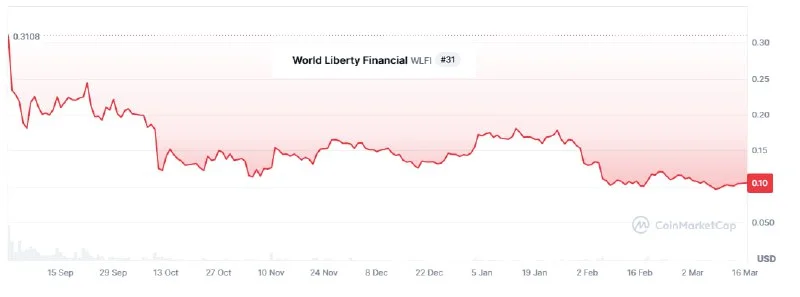
Would you pay $5 million just for the privilege of talking to a team whose token is in absolute freefall? That's the question the team behind Trump's World Liberty Financial ($WLFI) is posing to the market. Let me be blunt: this isn't a funding mechanism. This is one of the biggest red flags I've seen since my early days farming YAM at 3 AM back in DeFi Summer. It’s a desperate attempt to secure exit liquidity disguised as an exclusive offer, and the on-chain data confirms my suspicions.
In legitimate DeFi, value and access are earned, not bought in a backroom deal. Think about it. Uniswap's governance power comes from holding and delegating $UNI tokens, earned through participation. MakerDAO's stability is managed by a decentralized group of $MKR holders. These systems are built on transparency and community alignment. What $WLFI proposes is the exact opposite—an opaque, centralized model where deep pockets get influence while the token itself offers no discernible utility. This reminds me of the ICO-era madness, not the mature DeFi ecosystem we're building today.
My morning routine always starts with DefiLlama, and a quick check on $WLFI is telling. The Total Value Locked (TVL) is virtually non-existent, struggling to stay above $200,000. There's no protocol, no yield, just a token. A project asking for $5 million should have a TVL of at least 20-50x that amount to even be considered slightly serious. This isn't a project building a product; it's a project trying to sell a narrative, and the price chart reflects that failure. While Marcus Cole is probably charting the technical breakdown, I'm looking at the fundamentals, and I see a hollow shell.
After being burned by three rug pulls in my career, I have a non-negotiable checklist before I allocate even a fraction of my experimental portfolio. $WLFI fails on almost every count. Pay-for-access is just the latest, most audacious red flag in a long list.
- No Public Audits: I read audit reports for fun. The fact that there isn't a publicly available, reputable audit for $WLFI's contract is an immediate disqualifier.
- Centralized Wallet Distribution: On-chain data reveals the top 15 wallets, excluding exchange contracts, hold over 75% of the circulating supply. This is a massive risk for retail holders.
- Lack of Timelocks: There are no visible timelocks on the contract owner's privileges. This means the team could theoretically change the rules, mint more tokens, or drain liquidity at any moment.
- Utility? Zero: The token's only utility seems to be speculation on a political brand. There is no protocol, no fee-sharing, and no governance function for the average holder.
This isn't just risky; it's structurally designed for insiders to profit at the expense of retail. The $5 million access fee is simply the most explicit admission of this I've ever seen. They're not looking for partners; they're looking for a final, large-scale buyer before the floor gives out completely.
Projects like this give DeFi a bad name and distract from the real innovation happening. Instead of chasing these political meme-coins, investors should be focused on protocols with transparent value accrual. Finding a DeFi yield farming strategy safe from these kinds of shenanigans is paramount in 2026. This means sticking to protocols with battle-tested code, clear tokenomics, and real revenue.
My own portfolio reflects this belief: 40% $ETH, 30% in blue chips like $AAVE and $MKR, and 20% in promising RWA protocols that are bridging real-world assets on-chain. The remaining 10% for experiments would never touch something like $WLFI. For any new protocol, I conduct a personal DeFi insurance protocols review to see if Nexus Mutual or a similar service offers coverage—a sign of legitimacy. Even a well-planned airdrop farming strategy 2026 requires vetting projects for the same red flags $WLFI is waving.
My thesis is simple: $WLFI is a fundamentally broken project exhibiting classic signs of a pre-rug exit strategy. The $5 million fee is not a sign of strength but of terminal desperation. The only thing that invalidates this is an external, unpredictable event. Perhaps a major endorsement or a pivot into a real, audited product. But hope is not a strategy. As my friend Alex Volkov often notes, market psychology can be irrational, but it can't defy gravity forever when there are zero fundamentals.
In DeFi, when a project asks for millions just to talk to them, they're not selling access; they're selling you their exit liquidity.
I'm not touching this with a ten-foot pole. My capital is better deployed in protocols that respect their community and build real value. This whole situation serves as a stark reminder: always read the contract, check the wallets, and question the motives. So, I'll ask you this: beyond the political noise, what's the single biggest technical red flag that makes you instantly blacklist a DeFi project?