

📣 Create Blog for Traders!
Stop Watching news - Start Making it.
START


Agri-Prices Are Lagging. It's My Top Trade for 2026.
The broader commodity index is ripping higher, but agriculture is asleep at the wheel. Here's why that's about to change, and how I'm positioning for the snapback.
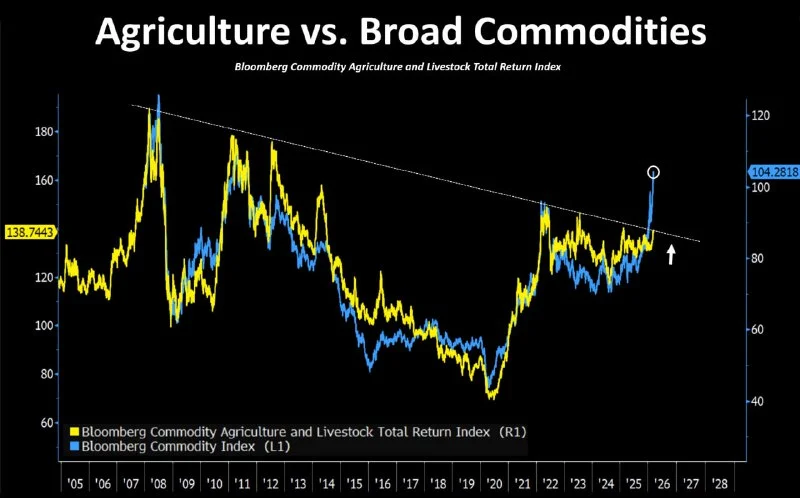
So here's what nobody's talking about this week. Every 'expert' is pointing at the chart showing the broader commodity index running hot while the global ag index snoozes. They call it a divergence. I call it a coiled spring. The trade is clear: the so-called commodities supercycle 2026 hasn't even started for the grain markets. While everyone is crowded into crude oil above $90 and chasing copper, I'm quietly building positions in the one sector that actually feeds the world. The mean reversion trade is coming, and it's going to be violent.
Let's be precise. The Invesco DB Commodity Index Tracking Fund (DBC) is up nearly 18% year-to-date. The Invesco DB Agriculture Fund (DBA), however, is barely up 4%. That's a massive performance gap. The narrative is that South American weather has been good, boosting supply forecasts for soybeans and corn. Add a strong dollar and fears of slowing Chinese demand, and you have the perfect recipe for depressed prices. But this is rearview mirror analysis. Most traders are wrong about what comes next.
My edge comes from looking ahead. I'm watching two things nobody seems to care about right now: the shift to a La Niña weather pattern expected this summer, which historically means hotter and drier conditions for the U.S. corn belt, and the increasingly fragile state of the Black Sea grain corridor deal. My contacts are telling me the shipping insurance premiums are already creeping up. The market is pricing in perfect weather and stable geopolitics. That's a bad bet.
My COT report analysis this week shows a classic bottoming pattern. The 'Managed Money' category—the hedge funds who are usually late to the party—are still holding a significant net-short position in Corn futures (ZC). Meanwhile, the 'Commercials'—the producers and users who actually know the physical market, the smart money—have been aggressively reducing their short hedges. They're buying. This tells me the downside is limited. They see what I see: the risk is all to the upside.
This is the complete opposite of what you see in precious metals. My long-term gold all time high prediction remains intact, but right now the COT shows Managed Money is at record net-long levels in Gold (GC). It's a crowded trade. The easy money has been made. I'm more interested in finding the next move, not chasing the last one. As Jake Morrison often points out in his macro work, the best trades are often the most overlooked ones. This is one of them.
I'm not just talking a big game. I'm putting my capital to work. Here are my primary positions heading into planting season:
- Long Corn (ZC): I've been scaling in since $4.40/bushel. My target is $5.25 by July. My stop-loss is a weekly close below $4.20. The risk/reward here is just too good to ignore.
- Long Soybeans (ZS): The chart looks even better here. I'm long from $12.10/bushel, looking for a test of the 200-day moving average around $13.50. My stop is tight at $11.70.
- Pair Trade: For those with a larger book, I'm also running a smaller position long DBA / short DBC to purely play the catch-up trade and neutralize some of the broader market risk.
This is a fundamental trade backed by seasonality and positioning. It's the kind of setup that built my career after I blew up my first account on a bad natural gas bet. You learn to respect the fundamentals. While traders like Emma Blackwood are parsing every word from the Fed, I'm checking weather maps and supply chain reports. Different games, same goal.
No trade is a sure thing. My thesis gets invalidated by a few key events. First, a sudden and deep global recession that craters all demand would sink everything, ag included. Second, a surprisingly dovish Fed could weaken the dollar, but if it's in response to a crisis, the risk-off move would hit commodities anyway. Third, and most directly, would be a record-breaking planting season in the U.S. with perfect weather from May through August. If that happens, I'll take my stop and re-evaluate. But I'm betting against perfection.
Everyone's chasing oil and copper. The real money in this commodities supercycle 2026 will be made in the dirt – in corn, beans, and wheat. This divergence won't last.
Ultimately, trading is about finding mispriced risk. The market is currently mispricing weather and geopolitical risk in the agricultural space. It's a fat pitch. While my friends chase digital tulips like Bitcoin at $74,000, I'm buying something real, something the world can't live without, and something that the charts say is about to explode higher. So, I'll ask you this: is the market being complacent, or am I completely misreading the upcoming US growing season?