

📣 Create Blog for Traders!
Stop Watching news - Start Making it.
START


GHYP vs. SPY: My 2026 ETF Pick for a Volatile Market
Grayscale's new HYPE ETF is pure speculation. Here's why I'm sticking with boring, profitable companies for my core holdings right now.
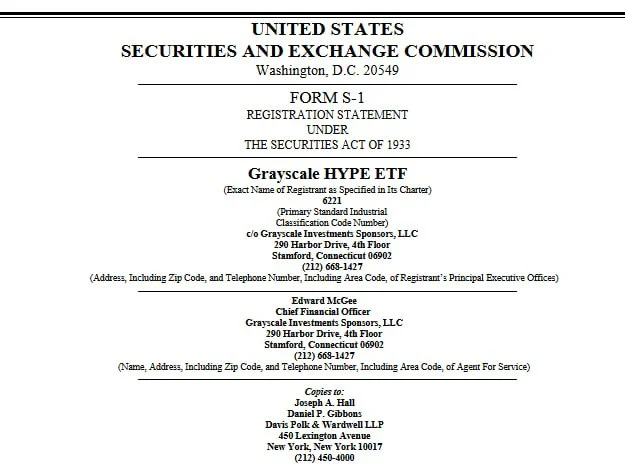
I counted 14 new crypto-related S-1 filings this quarter alone. Fourteen. When the capital markets are this eager to package and sell every new shiny object, my Wall Street instincts kick in. The latest is Grayscale's filing for a spot Hyperliquid ETF, the GHYP. It's a pure-play bet on a decentralized exchange's native token. And while the crypto crowd is buzzing, I see it as the perfect opportunity to compare the new breed of speculative vehicles against the old guard: the S&P 500 via the SPY.
In a market searching for direction, the key isn't finding the next 100x return, but protecting the capital you already have. This is a battle between speculation and fundamentals.
Let's be clear about what GHYP is. It's an ETF holding HYPE, the native token of the Hyperliquid DEX. The S-1 filing confirms Coinbase Custody and CoinDesk pricing, which lends it institutional credibility. But the filing also notes it will not include staking. That's a critical detail. Without staking rewards, you are holding a non-productive asset, and your entire thesis rests on price appreciation driven by... what exactly? Platform usage? Speculative inflows? It's a narrative trade.
The bull case is obvious: it’s a high-beta play on the continued growth of decentralized finance. If we see another DeFi boom, HYPE could dramatically outperform. But from a fundamental analyst's perspective, it's a nightmare. There are no earnings, no cash flows, no book value to anchor a DCF model. My friend Alex Volkov could probably give you a sophisticated on-chain analysis, but for me, this is less an investment and more of a venture capital-style bet on a protocol. It belongs in my 10% speculative sleeve, and even then, in a very small size.
On the other side, you have the SPY. It's boring. It's predictable. It represents 500 of the largest U.S. companies. But it's also backed by something tangible: trillions in revenue and hundreds of billions in actual profit. Heading into Friday's close, the market felt heavy, and many are asking about the right 'NASDAQ correction how to trade' strategy. For me, it's about owning quality.
That's not to say the S&P is without risk. It's currently trading at a forward P/E of around 21x, which is pricey by historical standards. My own S&P 500 price target 2026 is a modest 5,400, suggesting limited upside from here. But even with that tepid outlook, you're being paid to wait via dividends and earnings growth. With the geopolitical tensions that Jake Morrison correctly flags in his oil market analysis, a flight to the relative safety of U.S. large-caps is a scenario I can't ignore.
Let's be direct: neither of these is a true stock market crash protection strategy. For that, you need assets with low or negative correlation to equities, like long-duration treasuries or gold. In a real risk-off liquidation event, high-beta assets like crypto are often the first to be sold. GHYP would almost certainly fall much harder than the SPY.
- Fundamental Basis: GHYP is a bet on a protocol's future adoption. SPY is a claim on the current earnings of 500 established companies.
- Volatility Profile: GHYP will exhibit extreme, sentiment-driven volatility. SPY's volatility is tethered to broad economic performance.
- Source of Return: GHYP relies solely on price appreciation. SPY offers earnings growth, dividends, and buybacks.
- Risk in a Downturn: GHYP likely has a very high correlation to risk assets and would suffer immensely. SPY *is* the benchmark for the downturn.
I left Goldman Sachs to trade my own book, not to chase lottery tickets. While I might allocate a tiny fraction of my speculative portfolio to GHYP after it launches and we see the trading dynamics, it will never be a core position. The risk-adjusted return profile just isn't there for me. My capital is better served in the SPY, where I'm buying real cash flows at a valuation I can actually model. The potential 10x return from GHYP isn't worth the probable 90% drawdown if sentiment turns.
When the market is serving up volatility and uncertainty, chasing the newest, most speculative asset is a classic retail mistake. I'll be watching GHYP from the sidelines, at least for the first few months. The real question isn't whether you should buy it, but what percentage of your portfolio are you willing to treat like a venture capital check you might never see again?