

📣 Create Blog for Traders!
Stop Watching news - Start Making it.
START


Michael Burry is Right: Nvidia's Echo of Cisco's Peak
Everyone sees an AI revolution. I see a balance sheet flashing warning signs straight from the dot-com playbook. Here's what my analysis shows.
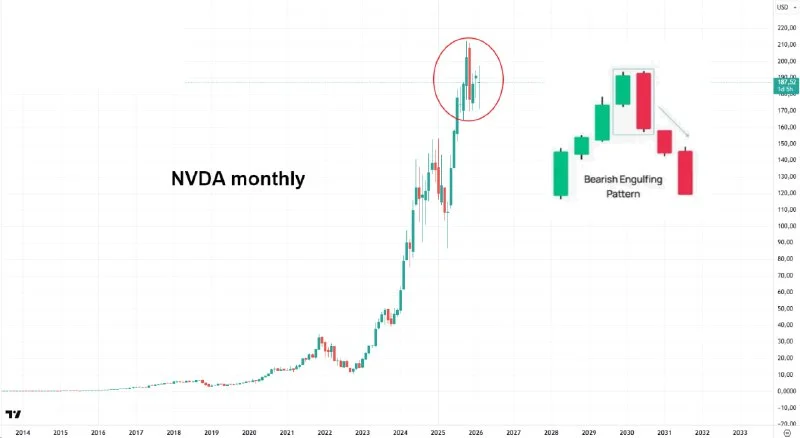
I was scanning Nvidia’s ($NVDA) latest 10-Q before my morning coffee, a habit from my Goldman days, and one number jumped off the page: a 387% year-over-year increase in quarterly revenue. The market loves it. The momentum is undeniable. But my mind immediately went to another filing I read years ago for a case study: Cisco's 10-K from the year 2000. Michael Burry is now flagging the parallels in corporate spending, and I have to say, he's seeing the same ghost in the machine that I am. The popular narrative is that $NVDA is untouchable, the sole provider of shovels in an AI gold rush. But when the customers are all buying those shovels with speculative capital, you have to start questioning the durability of the boom.
Let's be clear. In 2000, Cisco ($CSCO) was a phenomenal company. It built the core infrastructure of the internet. It had a market cap over $500 billion and a P/E ratio that soared past 150. The story was perfect — it was an essential monopoly on the future. Sound familiar? Cisco's problem wasn't its technology; it was its customers. They were dot-com startups, flush with venture capital, spending with abandon to build out infrastructure they didn't have the revenue to support. When the bubble popped, those customers evaporated. Cisco's revenue collapsed, and the stock fell over 80%.
Now, look at Nvidia. Who are its biggest customers? A handful of hyperscale cloud providers and a swarm of AI startups. These companies are in a frantic arms race, spending billions on H100 GPUs. But is this spending based on current, profitable AI applications, or on the *promise* of future ones? It feels very much like the latter. This is the kind of detail that gets lost in the high-level stock market analysis this week you see everywhere, but it's buried right there in the footnotes of the 10-K. It's a concentration risk that the market is completely ignoring. My friend Jake Morrison lives for this kind of momentum, and I get the appeal, but the fundamentals are screaming caution.
I ran the numbers through my discounted cash flow (DCF) model, and the results are... aggressive. To justify Nvidia's current market cap of over $2 trillion, you need to believe in sustained revenue growth of 40-50% annually for the next five years, followed by strong growth for another five, all while maintaining its current sky-high net income margins of over 50%. That's a scenario that assumes zero meaningful competition, no cyclical downturn in AI spending, and no geopolitical disruptions related to Taiwan. It's a scenario for a perfect world.
- Base Case Model: Assumes 30% growth tapering to 10%. Implies a valuation closer to $1.5 trillion, or roughly $600/share.
- Bear Case Model: A cyclical downturn in cloud spending. This could push the stock back towards the $450 support level seen last year.
- Bull Case Model: The market's current view. Assumes flawless execution and market dominance into the 2030s.
The current price isn't just pricing in success; it's pricing in total global domination without any friction. For those looking for the best blue chip stocks, this level of baked-in expectation should be a major red flag. True blue chips have durable, diversified earnings, not revenue streams dependent on a handful of clients in a capital-intensive arms race. This isn't one of the best dividend stocks to buy; it's a high-stakes bet on a single technological cycle.
I don't short companies like Nvidia. Shorting a momentum darling is a fool's errand. Instead, I'm simply on the sidelines, holding no position. I took profits on my earlier long from last year and am waiting for a more rational entry point. What would make me change my mind? A significant pullback to a more reasonable valuation would be a start. Or, seeing the AI industry translate its massive GPU spend into tangible, widespread, and profitable commercial applications that aren't just cloud-based models. The macro environment also plays a role; a more dovish Fed could keep the party going, a point I'm sure Alex Volkov would be quick to make.
Nvidia is a world-class company priced like a religion. And in the market, belief is a much more volatile asset than earnings.
The core risk here is that investors are confusing a revolutionary technology with a perpetually great stock, regardless of price. They were two different things for Cisco in 2000, and I suspect they will be for Nvidia as well. The question I keep asking myself is this: are we investing in the durable future of artificial intelligence, or are we just funding the peak of a very expensive hardware cycle?