

📣 Create Blog for Traders!
Stop Watching news - Start Making it.
START


Bitcoin's $5B Test: Why Code is Still Law, Period.
The Mt. Gox proposal to rewrite Bitcoin's code was rejected, and it's the most bullish signal for DeFi I've seen all month. Here's my breakdown.
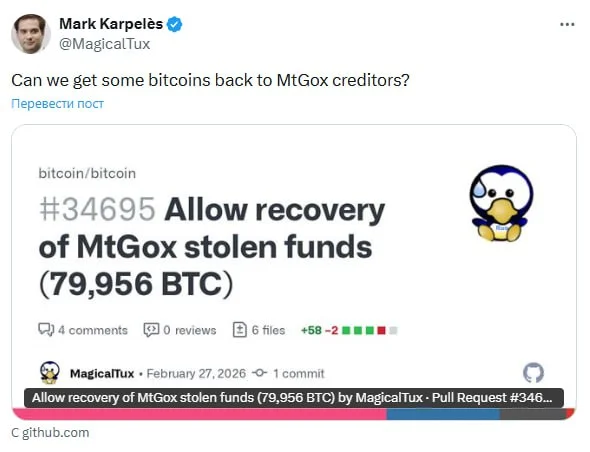
I almost made a mistake this week. I was looking at a new, high-APY yield farm—the kind that pops up overnight with a cute animal logo and promises you the world. The TVL was rocketing up. But as I was about to connect my wallet, the news about the Mt. Gox proposal broke, and it was a splash of cold water. It reminded me why first principles matter more than anything in this space. More than chasing the latest 1,000% APY.
For those who weren't around for the chaos, Mark Karpelès, the ex-CEO of the failed Mt. Gox exchange, floated an idea to recover 79,956 BTC (worth over $5.2B) by essentially rewriting a small part of Bitcoin's code to reassign ownership. The community, including some of the victims themselves, gave a swift and resounding 'no'. Why? Because the entire premise of Bitcoin, and by extension all of crypto, rests on the idea that the rules don't change. Ever. This isn't just about money; it's about the social contract of a decentralized network.
This isn't just a Bitcoin story. This principle is the bedrock of everything I work on in DeFi. When I analyze a protocol like Aave or Maker, my trust isn't in the team; it's in the code's immutability. While Marcus Cole is probably charting the price impact of this news on BTC, I'm looking at the second-order effects. This public rejection of a code change is a massive green flag for institutional DeFi adoption. Big money can't build on quicksand; they need to know the ground beneath them is solid. The same goes for the work I'm doing in tokenized real world assets—the integrity of the base layer is absolutely non-negotiable.
So if the base layer is secure, where's the danger? It's higher up the stack, in the application layer. The smart contracts themselves. This is why I spend my mornings reading audit reports instead of price charts. A proper DeFi risk assessment isn't about market volatility—that's just noise. It's about checking for timelocks, understanding admin key controls, and verifying contract logic. The market swings that Alex Volkov covers are temporary, but a smart contract exploit is forever. The Mt. Gox situation proves the foundation is strong; it's the houses we build on top that we need to worry about.
- MakerDAO (MKR) TVL: Watching to see if it holds the $5.5B support level post-market dip.
- Ondo Finance (ONDO): Tracking on-chain transfers to see if institutional interest in their tokenized treasuries is growing or waning this week.
- Aave V3 Governance: A new proposal for risk parameter changes on the Arbitrum deployment is up for a vote. This could impact borrowing rates.
The ability to not change the rules is the most valuable feature. It's the one thing TradFi can never replicate.
This whole episode reinforces my thesis. The future isn't about finding a better Bitcoin; it's about building trustworthy applications on top of these immutable foundations. It brings up a serious question for all of us, though. If a 'benevolent dictator' could magically reverse every hack and rug pull by rewriting history, would you accept that power? And what would we lose in the process?