

📣 Create Blog for Traders!
Stop Watching news - Start Making it.
START


Polymarket's Fake Volume is a Warning Sign for All Traders
Nearly 50% of the volume could be bots and airdrop farmers. Here's why that noise is a trap and how I'm trading around it.
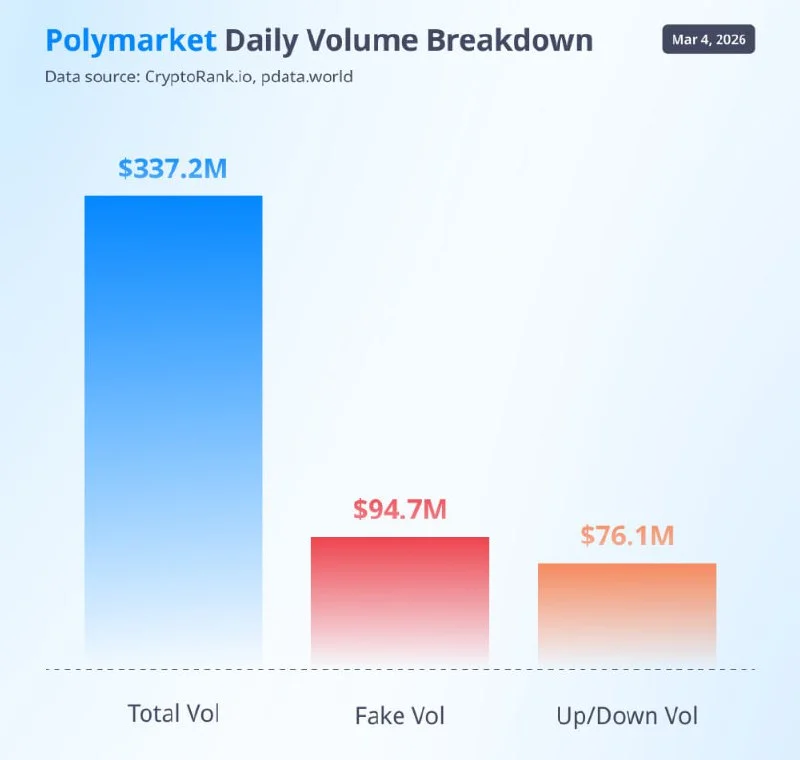
Saw a report this morning that nearly half the volume on Polymarket is basically fake. A mix of airdrop farmers churning dead markets (~28%) and bots placing bets every 15 minutes like clockwork (~23%). My first thought? I'm not surprised. In a market where BTC is ripping past $73,000, everyone gets complacent. They forget to look under the hood. This kind of garbage volume is a classic sign of a market getting frothy, and it's a trap for anyone not paying attention.
Look, I'm a price and volume guy. It’s the core of my strategy. But you have to know what you're looking at. Artificial volume creates fake signals — phantom breakouts, false support levels, and the illusion of liquidity. It’s designed to lure you in. This is why I always tell people learning technical analysis for beginners that context is everything. You can't just see a big green volume candle and ape in. You have to ask: who is behind this volume?
This isn't just a crypto problem. I've seen the same games played with sketchy offshore forex brokers. This is the classic playbook to generate exit liquidity for insiders. They create a buzz, paint the tape with fake buys, and then dump their bags on retail traders who are chasing the noise. As my friend Alex Volkov would say, you have to separate the signal from the noise.
- Clockwork Trading: Are trades happening at the exact same interval? That’s a bot.
- No Price Reaction: Huge volume spike but the price barely moves? That's likely wash trading.
- Dead Market Focus: Is all the action in a market no one cares about? Probably airdrop farmers.
So what's the move? You filter aggressively. For any of my favorite swing trading strategies that work, like a breakout-retest, I need to see volume confirmation from multiple sources. I want to see a volume surge on the initial breakout, a dry-up on the retest, and then another surge as it moves higher. The volume has to tell a logical story. I'll even pull up on-chain data sometimes, cross-referencing what people like Marcus Cole are seeing to make sure the volume represents real capital flow, not just a bot running a script.
I learned this lesson the hard way in 2021 trying to trade some low-cap coin. The chart looked incredible, volume was 'exploding'. I got in, and the floor fell out. It was all wash trading to pump the price before the founders dumped. A painful lesson, but one I wrote down in my journal and never forgot. Now, I trust the tape, but I verify everything.
Price pays, but volume tells the story. If the story sounds fake, it probably is. Trust the tape, not the hype.
This Polymarket situation is just a symptom of a larger disease in frothy markets. The real question isn't about one platform. It's about all of them. How much of the volume on your favorite exchange do you think is actually real?