

📣 Create Blog for Traders!
Stop Watching news - Start Making it.
START


DeFi Risk Rises as US-Ukraine Talks Delayed (2026)
Geopolitical jitters are back. I'm rotating out of high-risk farms and back into fundamentals. Here’s my on-chain playbook.
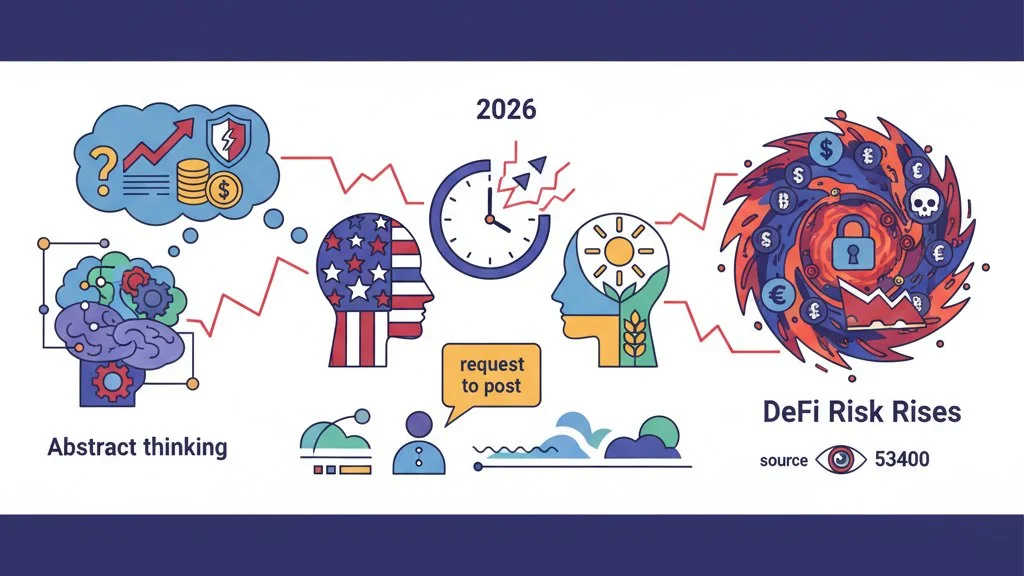
I almost made a mistake this week. A big one. I was deep in the docs of a new perps protocol on Arbitrum, APYs were looking insane, and I was seconds away from migrating a decent chunk of capital. Then the alert hit my screen: Zelensky confirming the US requested to postpone next week's trilateral talks. My hand froze over the 'deposit' button. It was a stark reminder that no matter how good the tokenomics look, macro risk can reprice everything overnight. While guys like Alex Volkov live and breathe this stuff, it's easy to forget in DeFi that our isolated ecosystem is still deeply connected to the real world.
My morning routine is sacred: coffee, DefiLlama, governance proposals. When news like this drops, the first place I look isn't the price chart—it's the Total Value Locked (TVL) flows. I'm less concerned with $BTC holding $70k, which I'm sure Marcus is watching like a hawk. I'm focused on where the liquidity is moving. On-chain data reveals that during macro uncertainty, capital acts like a startled school of fish. It flees the risky, unaudited high-yield farms on newer chains and rushes towards perceived safety.
What does 'safety' mean in DeFi? It means blue chips on mainnet. We're talking $AAVE, $UNI, $MKR, and of course, $ETH itself. Even with $ETH hovering at a disappointing $2,079.13, its role as the ultimate settlement layer makes it a relative safe haven. A proper Ethereum DeFi TVL analysis shows that while the absolute dollar value might drop with the price of ETH, the percentage of capital held in battle-tested protocols often increases during these flights to safety. Money leaves the degen farms and parks itself in lending protocols or stablecoin pools that have survived multiple cycles.
In DeFi, you don't get paid for the yield you earn; you get paid for the risks you correctly identify and survive.
This is the question every yield farmer needs to ask themselves right now. Those 1,000% APYs on a brand-new protocol look great until liquidity vanishes in an hour because of a headline from halfway across the world. I've been rugged three times—I learned my lesson the hard way. A truly DeFi yield farming strategy safe plan isn't about chasing the highest numbers; it's about surviving the downturns. This is where having a pre-flight checklist is non-negotiable.
Before I put a single dollar into a new protocol, and especially when I'm re-evaluating my positions during a risk-off event, I run through my personal smart contract security audit checklist. It's not just about reading the official audit report (which you absolutely must do), but about checking the things that can sink you instantly.
- Contract Ownership: Is the protocol owned by a single, anonymous Externally Owned Account (EOA)? Huge red flag. I look for a multisig wallet with known, reputable signers.
- Timelocks: Can the developers change the rules or drain funds instantly? A protocol without a timelock (typically 24-48 hours) on critical functions is an immediate 'no' for me.
- Token Distribution: What percentage of the token supply do the devs and early VCs hold? If it's over 30-40%, the risk of them dumping on retail is too high.
- Dependencies: What other protocols does this one rely on? If it's built on an oracle that has a history of exploits, that's a risk you inherit.
This simple checklist has saved me more money than any ten-bagger has ever made me. It forces a systematic, non-emotional review of the actual, tangible risks, not just the potential rewards.
So what am I actually doing? I've already trimmed my 10% experimental allocation by half. The capital from that high-APY farm I was eyeing is staying in $USDC for now. I'm also rotating a small portion of my Layer 2 altcoin holdings back into my core position of $ETH. My DeFi blue-chip bag ($AAVE, $UNI, $MKR) remains untouched – these are my long-term holds.
The most significant move I'm making is increasing my allocation to RWA (Real-World Asset) tokens. Specifically, I'm buying more tokenized US T-bills. This is the bridge between TradFi and DeFi that actually makes sense in moments like this. I can stay on-chain, self-custody my assets, but earn yield from the 'risk-free' rate of the traditional financial world. It’s the ultimate risk-off play within crypto. While others flee to stablecoins that yield nothing, I'm parking capital in an asset that is yielding over 5%, backed by the most liquid security in the world.
My thesis is invalidated if this postponement is a smokescreen for a major diplomatic breakthrough. If peace talks accelerate and a deal is announced, we'll see a massive risk-on rally, and my defensive posture will mean I miss the initial pump. That's a trade-off I'm willing to make. I'd rather protect capital and be late to the party than get wiped out chasing the last 10% of a move.
This all comes down to a fundamental question of risk management. When the world gets shaky, do you really know what's in your wallet? Is relying solely on algorithmic stablecoins for safety a huge mistake when tokenized T-bills offer both yield and a direct link to TradFi's ultimate 'risk-free' asset?