

📣 Create Blog for Traders!
Stop Watching news - Start Making it.
START


Tether's $12M Freeze: Why Your Stablecoins Aren't Safe
The latest USDT address freeze is another wake-up call. I'm moving more of my stables into decentralized and RWA-backed assets. Here’s my strategy.
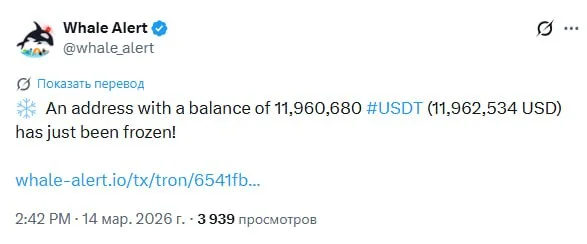
So here's what nobody's talking about with the Tether freeze this morning. Yes, an address holding nearly $12M USDT was blacklisted, likely at the request of law enforcement. But the real story isn't the 'who' or the 'why'—it's the 'how'. The fact that a single entity can unilaterally vaporize the utility of your assets should be a terrifying wake-up call for anyone in DeFi. While the market is distracted by Bitcoin's rejection at $72k that Marcus Cole wrote about, I see a much deeper, more systemic risk brewing in the very plumbing of our ecosystem.
Let me break down what this freeze actually means from a smart contract perspective. The USDT contract on Ethereum (and other chains) has a function that allows an administrator—Tether Limited—to add any address to a blacklist. Once blacklisted, that address can no longer send or receive USDT. The funds are effectively bricked. This isn't a bug; it's a feature. It's a backdoor that completely undermines the concept of censorship resistance we claim to value.
I got my start during the 2020 DeFi Summer, farming YAM at 3 AM with wallets full of USDT. Back then, we were just happy things worked. We didn't scrutinize the contracts enough. But it's 2026. We know better now. My entire investment thesis is built on reading the audits and understanding the tokenomics. And the tokenomics of USDT include a massive, centralized kill switch. That's a risk I'm no longer willing to ignore.
The direct risk of having your personal wallet frozen is low unless you're involved in illicit activities. The real, catastrophic risk is contagion. Imagine a government compelling Tether to freeze the addresses of major DeFi protocols like Aave or Compound. Their entire USDT pools, potentially worth billions, would become instantly worthless, triggering a cascade of liquidations and protocol insolvency.
Because of this, I've systematically reduced my direct exposure to USDT to less than 5% of my stablecoin holdings. If I need to use it for a specific trade, I'm in and out as quickly as possible. The rest of my 'safe' allocation is split among assets with more transparent and decentralized risk profiles.
- DAI: Over-collateralized and governed by MKR holders. It still has significant exposure to centralized collateral like USDC, but it's a step in the right direction.
- FRAX: A hybrid model that's evolving. Its complexity is a risk, but its commitment to on-chain governance makes it a compelling alternative.
- RWA Tokens: This is where I'm most bullish. Tokenized T-bills, for example, are backed by bankruptcy-remote, real-world assets. The yield is real, and the counterparty is the U.S. government, not a private company.
I’ve been burned by three rug pulls in my career. Each time, the lesson was to dig deeper. Check the contract ownership, check the timelocks, read the audit. This Tether situation reinforces that lesson. The key takeaway is this: your counterparty risk doesn't disappear in crypto; it just changes form. With USDT, your counterparty is Tether Limited and any government that can pressure them. I'd rather have my risk be transparent and on-chain.
This is why the most promising RWA tokenization projects to watch are gaining so much traction. They represent the bridge from TradFi that actually makes sense, blending real-world asset security with blockchain transparency. This is the core of the institutional DeFi adoption news that macro guys like Alex Volkov touch on; institutions need assets where the counterparty risk is clear and legally defined, not opaque. The best DeFi protocols 2026 will be the ones that build on this foundation, not on centralized stablecoins.
Centralized stablecoins are a necessary evil for now, but treating them as a long-term risk-free asset is the biggest mistake a DeFi investor can make in 2026.
This $12M freeze isn't an isolated incident. It's a reminder of the deal we've made for liquidity's sake. As for me, I'm actively choosing a different path, one based on verifiable collateral and decentralized governance. It might be less convenient today, but I'm certain it's the safer and more profitable path tomorrow. So, I have to ask: how much of your portfolio is sitting in an asset that can be frozen with a single transaction from a central administrator, and are you prepared for that risk?