

📣 Create Blog for Traders!
Stop Watching news - Start Making it.
START


Morgan Stanley's MSBT: DeFi vs. TradFi BTC Exposure in 2026
Morgan Stanley's spot BTC ETF launches April 8, 2026, challenging BlackRock. My analysis compares this new TradFi option to my DeFi-native BTC strategy. Here's why I'm adjusting my portfolio for the long game.
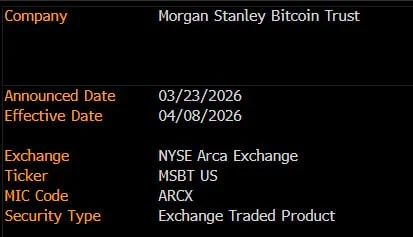
So here's what nobody's talking about in detail: Morgan Stanley dropping its spot BTC ETF, ticker MSBT, tomorrow, April 8, 2026. Yeah, you read that right. Another behemoth stepping into the ring, directly challenging BlackRock’s dominance in the institutional Bitcoin game. On the surface, it sounds bullish, right? More institutional money, more liquidity. Bitcoin is sitting around $68,160 right now, after a 2.5% dip in the last 24 hours, and Ethereum isn't looking much better at $2,079.78, down 3.9%. But for me, it's not just about the price action. It's about what this means for the *structure* of BTC exposure, and honestly, whether it's a better play than my existing DeFi strategies.
This isn't just another ETF. Morgan Stanley, a bank with immense reach and capital, launching a spot BTC ETF on April 8, 2026, signals a deeper embrace of crypto by traditional finance. It offers regulated, convenient access to Bitcoin for a client base that might shy away from direct crypto purchases or self-custody. This move broadens the on-ramp significantly, potentially drawing fresh capital that otherwise wouldn't touch native BTC. This institutional validation is huge, even if the direct price impact is a bit muted initially. It’s a clear sign that the market wants this product, and that means more mainstream adoption down the line. Marcus Cole often focuses on these macro catalysts for price action, and while I appreciate the sentiment, I’m always drilling down into the underlying mechanics.
Look, I get the appeal. For a pension fund or a large institutional investor, a product like MSBT is a no-brainer. They get exposure to Bitcoin's price movements without the headaches of custody, regulatory compliance, or dealing with crypto exchanges directly. It's packaged neatly, regulated by the SEC, and fits right into their existing investment frameworks. Liquidity will likely be solid, especially with Morgan Stanley's trading desks behind it. The fees will be a factor, of course. BlackRock’s IBIT set a pretty competitive bar, and I’ll be keen to see Morgan Stanley's expense ratio when the S-1 goes fully live. The downside for me? It's not *my* Bitcoin. It's a paper claim, with counterparty risk tied to the custodian. You're paying for convenience and regulatory cover, which is fine for some, but it's fundamentally different from holding the actual asset.
My portfolio is 40% ETH, 30% DeFi blue chips (AAVE, UNI, MKR), 20% RWA tokens, and 10% experimental. My BTC exposure comes primarily from wrapped Bitcoin (wBTC) deployed in established DeFi protocols. I've been researching this approach since the 2020 DeFi Summer — I was farming YAM at 3 AM, those were wild times, and I learned quickly about the risks involved. That experience taught me to check contract ownership and timelocks before putting a single wei into anything. For me, the real edge is the ability to generate yield on my BTC. I'm not just holding; I'm actively participating in the DeFi ecosystem.
When you're dealing with wBTC in lending protocols like Aave or Compound, or even in some of the newer Alex Volkov might call speculative restaking protocols comparison, the `smart contract security audit checklist` is non-negotiable. I read audit reports for fun; if you can't read the audit, you shouldn't invest. The risks are real: bugs, exploits, economic attacks. But with robust, battle-tested protocols, the yields (often 3-6% APY on wBTC lending, depending on demand) far outweigh the minimal fees of an ETF, and you retain control of your asset through self-custody. The TVL for wBTC across DeFi is currently well over $10 billion, indicating significant trust in these systems.
- Access: MSBT (Traditional brokerage) vs. DeFi (Wallet, self-custody)
- Risk Profile: MSBT (Counterparty, regulatory) vs. DeFi (Smart contract, impermanent loss, oracle risk)
- Yield Potential: MSBT (None, or minimal via cash management) vs. DeFi (Lending, LP, restaking — typically 2-8% APY)
- Control: MSBT (Indirect, custodian holds keys) vs. DeFi (Direct, 'your keys, your crypto')
- Fees: MSBT (Expense ratio, trading fees) vs. DeFi (Gas fees, protocol fees)
While Morgan Stanley's MSBT is a monumental step for TradFi, the real innovation and control for me still lie in DeFi. It's about owning the asset, not just a promise.
My verdict? While I see the institutional demand for MSBT, my conviction remains with DeFi-native BTC exposure. I'm not closing my wBTC positions in Aave or Compound. In fact, I'm maintaining my long-term DeFi blue-chip allocations. The ETF might push Bitcoin past $75,000 in the short term, especially heading into Friday's close if initial flows are strong, but I'm not trading around it. My portfolio is positioned for the long-term growth of DeFi and real innovation. What invalidates my thesis? A major, systemic smart contract exploit across multiple blue-chip protocols, or a regulatory hammer that makes DeFi yields untenable. But given the increasing maturity of the space and the rigor of the `smart contract security audit checklist` process, I think those risks are manageable for established projects.
The conversation shouldn't just be about ETFs bridging TradFi and DeFi. For me, that's just a sliver of the story. The true bridge, the one that excites me every morning when I check DefiLlama, is `real world asset tokenization explained`— that’s where the actual paradigm shift happens. ETFs are nice, but they're still playing by old rules. Are we missing the forest for the trees by focusing so much on these traditional wrappers, while the real decentralized revolution is happening elsewhere?