

📣 Create Blog for Traders!
Stop Watching news - Start Making it.
START


Crypto Liquidity Isn't Gone, It's Hiding: My Costly 2026 Lesson
Everyone's calling this a weak market, but they're looking in the wrong places. Here's how concentrated liquidity on Binance changed my entire trading strategy.
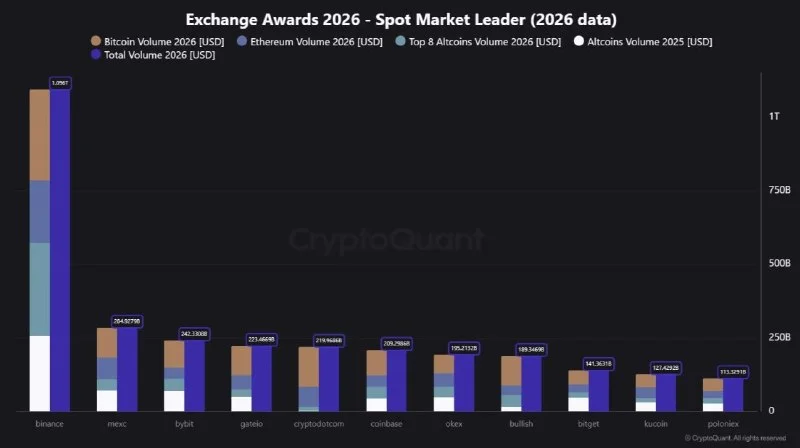
The chatter on Twitter is deafening. 'Bear market,' 'dead market,' 'liquidity crisis.' I see it all day. But when I turn to my Glassnode dashboard, the data tells a completely different story. The market isn't dry; it's just disciplined. Liquidity hasn't vanished, it has consolidated. While everyone complains about chop, Binance has quietly processed over $1.09 trillion in spot volume since January. That's not a bear market. That's a predator's market, and I recently learned the hard way what happens when you're the prey.
A few weeks back, I got seduced by a narrative. A new DePIN project, let's call it $NEXA, was getting hyped up. The chart looked primed—a clean consolidation below a key resistance level. In a 2021-style market, this would be a layup. My thesis was that a breakout could trigger a quick 30-40% run. I saw the story, I saw the pattern, but I completely ignored the most critical factor in today's market: the depth of the order book.
I went long $NEXA at $1.20, placing my stop loss just below a clear support level at $1.12. My target was the range high around $1.55. The risk/reward was solid. Or so I thought. What happened next is a classic tale of thin liquidity. A single large sell order hit the books on a small exchange. There were no buyers to absorb it. The price didn't just drop; it cascaded. My stop at $1.12 was annihilated as the price wicked down to $0.95 in a split second before bouncing right back up. I was out. My thesis wasn't necessarily wrong, but my venue and timing were. I was trying to play chess on a checkerboard.
The data is clear: liquidity is consolidating on major exchanges like Binance and in top-tier assets like Bitcoin and Ethereum. The days of throwing money at any new project are over for now. Smart money is playing defense, sticking to assets with deep order books and predictable price action. While my $NEXA trade was getting sliced up by a single whale, Bitcoin was calmly respecting its range between $76,500 support and $78,200 resistance.
- BTC Dominance: Firmly holding above 54%, acting as a market gravity well.
- Exchange Netflows: Still showing net accumulation for BTC on every significant dip, a sign of conviction from large players.
- Funding Rates: Neutral to slightly negative, indicating leverage has been flushed and the market is healthier.
This is the core of any good crypto market analysis today. You have to look at where the capital is comfortable sitting. For deep dives into which DeFi protocols might actually have long-term staying power (once liquidity returns), I'd check out Luna Park's work. For trading right now, though, the game is on the main stage.
My mistake was applying an old-market strategy to the new reality. Macro traders like Jake Morrison can analyze geopolitical tensions to trade oil because the liquidity in WTI futures is a given. In crypto, liquidity *is* the variable. It's the meta-game you have to win before you can even play the chart. The bitcoin halving impact on price is often a slow burn that starts with this exact type of capital concentration into BTC before spilling out into the broader market months later. I was trying to front-run that spillover, and I paid the price.
My biggest mistake was ignoring the meta-game. The money isn't chasing narratives right now; it's chasing liquidity. I paid for that lesson.
My approach has been surgically refined since that loss. I've cut 80% of the altcoins from my watchlist. My focus is now on high-volume pairs on Binance, Bybit, and OKX. I'm trading wider ranges on BTC and ETH, and my position sizes are scaled according to order book depth. I won't even consider entering a trade unless I see confirmation from on-chain flows. No on-chain confirmation, no trade. Period. It's a more patient, disciplined approach, but it's the only way to survive, and thrive, in a market this concentrated.
This concentration of liquidity feels like the market coiling for a massive move. It’s building tremendous potential energy. So the question isn't *if* a new altcoin season will start, but what catalyst will finally be big enough to fracture this BTC-centric gravity? What are you watching for?