

📣 Create Blog for Traders!
Stop Watching news - Start Making it.
START


Copper's 25-Year Breakout: My Playbook for Trading It
Citi is bullish, but predictions don't make you money. A clean chart setup does. Here's my step-by-step guide to trading this historic Copper move.
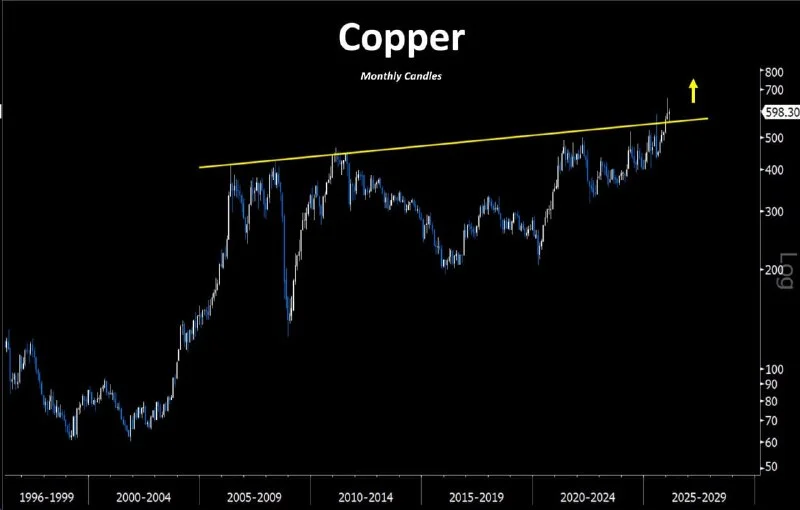
I saw the note this morning. The US is stockpiling copper at a record pace. Citi is calling for the rally to continue. But here's the number that actually got my attention: $5.02. That's the level on the continuous Copper futures contract (HG) we haven't cleanly broken in a quarter of a century. Forget the headlines for a second. A chart testing a level that has held for 25 years is a signal that gets me to sit up straight at my desk. This is the essence of support and resistance trading, and when a setup this clean appears, you have to have a plan ready.
Look, I'm not a macro guy. I'll leave the big-picture supply chain talk to people like Sarah Chen. My edge is on the chart, reading pure price and volume. And this chart is about as clear as it gets. When a price level holds for years, or in this case, decades, it builds up an incredible amount of significance. Think of all the orders, both buy and sell, that have accumulated around that $5.00 - $5.02 zone. A decisive break above it means all those sell orders are absorbed, and a vacuum opens up above. This isn't just another trade; it's a potential paradigm shift for the asset. These are the A+ setups I live for. But trading them requires a specific, disciplined approach. Chasing it will get you wrecked.
I learned this the hard way after blowing up my first two accounts. You can't just buy a breakout because it looks strong. You need a process. Here’s mine, straight from the whiteboard next to my monitors.
Price is what you pay, but volume is what tells you the truth. For a breakout of this magnitude, I need to see a massive surge in volume on the daily or weekly candle that closes above $5.02. I’m talking at least 150% of the 20-day average volume. If we push above the level on weak, anemic volume, I'm not interested. That’s a classic fakeout, designed to trap eager longs. Solid `volume analysis trading` is your best defense against getting caught in those traps.
This is where patience pays. I almost never buy the initial breakout candle. The highest probability entry comes when price rips through resistance, and then pulls back to *retest* that same level, which should now act as support. This is the market giving you a second chance to get in at a much better price with a clearly defined risk level. Waiting for the retest of $5.02 separates the pros from the amateurs who FOMO in at the top.
Once price comes back to our key level, it's time to zoom into a lower timeframe, like the 4-hour chart. This is where you learn `how to read candlestick patterns` for your entry. I'm looking for a clear sign of buyers stepping back in. A bullish engulfing candle, a hammer, or a pin bar right off the $5.02 level is the textbook signal I want to see. That's my trigger to get long.
So, let's apply this to the live chart. Here are the exact levels I have written down and am watching this week.
- Key Level: $5.02 (the multi-decade resistance)
- My Entry: Long entry on a 4H bullish candle pattern after a successful retest of the $5.02 level.
- Stop Loss: A close below $4.89. This gives the trade room to breathe but invalidates the setup if the retest fails decisively.
- Profit Targets: TP1 at $5.30 (approx 2:1 R/R), TP2 at $5.55 (approx 4:1 R/R). I'll move my stop to break-even once TP1 is hit.
This plan keeps me mechanical and removes emotion. If the setup doesn't materialize exactly like this, I don't take the trade. Simple. Even the best quant models from guys like Alex Volkov are built on rules and probabilities, not gut feelings. The biggest mistake I still fight is revenge trading. If I get stopped out on this, my journal tells me to walk away for the rest of the day. Period. It's a non-negotiable rule.
The biggest risk here is a major fakeout, also known as a bull trap. We could see price poke above $5.02 for a day or two, suck in all the breakout buyers, and then nuke back down below the level. This often happens when the breakout occurs on low volume. That's why waiting for the volume confirmation and the successful retest is so critical. It's my filter to avoid getting run over.
Forget the news, trade the chart. A 25-year level breaking on high volume is a signal you can't ignore, but you still need a plan to execute.
This setup in Copper is a fantastic real-time lesson in price action. It has all the elements of a career-making trade if you play it right, or an account-breaker if you get emotional. I'm watching it tick-by-tick. With the US government stockpiling and the chart coiling this tightly, is this the one commodity trade that outperforms even crypto this year?