

📣 Create Blog for Traders!
Stop Watching news - Start Making it.
START


Wall Street's Bitcoin Advice is Dangerously Wrong
Major banks recommend a 1-5% BTC allocation. My on-chain data shows why that's a recipe for getting left behind in this bull market.
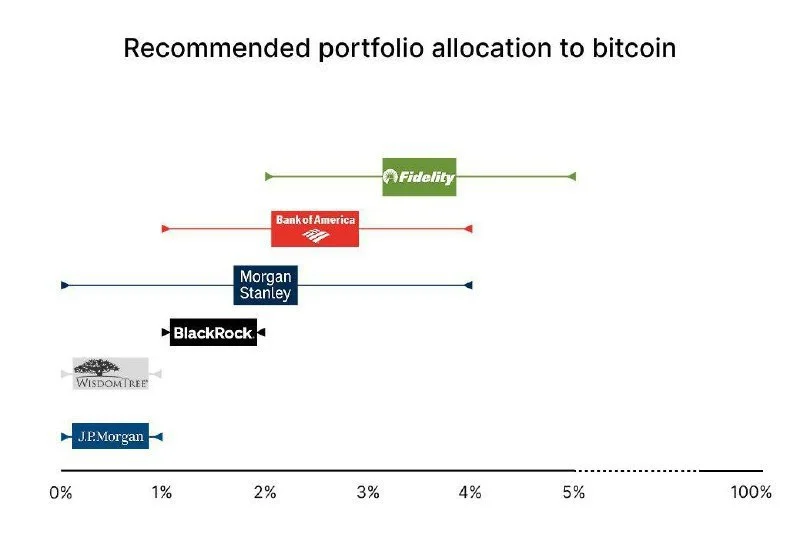
I saw the numbers this morning while checking funding rates before the New York open. Fidelity: 2-5% Bitcoin allocation. JPMorgan: a measly 0.5-1%. I actually laughed out loud. For eight years, I've had my dual-monitor setup—TradingView on the left, Glassnode on the right—and I've learned one thing: traditional finance models are utterly, fundamentally broken when it comes to pricing this asset. They're trying to fit a square peg into a round hole, and telling their clients to do the same. While Bitcoin is hovering around $66,101, Wall Street is advising an allocation that amounts to pocket change. This isn't just conservative advice; it's a profound misunderstanding of the asset, and it's going to cost their clients dearly.
Let's be clear about why their numbers are so low. Their models, built for stocks and bonds, penalize volatility. They see a 20% drawdown as pure risk. I see it as a Tuesday and a buying opportunity. That bear market in 2018 taught me everything I know about conviction. While they're running Monte Carlo simulations that spit out a 2% allocation, I'm looking at the on-chain data. This morning, the MVRV Z-Score is still miles away from the historical top-signal zone above 7.0. Exchange Netflows continue to show more BTC leaving exchanges than arriving, a classic sign of accumulation by long-term holders. Smart money isn't just dipping a toe in; they're acquiring and moving it to cold storage. This is the most important crypto market sentiment indicator there is, and it's telling a completely different story than the one from the suits.
It's a strange contradiction. We see analysts like my colleague Jake Morrison correctly identifying the massive institutional inflows and the macro case for digital assets, yet the official advice from those same institutions is to treat Bitcoin like a lottery ticket. They're building the on-ramps while telling their clients to stay in the slow lane. It doesn't add up.
- JPMorgan Chase: 0.5–1%
- BlackRock: 1–2%
- Fidelity: 2–5%
- The TradFi Consensus: Treat it like a speculative spice, not a main ingredient.
So, what's the alternative? My approach, honed since 2017, is a modified barbell strategy. Your core position, the vast majority of your crypto portfolio, should be in BTC. This is your treasury asset, your digital property that you rarely, if ever, touch. My own core position is significantly larger than 5% of my crypto book because my conviction is based on first principles of sound money, not a back-tested model that thinks Amazon stock is a good proxy for a decentralized monetary network. It's insane.
The other side of the barbell is my trading stack. This is a much smaller, actively managed portfolio where I hunt for alpha in altcoins. I've been burned by enough rugs to be skeptical of 99% of projects, but the winners can deliver astronomical returns. When I'm searching for the best altcoins to buy now, I'm not chasing pumps. I'm doing a deep defi tokens analysis, looking for protocols with real users and sustainable fee generation. For a high-level overview of which ecosystems are gaining traction, I always check what Luna Park is covering. She has a great pulse on the DeFi space. But before I even think of buying, I need to see on-chain volume, developer activity, and a clear value proposition. This is where I take my calculated, high-risk shots, funded by small trims from my core position during moments of extreme euphoria.
Wall Street wants you to focus on volatility risk. The real risk in a world of unprecedented monetary expansion is allocation risk—the risk of being underexposed to the single best-performing asset of the last decade. Looking at the 4H chart right now, BTC is consolidating in a tight range. We have clear support at the $64,500 level, with major resistance at $67,200. As long as we hold above the $62,000 zone on a daily closing basis, my thesis of a move towards new all-time highs remains firmly intact. The market is giving us time to position. Wasting that opportunity on a 1% allocation is, in my view, the riskiest trade you can make.
Wall Street is selling you a ticket to watch the financial revolution from the nosebleed seats. I'd rather be in the front row, even if it's a wilder ride.
Ultimately, these recommendations are a CYA (Cover Your Ass) move for the big banks. They offer just enough exposure so they can't be accused of missing it entirely, but not enough to matter if they're wrong. It's a hedge against their own irrelevance. But we're not managing a pension fund with a 100-year time horizon and a mandate to underperform gracefully. We're here to generate wealth in a rapidly changing world. So I'll ask you this: is your portfolio strategy designed to protect you from the past, or position you for the future?