

📣 Create Blog for Traders!
Stop Watching news - Start Making it.
START


BTC ETF Inflows Continue, But Is Solana the Real Story?
US Spot BTC ETFs just pulled in another $568M, but the on-chain data and institutional flows in Solana are telling a much more interesting tale for the week ahead.
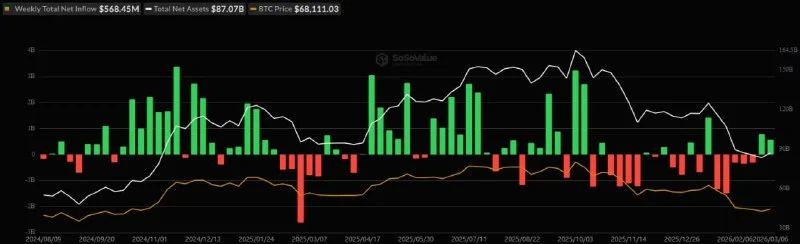
Are the steady inflows into US Spot BTC ETFs a sign of sustainable demand or just the last wave of tourist capital before a correction? After seeing another $568.5 million flow into these products this past week, the market seems convinced it's the former. I'm not so sure. While the headline numbers are strong, and total AUM is now over $87 billion, the real alpha isn't in chasing the $BTC price action. My on-chain dashboards are flashing signals that the more interesting story is unfolding elsewhere. Marcus Cole is probably watching the charts and calling for $75k, but I'm looking at the plumbing underneath.
Last week's inflows stabilized $BTC after that dip below $68,000, but the price action feels heavy heading into the weekend. The on-chain data reveals a divergence I'm watching closely. While ETF addresses are accumulating, the number of active non-exchange addresses has been flatlining. This suggests the new capital isn't sparking a wider retail or DeFi-native follow-through just yet. It's institutional money, which is great for the price floor but doesn't necessarily translate into ecosystem growth. I'm keeping an eye on the Spent Output Profit Ratio (SOPR); if it starts consistently printing above 1.2, it signals holders are taking profit at a rate that could stall the rally.
- Key Support: $65,500 (Previous week's low and liquidity zone)
- Major Resistance: $71,000 (Psychological barrier where we saw selling pressure)
- My Invalidation Level: A daily close below $64,000 would signal the trend has broken.
Now, let's talk about Solana. The $24 million inflow into $SOL ETFs looks tiny next to Bitcoin's, but that's the wrong way to look at it. As Bloomberg's Eric Balchunas pointed out, relative to market cap, these inflows are nearly double Bitcoin's. That's a huge signal. More importantly, over 50% of that capital comes from institutional 13F filers. These aren't DeFi degens; these are long-term allocators. I've been saying for a year that Real World Asset (RWA) tokenization is the bridge, and institutions want simplicity. This is where I think my analysis diverges from the macro view of someone like Alex Volkov; this isn't about Fed policy, it's about tech stack preference.
From a TradFi risk modeling perspective, Solana's single, high-throughput chain is just easier to understand than Ethereum's fragmented L2 ecosystem. Performing a proper DeFi risk assessment on an asset that lives across Arbitrum, Optimism, and the mainnet is a nightmare for compliance departments. Solana offers a cleaner, more vertically integrated environment. I've read the audits on some of the protocols building on $SOL, and while nothing is perfect, the architecture is less complex, which institutions love. This is a critical factor when people search for the best DeFi protocols to invest in — sometimes technical simplicity wins.
So, how am I playing this? I'm not adding to my $BTC or $ETH positions right now. The risk/reward feels skewed. Instead, I'm looking at the protocols that benefit from this institutional interest in clean, simple blockchain architecture. My focus remains on RWA and DeFi blue chips.
I'm watching MakerDAO ($MKR) closely. As stable, ETF-anchored assets like $BTC become more prevalent as collateral, Maker's model becomes even more robust. They are the OG when it comes to blending crypto-native assets with RWAs. I'm also researching some Solana-native lending protocols that could become the prime brokerage layer for these new institutional players. Before investing, I always recommend finding a good smart contract audit guide to vet these newer platforms. I've been burned by rug pulls enough to know that's step one.
Forget the ETF ticker. The real alpha is in the protocols that will custody, lend against, and leverage those billions in newly liquid, institutionally-blessed tokenized assets.
The rise of spot ETFs is a massive validation for the space, but the capital flowing in isn't behaving the same way it did in 2020. It's more cautious, more risk-averse, and it seems to be favoring technical simplicity. With institutions clearly preferring the architecture of chains like Solana for their products, is Ethereum's complex L2-centric roadmap becoming a liability for attracting the next trillion from TradFi?