

📣 Create Blog for Traders!
Stop Watching news - Start Making it.
START


Hyperliquid Oil Volume Hits $1.2B: A DeFi Stress Test
I've been tracking the on-chain data behind the oil futures explosion on Hyperliquid. It’s more than just a macro trade—it's a fundamental shift.
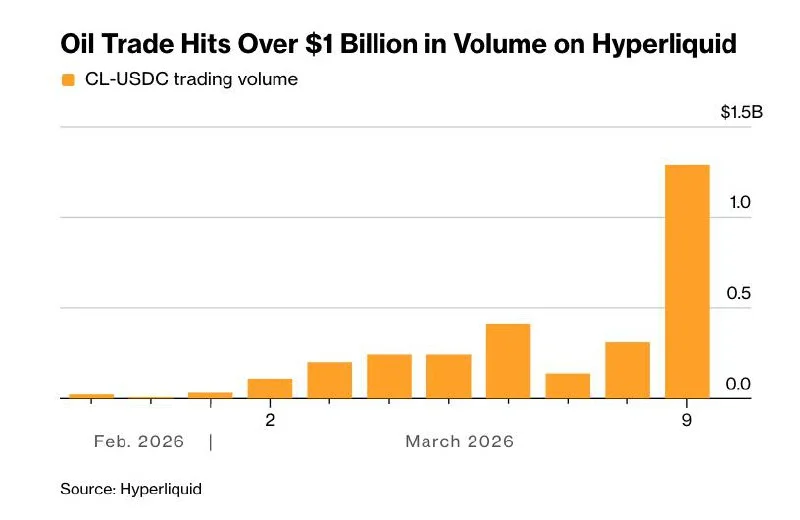
I almost made a mistake this week. A big one. When headlines about the escalating Iran conflict started flashing, my first instinct was to check the usual suspects: WTI, Brent, maybe some energy ETFs. I saw the initial reports of soaring volume on Hyperliquid for oil perps and dismissed it as degen noise. A rounding error. I was wrong. Watching that volume rocket from $21 million to over $1.2 billion in a matter of days wasn't just a blip; it was a seismic event for decentralized finance. This isn't just about oil prices. It's a live-fire stress test of the entire on-chain derivatives thesis, and so far, it’s passing in ways that should make the Chicago Mercantile Exchange very nervous.
So, what is Hyperliquid and why did capital flood there instead of somewhere else in the vast Ethereum DeFi ecosystem? I've been tracking them since their testnet. Unlike most DeFi perpetual exchanges that use an Automated Market Maker (AMM) model—think GMX or Synthetix—Hyperliquid uses a fully on-chain order book. For assets like BTC or ETH, an AMM works fine. For a traditional macro asset like oil, traders demand the tight spreads and deep liquidity that only an order book can provide. It's what they're used to.
The real kicker, and the reason for the volume explosion, is its 24/7/365 uptime. Geopolitical events don't wait for the opening bell at 9:30 AM EST. When news broke over the weekend, traditional markets were closed. Traders, desperate to hedge or speculate, had somewhere to go. This is DeFi’s core value proposition in action: providing financial services when the old guard can't. While Alex Volkov has been providing excellent macro analysis on the conflict's drivers, I'm fascinated by the plumbing that's enabling this new wave of trading.
Volume figures can be misleading. I’ve seen enough rug pulls to know that. My first priority was to verify if this was real, organic activity or just wash trading by a few bots. The on-chain data reveals a healthy trend. It wasn't just volume; Open Interest (OI) climbed steadily from around $2 million to over $95 million. That's a crucial metric. It tells me that new capital was entering the market and holding positions, not just scalping for a few seconds. These were real, directional bets.
- Total Volume (7D): $1.23 Billion
- Peak Open Interest: ~$95 Million
- Peak Hourly Funding Rate (Longs): +0.12%
- Primary Collateral: USDC
The funding rates tell the other half of the story. During the peak panic over the weekend, I saw the funding rate for longs spike to over 0.1% per hour. That's an annualized rate of over 1,000%. It was incredibly expensive to be long, indicating a massive, desperate demand to buy oil when no other venue was open. This is the kind of raw, unfiltered market sentiment you can only find on-chain.
This is where my skepticism kicks in. I read audit reports for fun, and new, high-flying protocols always set off my internal alarms. Hyperliquid runs on its own purpose-built L1 blockchain, which means you're not just taking on smart contract risk, but also consensus and bridge risk. I dug into their Zellic audit from last quarter. It was solid on the core clearinghouse and vault logic, but any bespoke L1 is a massive attack surface.
Anyone trading here needs a personal DeFi risk assessment checklist. How is the oil price feed secured? They use a combination of Pyth and their own node operators, which is better than a single source but still a centralization risk. What about the bridge used to get USDC onto the Hyperliquid L1? That's a prime target for hackers. While Marcus Cole is busy analyzing BTC shorts, I'm more concerned about the systemic risks in these new platforms that are suddenly holding hundreds of millions in user funds. A proper smart contract audit guide would tell you to check for timelocks on protocol upgrades and contract ownership—things I checked immediately. For now, they seem to be following best practices, but the risk is non-zero.
So, is this a temporary fad driven by a news cycle? I don't think so. The genie is out of the bottle. A huge pool of traders, from DeFi natives to TradFi refugees, have now experienced the power of a 24/7, permissionless, on-chain venue for a critical real-world asset. They won't easily go back to the old ways. This is the RWA tokenization I've been talking about for years—not some illiquid, tokenized real estate project, but a deeply liquid, globally relevant futures market.
This event proves that DeFi infrastructure is finally ready to compete with TradFi on its own turf, especially during times of crisis. The ability to manage risk or express a view at 3 AM on a Sunday is a feature, not a bug, and it's a feature that legacy exchanges simply cannot offer. This is the real bridge. It's not a marketing term anymore; it's being built, tested, and proven with billions of dollars in real volume.
For years we've asked 'when will institutions come to DeFi?' The Hyperliquid oil market shows they're already here, they just aren't using their corporate accounts. They're using anon wallets to hedge real-world risk when the CME is asleep.
The technology has proven itself under extreme pressure. The volume is real and the utility is undeniable. But it's all running on a new L1, secured by its own token, with price feeds from oracles, and funds held in a bridged contract. So I have to ask: are we simply swapping the operational risk of a closed CME for the technological risk of a DeFi protocol? Which devil do you trust more?