

📣 Create Blog for Traders!
Stop Watching news - Start Making it.
START


This $40K BTC Mining Watch is the Future of RWAs
GoMining and Jacob & Co. just launched a luxury watch with a 36% APR. It's a marketing gimmick, but it's also a fascinating glimpse into the next big DeFi trend.
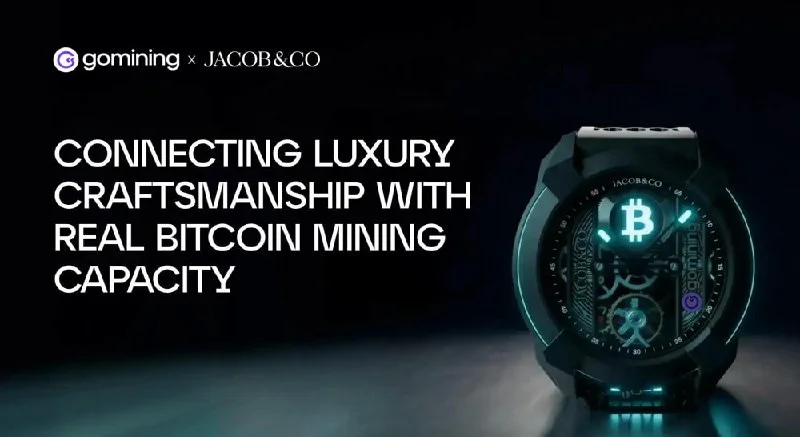
This new GoMining watch is a clever marketing stunt, but more importantly, it's a perfect, tangible example of where Real World Asset (RWA) tokenization is headed. While the watch itself is a questionable investment, the underlying concept of tokenizing real-world cash flows is the most important bridge between TradFi and DeFi being built today. After a choppy week where Bitcoin tested and failed to hold $72,000, as Marcus Cole pointed out, this kind of innovation story is a welcome distraction.
The market feels heavy after that rejection at $72k. I'm watching to see if we can establish a higher low or if we're in for more consolidation. My focus remains on the RWA sector, which has shown relative strength.
- BTC Support: $68,500 (Previous range high)
- BTC Resistance: $71,800 (The rejection point)
- MKR Support: $3,150 (21-day EMA)
- My RWA Watchlist: ONDO, MKR, PENDLE
Let's break down the tokenomics, so to speak. You pay $40,000 for the Jacob & Co. watch. In return, GoMining claims you get about $1,200 per month in BTC. That works out to $14,400 a year, a 36% APR. On the surface, that crushes most stablecoin yields. But as someone who reads audit reports for fun, my alarm bells are ringing.
This isn't a smart contract; it's a promise from a centralized company. What are the terms? Is the hashrate guaranteed for life? What happens when Bitcoin's mining difficulty inevitably increases, shrinking margins? This is a classic case of counterparty risk wrapped in a luxury package. The watch is essentially an NFT that grants access to a mining contract. In a way, this is real world asset tokenization explained in its most literal form: a physical item tied to a stream of digital income.
How does this 36% APR stack up against the best DeFi protocols 2026 has to offer? You can get 8-12% on lending protocols like Aave with significantly less counterparty risk (though smart contract risk is always present). Staking ETH derivatives offers around 4-5%. The risk profiles are fundamentally different. I'd rather trust audited, battle-tested code than a corporate promise, a perspective I think risk managers like Alex Volkov would appreciate.
I'm not buying the watch. I was farming YAM at 3 AM during DeFi Summer 2020; I've seen my share of unsustainable yields. But I am investing heavily in the infrastructure that makes these kinds of products possible. The real opportunity is in the protocols that are building the rails for RWA tokenization. Think MakerDAO (MKR) onboarding treasury bills or Centrifuge bringing real-world invoices on-chain.
My portfolio reflects this conviction: 20% is allocated to RWA tokens. My thesis is that the tokenization of everything—from mining contracts to real estate to private credit—is the multi-trillion dollar narrative that brings institutional capital into DeFi. The watch is just a shiny distraction from the real revolution happening at the protocol level.
Don't buy the shiny object that promises yield. Buy the protocol that provides the rails for a thousand such shiny objects to exist.
The risk with the watch is simple: GoMining controls the keys. They could change the terms, under-deliver on hashrate, or disappear entirely. There's no on-chain enforcement. This is why having a mental smart contract security audit checklist is crucial, even for off-chain products. You have to ask: who has custody? What are the termination clauses? Who is the arbiter of disputes? With this watch, the answer is 'the company,' and for me, that's not good enough.
So while it's a fun headline, I see it as a powerful signal of market direction. The fusion of luxury goods and digital cash flows is coming. Will the next Patek Philippe be backed by a portfolio of tokenized treasury bills, or is this just another novelty of a frothy market?