

📣 Create Blog for Traders!
Stop Watching news - Start Making it.
START


Put/Call Ratio Soars: Is Wall Street Hedging or Panicking?
The CBOE equity put/call ratio just screamed past 1.15. Most traders see fear. I see a calculated setup and a potential entry point.
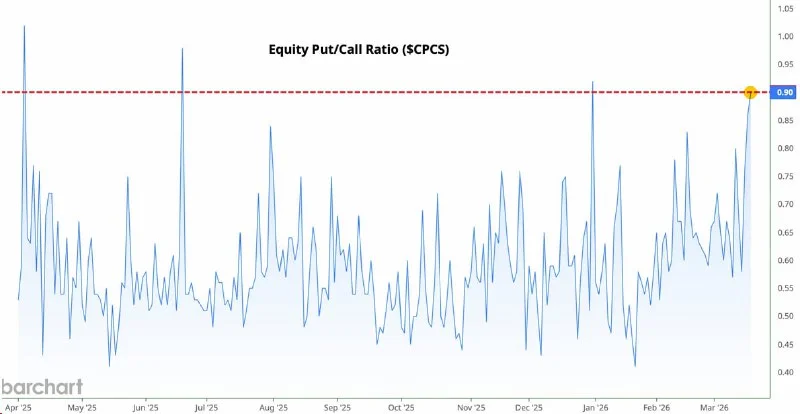
I was about to close out a profitable long in $MSFT heading into Friday's close, watching the position add a nice cushion to my Q1 performance. As I pulled up my options flow screener for a final look, something jumped off the page: a massive spike in the CBOE Equity Put/Call Ratio to 1.15. That's the highest reading we've seen since the Q4 2025 correction. My first thought wasn't panic. It was opportunity. The headlines are screaming that traders are betting on a decline, but from my desk, this looks less like a five-alarm fire and more like a very calculated, professional hedge.
First, let's be clear. A put/call ratio above 1.0 means the volume of bearish put options being traded is higher than bullish call options. It’s a direct measure of market sentiment. But sentiment is often a contrarian indicator. The last time we saw a spike like this, the S&P 500 bottomed two weeks later and rallied 8%. History doesn't repeat, but it often rhymes. My take is that we're seeing institutional players buying protection ahead of the Q1 2026 earnings season preview, not outright betting on a crash. The VIX, while elevated at 18.5, isn't exploding towards 30. That tells me this is calculated risk management, not sheer terror.
- Key Resistance: 5,350 (prior all-time high)
- Weekly Pivot: 5,280 (the 21-day EMA is critical here)
- Major Support: 5,200 (50-day moving average and psychological floor)
When fear gets this extended, it often means the worst of the short-term selling is already done. The market has a funny way of punishing the consensus, and right now, the consensus is clearly nervous. While I respect the macro headwinds that my colleague Alex Volkov often points out regarding Fed policy, this level of hedging feels overdone. The market has absorbed higher-for-longer rate talk for months. A sudden panic now seems misplaced unless there's new data on the horizon.
A proper magnificent seven stocks analysis shows this isn't a broad-based panic. Digging into the options flow, the put buying is heavily concentrated in names that have already shown weakness, like $AAPL and $TSLA. Meanwhile, names like $NVDA and $GOOGL still have a healthy call skew. This tells me funds are trimming risk in their laggards while holding onto their winners. It’s portfolio rebalancing, not a market-wide exodus. This is a crucial distinction that most retail traders will miss.
I am not joining the crowd and buying puts. My plan is to use this fear as a potential entry to add long exposure. This contrasts with the income-focused strategies of traders like Jake Morrison, who might be looking at high-yield dividend names right now. My focus remains on growth, and I believe my S&P 500 price target 2026 of 5,600 is still very much in play. We're heading into an earnings season where expectations have been managed lower, setting the stage for positive surprises. I'm viewing any dip towards the S&P 500's 50-day moving average as a gift.
When the Put/Call ratio spikes above 1.1 without a corresponding VIX explosion, it's usually smart money hedging, not dumb money panicking. I'm a buyer on the dip, not a seller on the news.
My primary trade idea is to go long the $SPY (S&P 500 ETF). I'm setting alerts for a pullback into the $521-$523 zone, which corresponds to that major 5,200 support level on the index. My stop-loss would be a firm daily close below $518. My initial profit target is a retest of the highs around $535, offering a risk/reward ratio of over 3-to-1.
This contrarian bullish thesis is invalidated if two things happen. First, a decisive daily close below 5,200 on the S&P 500. That would break the 50-day moving average and signal that sellers have truly taken control. Second, if next week's Core PCE inflation data comes in hotter than expected, it could force the Fed's hand and prove the put buyers right. That's the primary risk on the calendar.
Everyone sees the fear in the options market; it's impossible to miss. The real question is: are you using it as an exit sign, or are you preparing to use it as an entry signal?