

📣 Create Blog for Traders!
Stop Watching news - Start Making it.
START


Bitcoin Difficulty Drops 7.76%: Why This Is My Buy Signal
The mainstream sees panic, but the on-chain data from this week's Bitcoin mining adjustment is screaming opportunity. Here's my playbook.
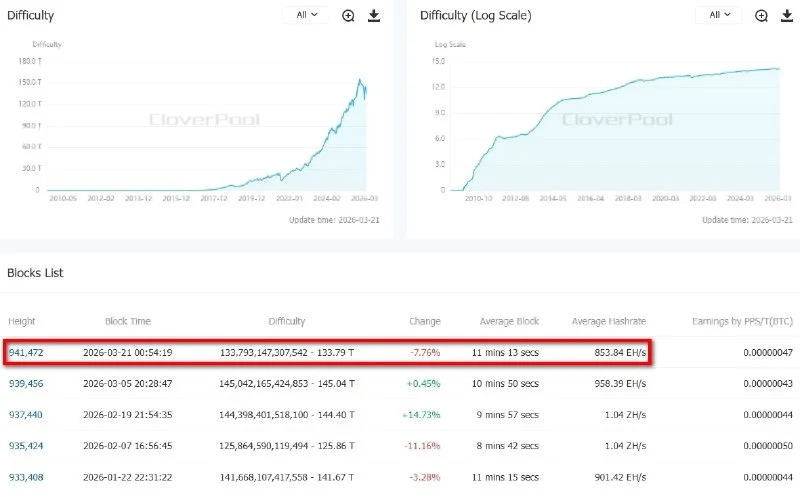
The headlines are screaming it this morning: Bitcoin's mining difficulty just plunged 7.76% to 133.79 T. I can already see the fear-mongering posts about a 'miner death spiral' starting to circulate. They're wrong. I've been in this market since 2017, and if that first brutal bear market taught me anything, it's that miner capitulation isn't the end—it's the market cleansing itself before the next major leg up. This isn't a signal to panic; for me, it's a signal to pay very close attention.
Let's get this straight. A difficulty drop means it's become easier to mine a Bitcoin block. This happens when the total network hashrate falls, which means miners are turning off their machines. The drop back in February was easy to dismiss; it was a winter storm in the US, a temporary physical disruption. This one is different. This is economic. With BTC hovering around $70,600, this adjustment tells me one thing: inefficient miners with high energy costs and older hardware are being forced out. They can't compete.
This is Darwinism for the Bitcoin network. Flushing out the weaker players strengthens the foundation. The remaining miners are the ones with low-cost operations and next-gen rigs. They are the strong hands. My morning check of Glassnode confirms it: while hashrate is down from its October 2025 peak, miner reserves aren't in a freefall. We're not seeing a mass exodus of coins onto exchanges. It's a squeeze, not a collapse.
The 7.76% drop in Bitcoin's mining difficulty suggests a network reset, not a crisis. On-chain data shows miner reserves remain stable, and exchange outflows haven't spiked. This indicates efficient miners are holding, flushing out weaker hands. It's a sign of consolidation, often preceding a price recovery.
Every morning, before I even look at a price chart, my second monitor is lit up with on-chain data. Right now, I'm laser-focused on the Hash Ribbons indicator. We haven't seen the bullish crossover yet, which would mark the end of miner capitulation and the start of a recovery, but the ribbons are tightening. This is the setup I look for. I'm also watching the Puell Multiple, which is currently sitting around 1.6 — far from the overheated levels above 3.0 we saw at the last cycle top. Miners are profitable, but not euphoric. It's a healthy middle ground.
- Key Price Support: Watching the $68,500 level, a previous consolidation zone.
- On-Chain Signal: A Hash Ribbons crossover on the daily chart would be my confirmation to add size.
- Invalidation: A sharp increase in miner-to-exchange flows above 5,000 BTC daily.
- Resistance Target: A successful bounce targets the $74,000 resistance zone first.
While everyone is getting whipsawed by geopolitical headlines, I tend to agree with Jake Morrison's recent take that the Iran situation is mostly noise for the crypto market. The real story isn't on cable news; it's written on the blockchain. This difficulty adjustment is a much cleaner signal for anyone formulating a crypto bear market strategy—or in this case, a 'shakeout before continuation' strategy.
My playbook is simple: I'm a buyer on dips into the high $60k's. I'm not deploying my full stack, but I'm accumulating. I'm looking for a retest of the $68,500 support level to add to my core BTC position. My stop-loss on this idea would be a daily close below $65,000, as that would suggest a more severe breakdown is underway.
When Bitcoin chops sideways like this, my eyes turn to the major altcoins. The classic Solana vs Ethereum comparison 2026 debate is more relevant than ever. I've been swing-trading SOL, and its recent performance holding the $85 support has been impressive. However, for my long-term holds, I'm still weighted towards ETH. Its network effect is undeniable. While SOL offers speed, ETH offers a battle-tested foundation. For a deeper DeFi protocol analysis, I'd point you to Luna Park; she lives and breathes that stuff. My take is purely from a trader's perspective: SOL for the swing, ETH for the hold.
This isn't a blind 'buy the dip' call. My thesis is invalidated if we see hashrate continue to plummet through the next difficulty adjustment and, more importantly, if miner wallets start dumping coins on exchanges in a panic. A sustained move above 5,000 BTC in daily miner outflows would force me to reconsider. But right now, the data shows a healthy culling of the herd, not a systemic crisis.
Miner capitulation is the market's way of cleaning house. Don't fear the reset; trade the signal it sends.
The market is giving us a clear on-chain signal while most traders are distracted by macro headlines and price wicks. The question is, are you going to listen to the noise or the data?