

📣 Create Blog for Traders!
Stop Watching news - Start Making it.
START


Crypto's 'Extreme Fear' Is a Trap (And I Almost Fell For It)
The Fear & Greed Index hit rock bottom, but on-chain data told a different story. Here's the trade I didn't make and the lesson that saved my portfolio.
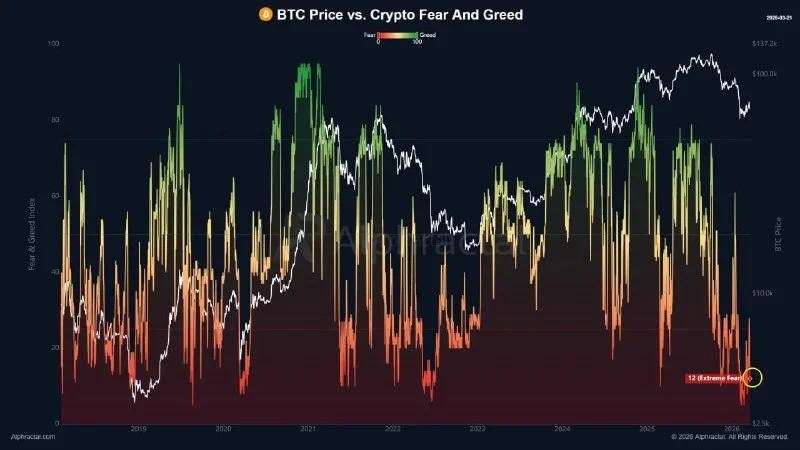
I'll be honest, my finger was hovering over the sell button on Friday. Seeing the Crypto Fear & Greed Index flash a score of 15 ('Extreme Fear') gave me a nasty flashback to my early days in 2020. I was farming YAM at 3 AM back then, and I’ve been burned by enough rug pulls to know what panic feels like. The headlines were screaming, BTC was sliding under $68,000, and every instinct I learned the hard way told me to de-risk. But I didn't. Because in 2026, relying on that index alone is one of the fastest ways to get wrecked.
The market was a sea of red. ETH dipped to $2,044, SOL was struggling at $85. Anyone just watching charts, like my friend Marcus Cole loves to do, would see a clear breakdown. But price action is a lagging indicator of conviction. While retail was panic-selling, the on-chain data I track on my custom dashboards was telling a completely different story. I saw two key metrics that made me pause:
- Stablecoin Exchange Inflows: They were flat. No massive rush of USDT or USDC to exchanges, which is what you'd expect if whales were preparing to dump.
- DeFi TVL Resilience: I checked DefiLlama. Total Value Locked across the top 20 protocols was down only 2.1%, while asset prices were down 4-5%. This means very few people were actually withdrawing their capital; the drop was almost entirely due to asset price depreciation.
- Low Leverage: Funding rates on perpetuals were neutral to slightly negative. This wasn't a leverage-fueled cascade; it was spot-selling, likely from newer market participants.
This wasn't the signature of a true market bottom falling out. It was the signature of a retail shakeout. The 'Extreme Fear' was localized to the people who watch the price, not the people who build and use the protocols.
The Crypto Fear & Greed Index isn't broken, but its usefulness has dramatically changed. In 2026, with so much institutional capital and complex derivatives, it's more a measure of retail leverage and options market sentiment than overall market conviction. On-chain data like TVL and stablecoin flows provide a much clearer picture of what smart money is actually doing with their assets.
I was doing a restaking protocols comparison for my own research, looking at EigenLayer versus some of the newer players. Their TVLs were sticky. The fundamentals hadn't changed. My personal smart contract security audit checklist—a system I built after my third rug pull—still gave them all a green light. So why would I sell a fundamentally sound asset just because a sentiment gauge got cold feet? It made no sense. This is where a broader macro view, like the kind Alex Volkov provides, is far more useful than a simple fear index.
Instead of selling, I actually used the dip to re-evaluate my allocations. This kind of volatility is exactly why I've dedicated 20% of my portfolio to RWA tokens. While everyone else is freaking out about a 5% crypto dip, my tokenized T-bills are just quietly yielding 5.5% APY, completely uncorrelated. The lesson for me was that the best defense isn't selling, it's diversifying into assets whose value isn't based on market sentiment. I'm constantly adding to my list of RWA tokenization projects to watch, because this is the bridge between TradFi and DeFi that brings stability.
So, the trade I almost made—selling off some of my more experimental DeFi holdings to consolidate into ETH—never happened. I held. And I'm glad I did. The real risk this week wasn't a market crash; it was the risk of being shaken out of perfectly good positions by a noisy, retail-focused indicator. It’s a rookie mistake, and I’m annoyed I even considered it. It proves that no matter how long you've been in this space, the psychological pull of fear is always there. You have to fight it with data.
Sentiment follows price, but value follows fundamentals. Stop watching the Fear Index and start watching the on-chain capital flows.
This experience just reinforces my core philosophy: if you can't read the audit report and understand the tokenomics, you shouldn't be in the position. So I'll ask you this: is your portfolio strategy built on solid fundamentals, or is it being dictated by a lagging sentiment indicator designed for a market that barely exists anymore?