

📣 Create Blog for Traders!
Stop Watching news - Start Making it.
START


Bitcoin Miner Crisis 2026: Is a $19k Loss Per BTC Bearish?
Miners are deep in the red as production costs soar past Bitcoin's price. But my on-chain analysis shows a different force is now in control.
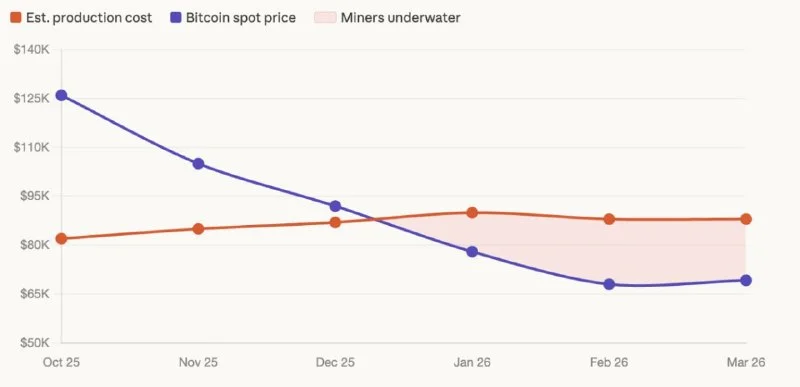
The number that hit my screen this morning was stark: $88,000. That's the estimated average cost to mine a single Bitcoin right now. With BTC trading at around $68,100, you don't need a calculator to see the problem. That's a $19,900 loss on every coin produced for the average miner. In any other cycle, this would be a five-alarm fire, a clear signal that a brutal capitulation event is just around the corner. I survived the 2018 crash; I know what that looks like. But this is 2026, and the game has fundamentally changed. The market is now a battleground between two colossal forces: old-guard miner supply versus new-guard institutional demand.
Let's first look at the classic bear case, because it shouldn't be ignored. When miner profitability goes negative, a predictable chain reaction begins. First, miners stop holding their newly minted coins and start selling them immediately to cover massive operational costs—electricity, hardware, staff. Second, they begin to sell off their treasury reserves, the BTC they've been holding for months or years. This is pure, relentless sell pressure. My Glassnode dashboard shows the Miner Net Position Change metric is starting to dip negative, confirming that more coins are leaving miner wallets than are being accumulated.
If this pressure persists, less efficient miners with higher costs go out of business. They turn off their rigs, and we see the network hashrate drop. A falling hashrate is historically a sign of network weakness that spooks investors and can trigger a deeper price correction. This is the scenario that has played out in every previous bear market. It’s a self-reinforcing downward spiral. This isn't like the complex macro world of forex that Jake Morrison analyzes; crypto has its own internal, transparent central bankers—the miners—and right now, they're hurting.
Because the other side of the ledger has never been stronger. The definitive bitcoin ETF inflows analysis shows a wall of institutional demand that simply didn't exist in previous cycles. We're talking about billions of dollars per week being vacuumed up by entities like BlackRock and Fidelity. This demand is programmatic, relatively price-insensitive, and comes from capital pools that make the entire crypto market cap look like a rounding error. They aren't buying for a 2x flip; they're allocating for a decade.
This institutional bid is absorbing miner selling and then some. While the average miner is unprofitable at $88k, the most efficient operations are still in the green. The market is forcing out the weak players while their sold coins are being transferred to the strongest hands we've ever seen in this asset class. This is forced consolidation on a massive scale. The coins are moving from those who must sell to those who simply want to buy.
- Driving Force: Miner selling is driven by necessity (covering opex). ETF buying is driven by strategic allocation (long-term thesis).
- Time Horizon: Miners are forced to think short-term (daily profitability). Institutions are allocating with a 5-10 year view.
- Source of Funds: Miner selling is finite (limited by their BTC reserves). Institutional buying is effectively limitless relative to current market size.
- Market Impact: Miner pressure creates volatility and dips. Institutional demand creates a powerful, rising price floor.
I'm not selling my core BTC position. My analysis shows this period of miner stress is a feature, not a bug, of this bull market. It's the mechanism by which the last large cohort of forced sellers is flushed out before price discovery can continue. While this consolidation in Bitcoin might give some oxygen to the DeFi projects that Luna Park follows, the primary trend remains the institutionalization of Bitcoin itself. This isn't a signal to sell; it's the market building a new, higher-level support base right before our eyes.
My invalidation point is clear. If we see a dramatic and sustained reversal in ETF inflows for more than two consecutive weeks, coupled with a decisive break below the $60,000 psychological support, I will re-evaluate. That would signal that the demand wall is cracking. Until then, I view any dips caused by miner selling as accumulation opportunities. The 200-day moving average, currently sitting near $54,000, remains my ultimate line in the sand for this bull structure.
Miner pain is temporary, but institutional adoption is permanent. Don't let short-term supply FUD shake you out of a long-term paradigm shift.
This brings up a crucial question for this new era of crypto. Are the ETFs creating a 'too big to fail' scenario for Bitcoin's price floor, effectively making traditional cycle indicators like miner profitability obsolete?