

📣 Create Blog for Traders!
Stop Watching news - Start Making it.
START


Willy Woo Sees a Bitcoin Crash, I See an ETF-Fueled Floor
Everyone's spooked by Willy Woo's call for a $45k Bitcoin. The on-chain data I'm watching tells a completely different story for March 2026.
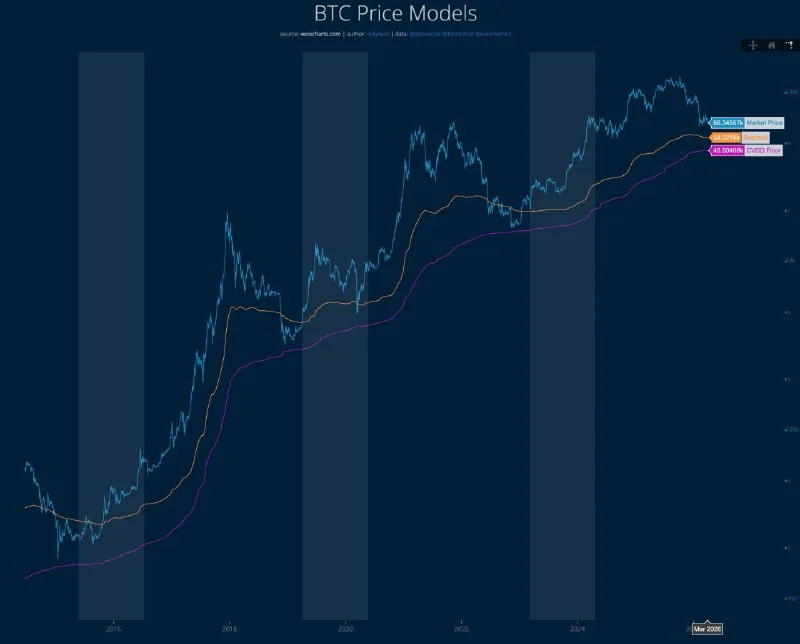
Last time we saw this level of fear coupled with sideways price action was back in late 2020, right before BTC ripped from $20,000 to over $60,000. History doesn't repeat, but it often rhymes. This morning, everyone's passing around Willy Woo's note calling for a potential cycle floor between $54,200 and $45,500. I respect Woo's work—his models are legendary. But in this new era of institutional capital, I think they're missing the bigger picture. The game has changed, and relying solely on models built for a retail-driven market is a mistake. While the market chops around $67,500, I'm not selling my core position. In fact, I'm looking for spots to add.
The elephant in the room is the spot Bitcoin ETF. Woo's CVDD Floor Model is brilliant, but it's calibrated on historical data from a market dominated by crypto natives and retail speculators. Today, we have a completely different animal. The persistent, almost programmatic, daily buying from the likes of BlackRock and Fidelity creates a structural bid that never existed before. A proper bitcoin ETF inflows analysis shows that while the pace has slowed from the February frenzy, we're still seeing net positive inflows on most days. This isn't hot money; it's sticky, long-term allocation capital. This demand creates a much higher, and much firmer, price floor than we've ever had. A drop to $45,500 would imply a catastrophic failure of this new structural demand, and I just don't see the data to support that thesis right now.
This is the core of my disagreement. When I pull up Glassnode, the story is one of strength, not impending collapse. Smart money isn't selling; they're accumulating. Retail might be panicking on Woo's headlines, but the chain tells me everything I need to know. For anyone looking for a solid bitcoin price prediction this week, these are the metrics that matter more than any model.
- Exchange Netflows: We've seen over $1.2 billion in BTC leave centralized exchanges in the past 14 days. Coins moving to cold storage is bullish, period. It's the opposite of what you'd see before a major dump.
- MVRV Z-Score: My dashboard shows the MVRV Z-Score is currently at 2.95. This is a healthy level for a bull market consolidation. The real danger zone, where tops are formed, is typically above 6.0. We are nowhere near that level of euphoria.
- Long-Term Holder Supply: It's still near all-time highs. The diamond hands who survived 2022 aren't shaken by a 10% dip. They're not the ones selling here.
Of course, we can't ignore the macro environment. My colleague Jake Morrison has been covering the geopolitical tensions that could spark a risk-off move across all assets. But increasingly, institutional players are viewing Bitcoin not as a risk-on tech stock, but as a hedge against the very monetary debasement that comes from such global instability. The macro fear could, counterintuitively, drive more capital into BTC.
Another piece of the puzzle is capital rotation. Money isn't necessarily leaving the crypto ecosystem; it's just moving. As Bitcoin consolidates, we're seeing capital flow into high-beta plays in DeFi and other altcoin sectors. The best altcoin season indicators are starting to flash green, not red. This suggests traders are comfortable taking on more risk within the crypto space, which is not what happens when they expect the floor to fall out. For a deeper dive on where that money is flowing, Luna Park's work on the latest DeFi yields is essential reading. It shows an ecosystem that is vibrant, not fearful.
My thesis is simple: the institutional bid provides a floor far higher than historical models suggest. A dip is a buying opportunity, not a reason to panic. I'm watching the $65,500 level, which corresponds with the 21-day EMA on the daily chart, as the first line of defense. Below that, the major support zone I'm interested in is $60,000-$62,000, which was the consolidation range before the last leg up. I would become concerned, and my thesis would be invalidated, if we get a weekly close below $59,000. Until then, I see this as healthy price action designed to shake out weak hands before the next major move higher.
The market is trying to scare you out of your position with old models. The on-chain data and ETF flows are telling you to hold the line.
I'm not saying Woo is wrong—a black swan event could certainly push us down to his levels. I'm saying the underlying market structure makes that path highly improbable without a significant catalyst. The passive, daily demand from Wall Street is a force his models have never had to account for before. So, is relying on pre-2024 cycle analysis the smart play, or is it like trying to navigate a new highway using a map from the 1980s?