

📣 Create Blog for Traders!
Stop Watching news - Start Making it.
START


S&P 500 Dip: Overreaction or Warning Sign for 2026?
The market's reaction to geopolitical news was unusually sharp. Here's my breakdown of key levels, my watchlist, and my S&P 500 trade plan for the week.
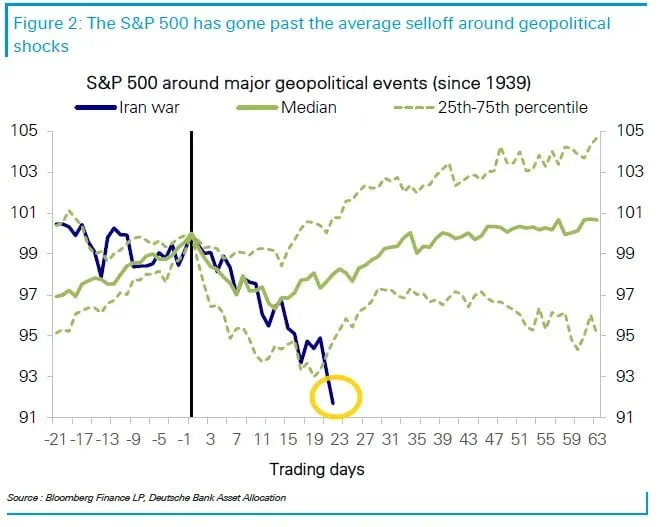
Is this recent geopolitical shudder the 'big one' everyone’s been waiting for? A note from Deutsche Bank hit the wires this morning highlighting that the S&P 500's drop was sharper than the historical average for these kinds of shocks. While the headlines are ugly, my initial analysis suggests this is a volatility event, not a fundamental shift. I'm viewing this as a potential opportunity to add exposure, assuming key technical levels hold.
Last week was a risk-off affair. Escalating tensions overseas sent traders scrambling for safety, pushing the VIX up to 19.5 and knocking the S&P 500 down 3.2% to close at 5,115. The sell-off was broad-based, but high-beta tech and consumer discretionary names took the brunt of the hit. It felt less like panic and more like systematic de-risking heading into the weekend, a classic institutional move.
- Key Support: 5,050. This level represents the 50-day moving average. A bounce here would be very constructive.
- Major Support: 4,980. This is the 100-day MA. A break below this level would signal a more significant correction.
- Initial Resistance: 5,175. The first hurdle to clear on any recovery attempt.
- Major Resistance: 5,260. The prior all-time high.
When I see a market reacting to headlines, the first thing I do is go back to the fundamentals. Has the earnings power of the index fundamentally changed? Right now, the answer is no. The S&P 500 is now trading at a more reasonable 19.5x forward P/E, down from over 21x just two weeks ago. My magnificent seven stocks analysis shows that these companies are sitting on mountains of cash and have incredibly resilient business models. The geopolitical risks that Jake Morrison correctly identified in his oil market breakdown are real, but they don't yet justify a full-blown bear market in equities. I'm still modeling for 8-10% EPS growth for the index this year.
I'm watching two distinct possibilities. First, if support at 5,050 fails, I'll look at a defensive play, likely the Utilities Select Sector SPDR Fund (XLU), as a short-term hedge. Second, and my preferred scenario, is a successful test of that 50-day MA. If we see a strong bullish reversal candle there, I'll be looking to add to high-quality tech names like Microsoft (MSFT). My DCF model for MSFT still suggests a fair value north of $480, offering a solid margin of safety from current levels.
I'm not a hero who tries to catch a falling knife with my entire book. My plan is to scale into the SPDR S&P 500 ETF (SPY). I've already started a small position. My plan is as follows:
- Entry Zone: I will add size between $504 - $508, corresponding to the S&P's 50-day MA.
- Stop Loss: A daily close below the 100-day MA, roughly $495 on the SPY.
- Price Target: I am targeting a retest of the highs, looking for $525 on SPY by summer.
This is a fundamentals-driven trade. My view contrasts with the more cautious global macro picture that Alex Volkov often paints, but I believe US corporate earnings will be the ultimate driver here. The key is a disciplined stock market crash protection strategy—knowing exactly where your thesis is wrong. For me, that's a break of the 100-day.
Let's be clear: I could be wrong. My bull thesis is invalidated if we see a few key things happen. A sustained move in the VIX above 25 would signal real fear, not just a correction. Second, a decisive break and close below the 100-day MA (~4,980) would suggest a much deeper drawdown is underway. But the most important tell would be signs of stress in the credit markets; if high-yield spreads start blowing out, all bets are off.
Geopolitical shocks cause volatility. Strong balance sheets and earnings growth create long-term value. I'm betting on the latter.
Ultimately, this is a test of conviction. The market is offering better prices than it was a month ago, but with more perceived risk. Are you using this drop to de-risk your portfolio, or are you like me, sharpening your pencil and looking for entries?