

📣 Create Blog for Traders!
Stop Watching news - Start Making it.
START


CDS Volumes Surge: Price Action vs. Default Insurance in 2026
US Corporate CDS trading volumes are hitting records, signaling deep fear. I'm breaking down how I'm trading this shift, focusing on direct price action over complex derivatives.
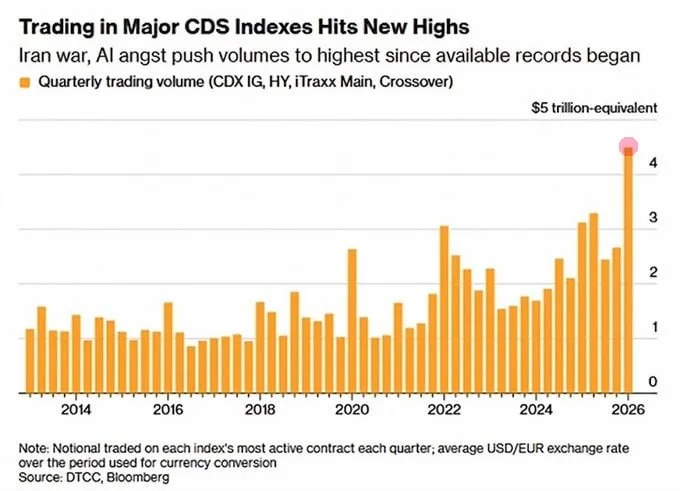
So here's what nobody's talking about loud enough: US corporate Credit Default Swap (CDS) trading volumes are absolutely ripping, hitting all-time highs as of this Monday, April 06, 2026. This isn't just noise; it's the big money, the institutions, screaming about rising default risks in the corporate sector. They're buying insurance, folks. But for us retail traders, the question isn't whether the big boys are hedging – it's how we can capitalize on the fear directly on our charts. Forget the complex CDS contracts; I'm all about pure price action here, and this setup is screaming opportunity if you know where to look. It's a classic head-to-head: do you try to understand the plumbing, or do you just trade the flood?
When CDS volumes break records, it means the smart money is paying top dollar to protect against corporate defaults. The Markit CDX North America Investment Grade Index, for example, has seen its spread widen by 15 basis points over the last two weeks, pushing closer to 120 bps. That tells you treasurers and hedge funds are getting nervous. This isn't some abstract economic theory Emma Blackwood might debate; this is real money protecting real assets. From my experience, when institutions get this defensive, it usually translates into weakness in risk assets, especially those leveraged companies that rely on cheap credit.
I've been tracking this shift. Sarah Chen recently highlighted how hedge fund selling hit a 12-year high, and this CDS action is just another piece of that puzzle. It's a massive capital rotation, and if you're not paying attention to where the capital is flowing *from*, you're gonna get chopped up.
My approach is simple: I don't trade CDS. I trade the reaction. If corporate debt is under pressure, certain sectors and individual stocks are going to get nuked. I'm looking for short setups in companies with high debt-to-equity ratios and declining cash flow. This is where the best day trading setups today will emerge for those willing to go short. I'm not blindly shorting everything, though; you need clear levels.
- Short Setup Target: High-debt regional banks, speculative tech with negative free cash flow.
- Key Level Breakdown: Watch for breaks below the 200-day EMA on the daily chart with heavy volume.
- Volume Divergence: Look for price making new highs on decreasing volume – classic bear flag setup.
- Confirmation: A clean retest of a broken support as new resistance, then a dump.
For example, I'm eyeing a short on a regional bank ETF (ticker I won't name publicly, but you know the type) if it breaks below $48.50. My stop-loss would be a clean close above $49.75, targeting $45.00 initially. That's a solid 1:2.8 R:R right there. This kind of setup aligns perfectly with my day trading risk management rules: define your risk, define your target, and stick to it. No revenge trading if it rips against me; I'm working on that, believe me.
Honestly? For most retail traders, trying to get into the CDS market is like trying to catch a falling knife with your bare hands – complicated, illiquid, and expensive. It's designed for institutional players who need to hedge massive bond portfolios. The bid-ask spreads are wide, and the contracts are complex. You're better off finding a proxy trade. Instead of buying CDS on a company, just short the stock or an ETF that holds those risky bonds. It's cleaner, more transparent, and you can manage your risk with simple stop-losses. This is a classic case where the indirect approach is often superior for nimble traders.
While the record CDS volumes are a blaring siren, it doesn't mean we need to become CDS experts. It just means the macro backdrop is shifting to a 'risk-off' environment. This provides incredible opportunities for swing trading strategies that work 2026, especially on the short side for weaker companies. Think about it: if the big boys are hedging defaults, they're preparing for a world where some companies just can't pay up. That's going to hit their stock prices.
Even in crypto, where Marcus Cole often tracks big liquidations, we could see a flight to quality. While Bitcoin is up today at $69,319.00, if corporate fear really takes hold, even BTC could get hit as liquidity dries up. I'd be watching the $65,000 level on BTC if this CDS fear truly escalates. Right now, it's holding up, but don't sleep on the potential for a nasty wick down.
My thesis here – that rising CDS volumes signal a bearish shift for risk assets and present short opportunities – is invalidated if we see the CDX spreads tighten significantly (say, back below 100 bps). If corporate earnings reports coming out in the next few weeks are surprisingly strong, or if the Fed hints at rate cuts, that could ease default fears. But right now, the charts for high-yield bond ETFs look weak, with the 21 EMA on the 4H acting as strong resistance.
Don't get caught up in the 'why' of institutional hedging. Focus on the 'what' the market is telling you through price and volume. That's where the real money is made for us.
So, while the big players are buying default insurance, I'm out here looking for the companies they're insuring against, ready to short their equity. It’s a cleaner, more direct play. What are you seeing on your charts? Are you fading this CDS fear, or leaning into it?