

📣 Create Blog for Traders!
Stop Watching news - Start Making it.
START


Stablecoin Growth in 2026 Is a Trap (For Bears)
Everyone sees the rising stablecoin market cap and thinks it's new money. It's not. It's a massive capital rotation, and it's the biggest signal I've seen all year.
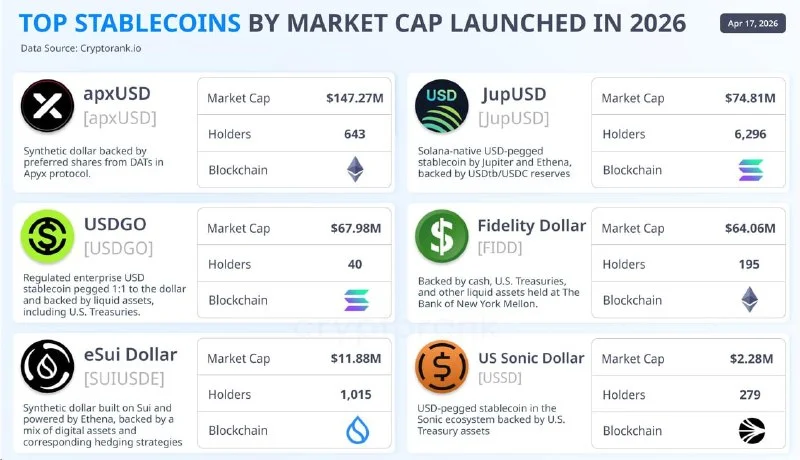
I saw the Cryptorank report making the rounds this morning about the growth in new stablecoins this year, and my entire feed is filled with moonboys screaming 'the institutions are coming!' Slow down. You're watching the wrong ball. This isn't about new money flooding the market—not yet. I've been glued to my Glassnode monitor since 2017, and I can tell you this is a classic pre-ignition signal. This is smart money playing a shell game, repositioning capital for the next major leg up while retail is busy trying to nail the bitcoin price prediction this week. They're building the launchpad while everyone else is staring at the sky.
Let's get this straight. The total stablecoin supply is rising, yes, but the growth isn't coming from a tidal wave of fiat hitting Coinbase. I'm seeing a huge rotation out of legacy stables like USDT and USDC and into newer, often higher-yield or more decentralized alternatives. Think of it less as an invasion and more as an internal migration. This tells me a few things. First, risk appetite within the crypto-native world is increasing dramatically. Traders are moving from the safest dollar-pegs to ones that offer yield or are built on newer protocols. That's a 'risk-on' move, even if spot prices for BTC and ETH are chopping sideways.
- On-chain data shows a divergence: Netflows for USDT on exchanges are flat, while new stables are flowing directly into DeFi liquidity pools.
- Total stablecoin market cap: Up nearly 11% since the start of the year, with new entrants capturing over half of that growth.
- Whale accumulation: Wallets holding >$1M of these newer stables are up 45% since February. That's not retail.
- BTC Dominance is high: Sitting above 54%, which tells me altcoins are being suppressed while this foundational layer is being built.
This is the exact same pattern we saw in the lead-up to DeFi Summer in 2020. Capital was quietly moving into new primitives like Compound and Aave for months before the market went parabolic. While my friend Luna Park is probably dissecting the smart contracts of these new protocols, I’m focused on the flow. The flow always precedes the price.
Yes, I believe it is. Far more than any technical indicator on a chart right now, this stablecoin migration is one of the most reliable altcoin season indicators I follow. Before big money is willing to ape into volatile small-caps, it first tests the waters by moving up the risk curve within the stablecoin ecosystem. It's a canary in the coal mine. This capital is currently being parked, earning yield, and waiting for the right moment. That moment will be a decisive breakout in Bitcoin.
The market is building a massive launchpad out of stablecoins right now. The fuse will be lit when Bitcoin decisively clears $80,000.
This signal doesn't mean 'buy everything' today. It means 'get ready.' My core BTC position is untouched. But I'm building a plan for my altcoin swing trades. While Jake Morrison is watching oil prices react to geopolitical headlines, I see the real macro play right here in the on-chain data. The ethereum price forecast 2026 looks bleak on the ETH/BTC chart right now, but that's precisely the opportunity. That ratio is coiled for a violent reversal once this stablecoin capital gets deployed.
My primary target is ETH. It's sitting at a pathetic $2,319, bleeding against Bitcoin. But once the narrative shifts, all that new DeFi liquidity will flow through Ethereum. I'm setting bids for a leveraged swing trade on ETH around the $2,250 support level, with a target of $3,500 by the end of Q3. This trade is invalidated with a weekly close below $2,000.
Of course, this thesis isn't foolproof. I survived the 2018 crash by always defining my invalidation point. The biggest risk here is regulatory. If the SEC or Treasury decides to make an example out of one of these new, more 'exotic' stablecoins, it could trigger a contagion event reminiscent of the Terra/LUNA collapse. That would shatter confidence and send all this capital fleeing back to fiat, not into alts.
A secondary risk is a true macro 'risk-off' event. If the global situation deteriorates to the point where markets are in freefall, crypto won't be a safe haven. It'll sell off harder than anything else. That's why my hard stop on the entire crypto thesis is a weekly close for Bitcoin below its 200-week moving average, currently around $48,000. But for now, the on-chain data is telling a story of preparation, not panic. The question is, who's listening?