

📣 Create Blog for Traders!
Stop Watching news - Start Making it.
START


Record Stock Buybacks in 2026: The Market's Sugar High
Corporate America is buying back its own stock at a record pace. While the crowd cheers, I see a glaring warning sign for long-term investors.
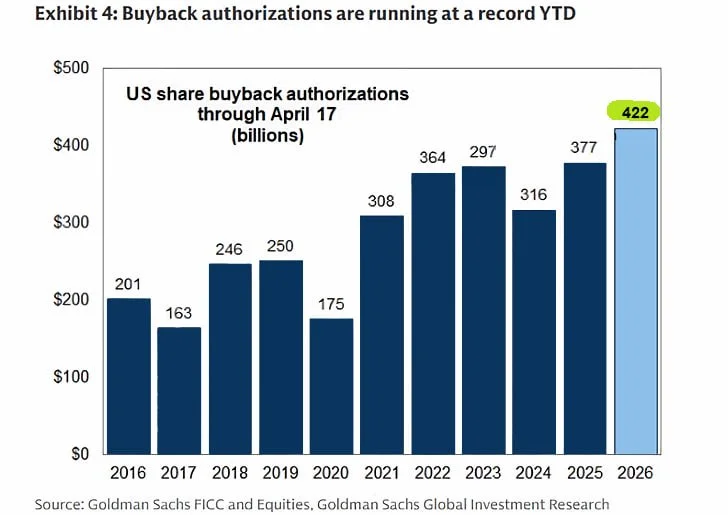
The headlines this week are euphoric. Goldman's data confirms what we've been seeing on the tape: US stock buybacks have already shattered all-time records for 2026. The S&P 500 is pushing highs, and the consensus view is that this corporate cash deployment is a massive safety net for the market. Everyone seems to think this is a clear buy signal. They're wrong. In my stock market analysis this week, I see this not as a sign of strength, but as a symptom of a deeper problem — a massive failure of corporate imagination.
This isn't a safety net; it's a sugar high. Companies are using financial engineering to mask slowing organic growth, and investors are paying a premium for it.
Let's be clear on the numbers. We're talking over $500 billion in authorized buybacks year-to-date. This is an unprecedented pace. The bull case is simple: fewer shares outstanding means higher Earnings Per Share (EPS). A company with $10B in earnings and 1B shares has an EPS of $10. If it buys back 10% of its shares, its EPS magically jumps to $11.11 without earning a single extra dollar. This is what's propping up valuations.
The quants and momentum traders love this. I can imagine someone like Alex Volkov building a model that simply buys the companies with the biggest buyback programs. And for a while, it works. But as a fundamental analyst, I have to look under the hood. I used to spend my days at Goldman reading 10-K filings, and the story is always in the footnotes. Right now, the footnotes show that while share counts are shrinking, revenue growth for many of these same companies is anemic.
Yes, I believe they are. The most telling data point for me isn't the buyback number, but the Capital Expenditure (Capex) figure. Corporate investment in future growth—new factories, R&D, technology upgrades—is nearly flat. The latest data showed Q4 2025 Capex growth at a paltry 1.2%, barely keeping pace with inflation. When a management team sees more value in shrinking the denominator (shares) than growing the numerator (earnings), it's a red flag.
They are choosing short-term stock price boosts over long-term innovation. This is particularly prevalent in mature tech giants like AAPL and MSFT, who are responsible for a huge chunk of these buybacks. Their core markets are saturated, and instead of taking big risks on the next paradigm-shifting technology, they're placating Wall Street with financial maneuvers. It's a safe bet, but it's not a growth strategy.
I'm not running for the hills and selling everything. But I am making significant adjustments. This environment has me rotating out of companies whose EPS growth is primarily buyback-driven and into businesses demonstrating real, organic growth. I'm focusing on what I believe are the best dividend stocks to buy 2026, but with a twist. I don't just want yield; I want 'growth-yield'.
- Sustainable Dividends: A payout ratio under 60% shows the dividend isn't starving the company of cash.
- Capex Reinvestment: I want to see Capex as a percentage of revenue staying stable or, ideally, growing year-over-year.
- Real Revenue Growth: Top-line growth of at least 5% annually, proving they aren't just cutting their way to profitability.
- Reasonable Valuation: I'm avoiding anything with a forward P/E over 20x. The S&P 500 currently trades at 21x forward earnings, which is historically rich.
This is a very different approach from a macro trader like Jake Morrison, who is likely focused on how geopolitical tensions in the Middle East might create volatility. While he's watching oil prices, I'm digging through cash flow statements. Both are valid, but my fundamental view is that this internal corporate behavior is a more significant long-term risk than any single headline.
My cautious stance is invalidated if two things happen. First, if the earnings season preview Q1 2026 turns out to be sandbagging and we see a massive re-acceleration in organic revenue growth across the board. If companies start posting 10-15% top-line growth, then the buybacks are just a cherry on top. I don't see that happening given the macro backdrop.
The second, and more likely, risk to the buyback trend itself is interest rates. A significant portion of these buybacks are funded with cheap debt. If the Fed has to hold rates higher for longer than anticipated, or even hike again, the math for debt-funded buybacks falls apart. That's the pin that could pop this specific bubble. The cost of capital would rise, and companies would be forced to pull back, removing the single biggest buyer from the market.
So, as we head toward Friday's close, I'm holding my core positions but have raised my cash allocation to 15%. I've set tight stop-losses on my high-multiple growth names. I'd rather miss a little more upside from this buyback frenzy than get caught in the inevitable hangover. The market can remain irrational longer than you can remain solvent, but fundamentals always, eventually, matter.
At what point does 'returning capital to shareholders' become a confession of 'a total failure of corporate imagination'?