

📣 Create Blog for Traders!
Stop Watching news - Start Making it.
START


Crypto Fear Hits Max: My DeFi Strategy for This Dip
The CoinMarketCap fear index is screaming panic. Here’s how I'm using on-chain data to find opportunities everyone else is missing.
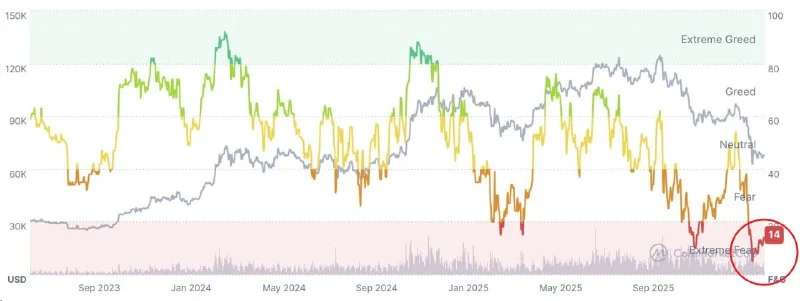
My entire feed this morning is a sea of red. Bitcoin just sliced through $66,000, Ethereum is struggling to hold $3,500, and the CoinMarketCap 'Fear & Greed' index is apparently at its historical maximum for gloom. Total panic. While traders like Marcus Cole are probably staring at 4-hour charts looking for a bounce, I'm doing the opposite. I'm turning off the price alerts and opening my DefiLlama dashboard. Because in DeFi, fear is a signal, but it's not a signal to sell. It's a signal to hunt for quality.
Price is just sentiment. It's a lagging indicator of human emotion. On-chain data, however, shows action. It tells you where capital is *actually* flowing, not just what people are screaming about on Twitter. When the market nukes, the first thing I check isn't the price of ETH; it's the Total Value Locked (TVL) stability in protocols like Aave and MakerDAO. Is the 'smart money' pulling liquidity, or are they holding firm? Are protocol revenues declining, or are they increasing from liquidation fees? This is the core of a proper DeFi risk assessment. Price charts show the panic; on-chain data shows the plan.
I'm not trying to catch a falling knife. That's a gambler's game. My goal is to use the market dislocation to my advantage by allocating to protocols that are built to withstand this kind of storm. It's a simple, three-step process I've refined since my early days farming YAMs at 3 AM back in 2020.
TVL is a vanity metric. It's easily manipulated by mercenary capital that will flee at the first sign of trouble. Protocol revenue, on the other hand, is proof of product-market fit. It means people are actually *using* the dApp and are willing to pay fees for it. I look for protocols whose daily fees remain stable or even increase during a downturn. This shows a sticky user base and a resilient business model, which is the foundation for any long-term `yield farming strategy 2026`.
I can't stress this enough: if you can't read the audit, you shouldn't invest. I’ve been burned by three rug pulls in my career, and every single one could have been avoided by checking contract ownership and timelocks. I don't just see a checkmark from a top audit firm and move on. I read the report. I look for the severity of findings, centralization risks, and any special privileges given to the admin keys. A clean audit in a fearful market is a massive green flag.
This is my obsession, and it’s where the real opportunity lies right now. RWA tokenization is the bridge. When on-chain speculative yields are collapsing, protocols that generate yield from off-chain, real-world sources become incredibly attractive. I'm talking about tokenized U.S. T-bills, private credit, and real estate. The yield might only be 5-10%, but it's uncorrelated to crypto market sentiment. This is the stuff that will finally trigger meaningful `institutional DeFi adoption`. It's a completely different risk profile than the high-leverage perpetuals trading that Alex Volkov covers, offering a stable foundation in a volatile market.
Let's make this practical. I've been increasing my exposure to protocols that are heavily invested in RWAs. MakerDAO (MKR) is the obvious blue-chip example. It has weathered every storm crypto has thrown at it, and a huge reason is its diversification into stable, off-chain collateral.
- Protocol: MakerDAO (MKR)
- Current RWA Exposure: Over $2.5 Billion in assets
- Source of Yield: Primarily US T-Bills and corporate bonds
- My Risk Assessment: Low smart contract risk (battle-tested for years), moderate centralization risk via RWA partners (the main thing to watch).
By holding MKR, I'm getting exposure to the fees generated by a protocol that is increasingly backed by the most stable collateral in the world. While everyone else is panicking about the price of SOL dropping 7%, Maker is quietly earning yield from the TradFi system. That’s my kind of play.
The single biggest mistake is chasing phantom yields. In every downturn, a dozen new protocols pop up offering a 2,000% APY on some new governance token. It's a trap designed to drain your liquidity. The insane APY comes from printing a worthless token into oblivion. Your token count goes up, but the dollar value goes to zero. Don't be exit liquidity. Sustainable yield is boring. It's in the single or double digits. And it's the only kind that survives a bear market.
In a market screaming 'sell,' the smartest move is to find what's quietly being built and bought. Look for revenue, not just hype.
This fear is a filter. It's washing out the weak-hand tourists and the unsustainable projects. The protocols that maintain users and revenue *right now* are the ones that will dominate the next cycle. I'm not selling my core DeFi positions in AAVE or UNI. I'm using this as an opportunity to rotate my stablecoin reserves out of low-yield pools and into these RWA-backed strategies. The real question isn't *if* you should buy this dip, but *what* part of the digital economy you are actually buying into. Are you betting on a short-term price bounce, or are you investing in long-term, sustainable cash flow?