

📣 Create Blog for Traders!
Stop Watching news - Start Making it.
START


Tech Correlation Hits 10-Year Low: Time to Short QQQ?
The Magnificent 7 are no longer moving in lockstep. Here's my breakdown of fading the index versus picking winners and losers in a fractured market.
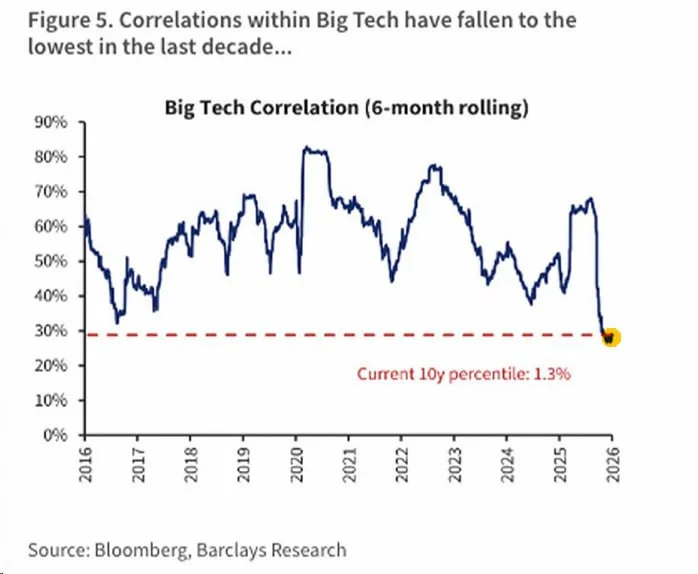
Last time we saw a divergence this wide among market leaders was heading into the choppy markets of 2018. The generals weren't marching together, and it led to a nasty drawdown. Now, Barclays data shows the positive correlation between US Big Tech stocks has cratered to its lowest level in a decade. The whole 'Magnificent 7' trade is fracturing. Some traders see this and immediately want to short the QQQ. They think it’s a sign of a major top. I see it differently. This is where a deep understanding of support and resistance trading separates the pros from the crowd.
The logic is simple enough. If the biggest stocks that hold up the market are no longer rising together, the index itself must be weak. It’s like an engine sputtering on half its cylinders. The play here is to short an ETF like the QQQ or use options to bet on a downside move for the whole NASDAQ 100.
This is a macro bet. You're saying the entire structure is faulty and due for a fall. The problem? It's a blunt instrument. You could be 100% right that five of the seven giants are rolling over, but if NVDA and META decide to rip another 10%, you're going to get squeezed hard. I’ve seen it happen. This is the kind of top-down view that Alex Volkov is great at spotting, but for a guy like me who lives on the 15-minute chart, it feels imprecise and leaves too much to chance.
This is where I live. Forget the index. A breakdown in correlation is a gift for a price action trader. It means individual stock character matters again. It means fundamentals, which Sarah Chen covers so well, are actually creating dispersion in price. For me, the chart is all I need. The money isn't in predicting the direction of the whole market; it's in identifying the strongest horse and the weakest donkey.
This environment is where you find the best day trading setups. You go long the stock making higher highs on volume and short the one that can't even reclaim its 50-day moving average. You're trading relative strength and weakness, which is a much higher probability game than just guessing if the Fed is going to spook the entire market.
Just pull up a chart of NVDA next to AAPL. It's night and day. NVDA is in a clean, beautiful uptrend. I'm looking for dips toward the $900 psychological level to get long, with a clear stop below the prior swing low. It's a textbook breakout-retest play. On the other hand, AAPL has been struggling below its 200-day moving average for weeks, currently hovering around $170. Any weak rally on low volume is a potential short entry for me. Why on earth would I bundle these two opposite stories into a single bet on the QQQ?
- Precision: Index Fade is low precision. Stock Picking is surgical.
- Risk Management: Index stops are wide and macro-based. Stock Picking stops are tight and chart-based.
- Profit Potential: Index Fade offers a huge win if you nail a crash. Stock Picking offers consistent, repeatable wins.
- Required Skill: Fading requires timing the entire market. Picking requires reading a single chart.
For me, it's not even a contest. The stock picker's approach wins, hands down. Trying to call a major market top is a fool's errand. I should know; my old trading journals are littered with the expensive lessons I learned trying to be a hero. It's a quick way to trigger my worst habit: revenge trading. I get stopped out shorting a strong market, then I get angry and try again with a bigger size. Disaster.
I'll stick to what works. Follow the volume. Trade the setups on the screen in front of me. This divergence isn't a warning sign; it's a massive green light for active traders. The real edge isn't predicting the crash; it's exploiting the chaos before it happens. One of the best swing trading strategies that work is simply buying strength and selling weakness, and this market is serving those setups on a silver platter.
In a market where the generals are fighting each other, you don't bet on the war ending. You pick the winning soldier for today's battle.
The herd is asking if the market is about to nuke. I'm asking a different question. Are you focused on which stock is the absolute best long and which is the absolute best short on your watchlist right now?