

📣 Create Blog for Traders!
Stop Watching news - Start Making it.
START

That Polymarket Bet Wasn't Luck, It Was a Trade
Everyone is screaming 'insider info' about the trader who won big on the US-Iran strike bet. They're missing the point. The charts were telling the story all along.
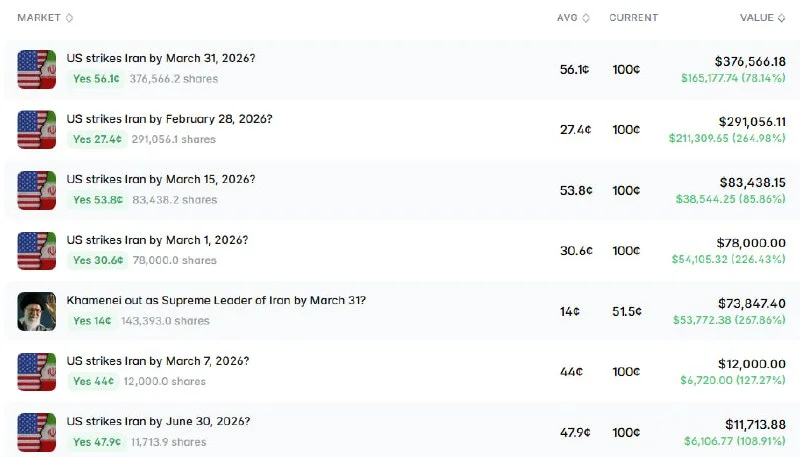
So here's what nobody's talking about regarding that massive Polymarket win. The entire internet is losing its mind, screaming 'insider info!' or 'insane luck!' over that US-Iran strike bet. Give me a break. Calling it luck is the laziest analysis I've ever heard. As a trader, you learn one thing fast: the market prices in fear and greed long before it hits the headlines. This wasn't a lottery ticket; it was a calculated, asymmetric bet based on pure price action.
When news like this breaks, everyone rushes to find a narrative that fits. The idea of some shadowy figure with government contacts makes for a great story. It's way more exciting than staring at candles on a 4-hour chart. But the real story is almost always in the price. I've been trading full-time since 2019, and I've seen this pattern play out over and over. Geopolitical tension doesn't just appear out of nowhere; it builds, and that building pressure shows up in key assets.
Forget the news for a second and look at the chart of crude oil (WTI) in the two weeks leading up to the end of February. What do you see? I saw a slow, grinding consolidation pattern forming right above the key support level of $75/bbl. Volume was drying up, which is classic. It's the quiet before the storm. The market was coiling up like a spring, and any catalyst was going to send it flying. That, right there, is one of the best day trading setups you can find, and it applies to swing trades too.
This trader wasn't betting on a specific intelligence report. They were betting on a volatility expansion. They saw the same thing I did: a market primed for a move. It's like what Alex Volkov often points out—the market is just a machine for processing human emotion on a massive scale. And the emotion was fear.
- WTI Daily Chart: A series of higher lows forming a clear ascending triangle against horizontal resistance at $79.
- Volume Profile: A massive drop-off in volume above $80, indicating little supply was left to stop a rip higher.
- RSI(14) on 4H: A hidden bullish divergence was forming. Price was flat, but the RSI was quietly creeping up. This is a subtle but powerful RSI divergence strategy.
- Open Interest: A spike in call options on oil futures expiring in March. Big money was placing its bets.
You put those pieces together, and the Polymarket bet starts to look less like a wild guess and more like a hedge or a speculative position with an absolutely insane risk/reward profile. The odds were long, sure, but the technical picture supported a high-impact event.
This is a concept that many fundamental-focused analysts just don't get. My friend Sarah Chen is brilliant with balance sheets, but she'd look at this bet and see a 99% chance of failure. A trader sees the 1% chance of a 100-to-1 payout. That's the game. This is one of those swing trading strategies that work precisely because they fail most of the time, but the one win pays for all the small losses and then some.
I've taken trades like this myself. Not on Polymarket, but using far out-of-the-money options on stocks heading into earnings. Most expire worthless. But the one time you nail it, it makes your quarter. The hard part is managing the psychology. A win this big can make you feel like a genius, and that's dangerous. It's a fast track to getting reckless and revenge trading after your next inevitable loss. Trust me, I've made that mistake more times than I'd like to admit—it's still my biggest weakness.
Could I be wrong? Absolutely. Maybe the guy's uncle is a four-star general. It's possible. But it's also the least likely explanation and, more importantly, it's not a repeatable process. My entire edge is built on finding patterns and setups that I can trade again and again. The 'insider info' angle is a trading dead-end.
The real risk here isn't misinterpreting this one event; it's encouraging new traders to gamble on low-probability outcomes without understanding the underlying structure. For every trader who won this bet, I guarantee you 999 others have blown up their accounts trying to catch similar lottery tickets without an edge.
Stop looking for conspiracies and start looking at your charts. The market tells you everything you need to know long before the news does.
Ultimately, we'll never know for sure. But as traders, our job is to deal in probabilities, not certainties. And the charts showed a much higher probability of a violent move than the talking heads on TV would have you believe. So instead of asking if that trader was lucky, maybe the better question is: what high-conviction, low-probability setup are you ignoring on your own charts right now?