

📣 Create Blog for Traders!
Stop Watching news - Start Making it.
START


Global Stocks Fall; Is South Korea's Plunge a Warning?
The KOSPI just had its worst day since 2008. This isn't just a regional issue; it's a potential stress test for global risk appetite that I'm watching closely.
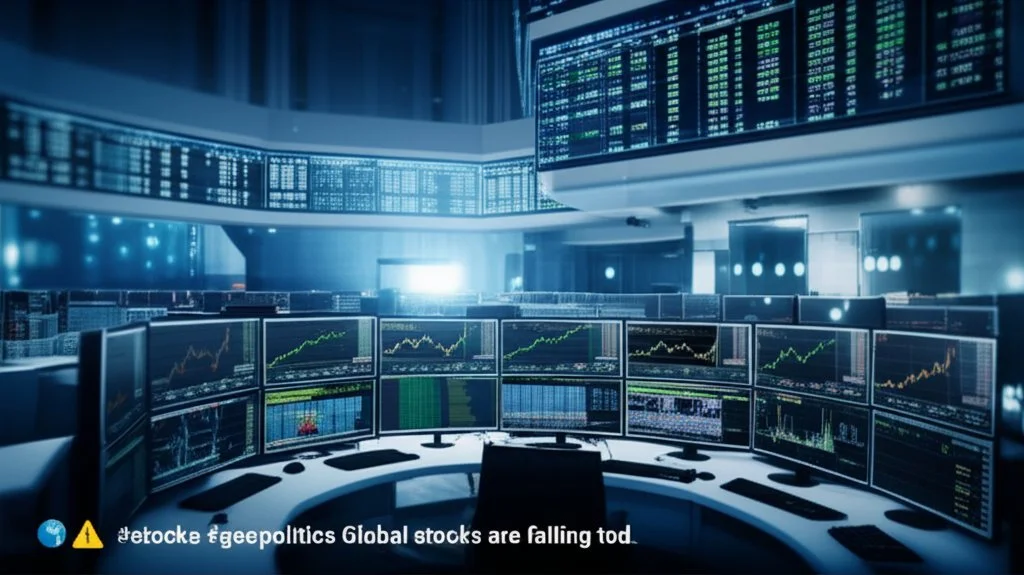
The sharp sell-off in South Korea this morning isn't an isolated event; it’s a potential canary in the coal mine for global risk appetite. Scanning my pre-market screens, the sea of red originating from Asia was impossible to ignore. While many traders focus solely on domestic headlines, my time at Goldman taught me that significant regional shocks often have a nasty habit of going global. And a drop of this magnitude in a key export-driven economy like South Korea demands our full attention.
South Korea's benchmark KOSPI index experienced its most severe single-day percentage drop since the 2008 Global Financial Crisis. We're talking about a significant deviation, not just a minor dip. This matters because South Korea is a bellwether for global trade and technology manufacturing—think semiconductors and electronics. A shock to its system often signals deep concerns about global demand or, more worrisomely, escalating geopolitical tensions in the region. The currency, the Won, also took a significant hit, which complicates things for foreign investors.
So, how does this affect the stock market outlook today here in the US? Fear is contagious. My immediate concern is how this risk-off sentiment translates to the S&P 500. My current S&P 500 price forecast requires a re-evaluation of key support levels. While Jake Morrison might focus on the pure technicals of the chart, I'm looking at the fundamentals this impacts. A global growth scare could hit the earnings estimates for multinational tech and industrial giants that make up a huge slice of the index. We're already seeing futures react negatively.
You can't analyze this move without considering the geopolitical backdrop. While the headlines are vague, this kind of market reaction is rarely just about a bad economic print. It often stems from something more systemic. It's a reminder that macro and political risk are not just abstract concepts; they can wipe out portfolio value overnight. I'd recommend reading Alex Volkov's latest brief on global tensions, as his insights are likely very relevant to what's unfolding.
In moments like these, the conversation inevitably turns to defensive positioning. The frantic search for the best dividend stocks to buy begins. My strategy doesn't change much, because I always favor companies with fortress balance sheets and durable cash flows. But in a risk-off tape, these names become havens. I'm reviewing my holdings in consumer staples and healthcare, trimming anything with high international revenue exposure (especially to Asia), and raising a bit of cash. Panic is not a strategy, but prudence is.
Don't dismiss regional shocks. The 1997 Asian Financial Crisis started in Thailand. Today's tremors often become tomorrow's earthquakes.
- S&P 500 (SPX) Support: I'm watching the 5,150 level. A break below that on high volume would signal further downside to me.
- US Dollar Index (DXY): A flight to safety could push the DXY higher. A move above 105.50 would pressure equities and international markets further.
- Volatility Index (VIX): Is this a sustained fear event? I need to see the VIX close above 18 to believe this has legs.
Ultimately, the key question is whether this is a temporary, sentiment-driven sell-off or the first sign of a fundamental crack in the global growth story. My gut tells me to be cautious and respect the price action. Is this a moment to trim risk, or is it the dip-buying opportunity aggressive investors have been waiting for?