

📣 Create Blog for Traders!
Stop Watching news - Start Making it.
START


Iran Sell-Off: A Gift for Value Investors in 2026
The market is panicking about geopolitics. I'm calmly buying undervalued quality stocks. Here's my watchlist and why this fear is a classic overreaction.
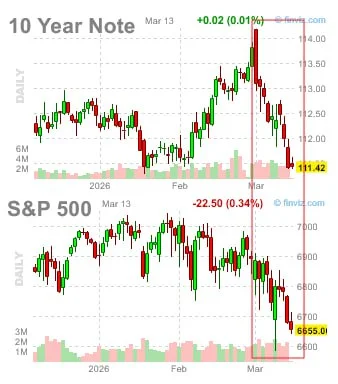
The headlines are screaming about Iran, the S&P 500 is down 3.5% this week, and bonds are selling off in tandem. Good. The market needed this reality check. For weeks, we've been floating on stretched valuations and ignoring a 10-year Treasury yield creeping towards 4.8%. This geopolitical flare-up isn't the fundamental reason for the drop; it's the convenient catalyst that finally gave twitchy algorithms permission to hit 'sell'. While traders like Jake Morrison might see this global crisis talk as just noise for short-term crypto plays, for long-term equity investors like me, this is where the opportunities appear.
Let's be methodical. Before this week's news, the S&P 500 was trading at a forward P/E ratio of nearly 22x, well above the 10-year average of 18.5x. That's frothy. The equity risk premium—the extra return you expect for holding stocks over risk-free bonds—was getting dangerously thin. The market was priced for perfection, and the situation in Iran is, admittedly, far from perfect. But is it a reason to dump high-quality American companies with pristine balance sheets?
I argue it's not. This isn't a systemic crisis (yet). It's a risk-off event that's indiscriminately punishing good and bad companies alike. My work, going back to my time at Goldman, has always been about separating the signal from the noise. The noise is the 24/7 news cycle. The signal is in the cash flow statements and the balance sheets. The real story is that you can now buy best-in-class businesses for 5-10% cheaper than you could last Friday. I've been deploying cash this week, and I'm not losing a minute of sleep over it.
Everyone wants to know if the tech giants are finally on sale. The answer is: it's getting interesting. They were, frankly, priced to perfection. Take Microsoft (MSFT) as an example. It dropped from $450 to around $425. Before the dip, it was trading at a forward P/E of 35x. Now, it's closer to 32x. Is it objectively cheap? No. But this is a fortress company projected to grow its Azure cloud business by over 25% this year. A 5% discount on a compounder like that is a decent entry point for a long-term position. I've been building a position in MSFT since it broke below its 50-day moving average, with an initial tranche at $430.
Nvidia (NVDA) is a different beast. The sell-off has knocked it down almost 8%. Its valuation is still astronomical by any traditional metric, but its earnings growth is undeniable. For me, the risk/reward here is less clear. I'm watching it, but I'm not buying it. The risk of supply chain disruption, however remote, adds a layer of complexity that doesn't exist for a software-dominant player like Microsoft.
In this environment, I'm leaning into quality and dividends. These are some of the best value stocks undervalued by a market obsessed with macro headlines. My personal spreadsheet of earnings surprises shows that in times of uncertainty, companies with predictable cash flows and shareholder returns consistently outperform.
- Procter & Gamble (PG): A classic defensive play. People don't stop buying toothpaste during geopolitical conflicts. The stock is down 4%, pushing its dividend yield to a more attractive 2.9%. It's a boring, beautiful cash-flow machine.
- Lockheed Martin (LMT): This is the obvious geopolitical play, but it's also a value and dividend story. It trades at a forward P/E of 16x with a solid 2.7% yield. Its order backlog provides years of revenue visibility.
- UnitedHealth Group (UNH): Healthcare is another defensive sector. UNH has been beaten down over regulatory concerns, but this dip has pushed its P/E to below 18x, a multi-year low for a company that has consistently grown earnings by double digits.
I am not naive. A full-scale, prolonged conflict that closes the Strait of Hormuz would be a game-changer. That's the black swan here. If Brent crude spikes and holds above $120/bbl, the resulting inflation would force the Fed's hand and likely trigger a genuine recession, not just the mild correction we're seeing now. This is the single most important variable I am tracking. I'm keeping a very close eye on the analysis from macro experts like Alex Volkov on this front, because a sustained energy crisis would make my entire 'buy the dip' strategy look foolish. My risk management is simple: a daily close on the S&P 500 below its 200-day moving average (currently around 4,850) would force me to significantly reduce my exposure.
Geopolitical panics are the market's periodic gift to fundamental investors. While everyone else is selling the headline, I'm buying the footnotes in the 10-K.
For now, my DCF models show that the intrinsic value of the companies I'm buying hasn't changed one bit this week. Their stock prices have. That's a disconnect I'm happy to exploit. Is buying into this fear the smart, contrarian move, or am I underestimating the potential for this conflict to spiral into a true global crisis? Let me know your take.