

📣 Create Blog for Traders!
Stop Watching news - Start Making it.
START


Hartnett's 2008 Warning: Value Stocks vs. Big Tech 2026
BofA sees echoes of the financial crisis. My analysis on whether to pivot to undervalued stocks or stick with big tech's momentum.
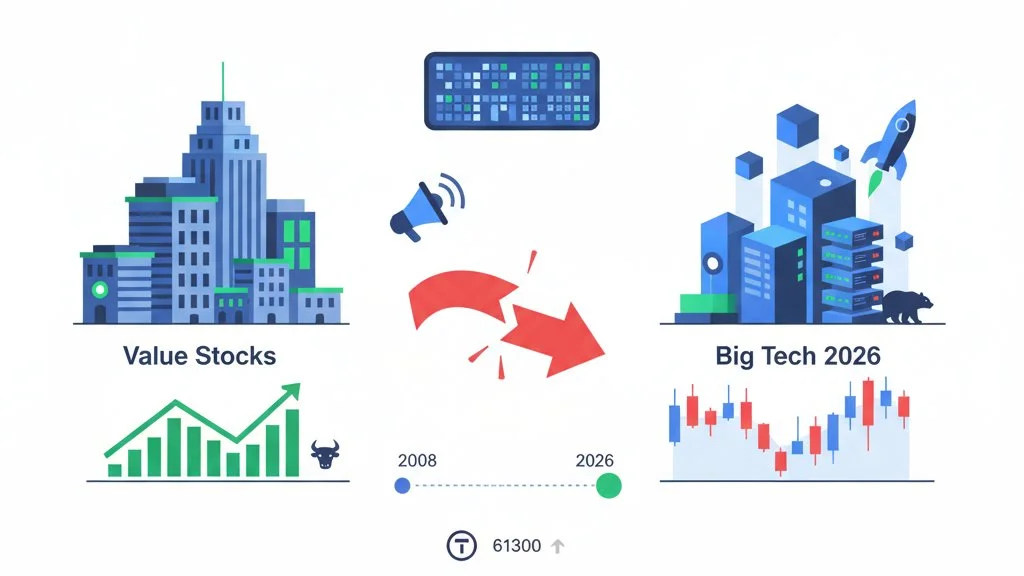
WTI Crude broke $95 a barrel this week. That number alone should give any strategist pause. When I saw Michael Hartnett's note from BofA floating around, connecting high oil prices and stress in private credit to 2008, it wasn't just another headline. It was a direct hit on two of the market's biggest blind spots right now. Everyone's chasing the latest AI stocks to buy now, but the plumbing of the system—credit and energy—is starting to make some unnerving noises.
Let's be clear. Hartnett isn't just fear-mongering. The two pillars of his argument are solid. First, oil. Sustained prices above $90-$100 act as a tax on the consumer and a direct input cost for nearly everything, squeezing corporate margins. We saw this movie play out before the Great Financial Crisis. Second, and what I find more concerning, is the opacity of the private credit market. After years of ZIRP, trillions flowed into this space. Now, with rates higher, we're hearing whispers of trouble. I'm tracking a few large credit funds, and one just marked down a major loan to a PE-backed software firm by 70%. That's not a headline you'll see on CNBC, but it's the kind of thing you find digging through filings—the real story is always in the footnotes.
If you believe a storm is coming, the playbook is simple. You want companies that sell things people need, not just want. Think consumer staples, healthcare, and select industrials with bulletproof balance sheets. I'm talking about names like Procter & Gamble ($PG) or Johnson & Johnson ($JNJ). They won't give you the exhilarating ride of a tech stock, but their low betas and stable dividends can feel like a godsend in a downturn. My screener is currently focused on finding the best value stocks undervalued based on a few key metrics:
- Forward P/E below 15x
- Debt-to-Equity ratio under 0.5
- Consistent free cash flow growth (>5% annually)
- Dividend yield above the 10-year Treasury
These companies don't need access to capital markets to survive; they generate their own. It's a boring strategy, but it's the one that keeps you in the game when things get ugly.
On the other side of the trade, you have the momentum crowd. Their argument? Comparing today's tech behemoths to the fragile banks of 2008 is apples and oranges. My colleague Jake Morrison often argues for trading the chart, not the fear, and there's a strong case for that here. A proper magnificent seven stocks analysis shows companies like Microsoft ($MSFT) and Google ($GOOGL) are effectively fortresses. They have more cash than many countries, dominate their respective fields, and are at the forefront of the biggest technological shift of our generation: AI.
Sure, a 35x forward P/E on a name like Nvidia ($NVDA) seems steep. But my DCF model, assuming even a conservative deceleration in growth, still suggests upside if they continue to execute on their AI roadmap. Unlike the flimsy, debt-fueled growth of the pre-2008 era, this is growth backed by massive free cash flow and genuine technological moats. The argument is that these companies *are* the new defensive plays because their products are non-negotiable for modern business.
No, but the risks are rhyming. The core difference is the banking system. Post-2008 regulations have made systemically important banks far more resilient. The risk hasn't vanished; it has simply migrated from public balance sheets to the shadowier worlds of private equity and private credit. The trigger might not be subprime mortgages, but a cascade of defaults in an opaque, highly-leveraged market could produce a similar credit crunch. Macro expert Alex Volkov would likely agree that the specific vehicle of contagion is different, but the systemic risk of leveraged bets going bad remains.
The market isn't set up for a 2008 repeat, but it's ignoring the systemic risk that has simply moved from Wall Street banks to private credit funds.
From my years at Goldman, I learned that you don't fight the primary trend, but you absolutely must respect risk. The momentum in AI and big tech is undeniable. However, the warnings from the credit and energy markets are too loud to ignore. My personal strategy heading into Q2 2026 is a barbell approach with a heavy tilt towards quality and value.
I have been trimming my highest-flying tech positions—specifically taking about 20% off my $NVDA position—and reallocating that capital into the healthcare and consumer staples sectors. I'm not selling out of growth entirely; that would be a mistake. But I am rebalancing to increase my allocation to companies that can weather a significant economic slowdown. Risk-adjusted, the expected return from a boring utility stock with a 5% yield looks much more attractive to me right now than chasing another 10% in an already over-extended tech name.
So, which is it for you? Are you betting on the fortress balance sheets of Big Tech to power through any storm, or are you quietly building a portfolio of defensive value names, preparing for a credit event that most of the market is ignoring?