

📣 Create Blog for Traders!
Stop Watching news - Start Making it.
START


S&P 500 on Hyperliquid: My Breakout Retest Trade Plan
The S&P 500 is now tradable on a DEX. Huge. But most traders will get rekt. Here’s the exact price action setup I'm using to trade it.
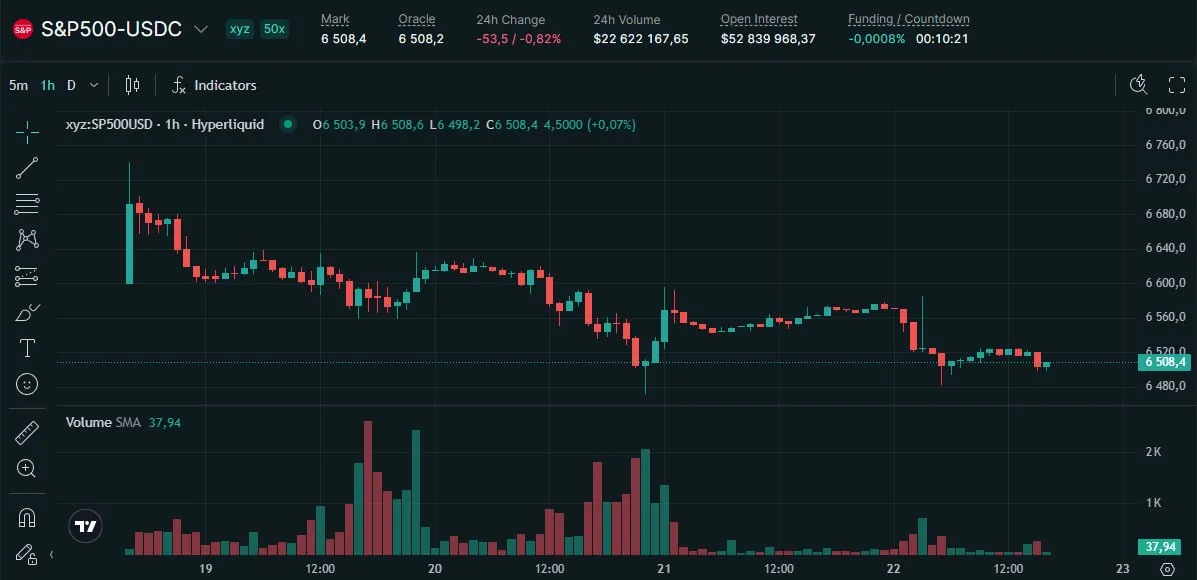
So the news dropped this week: the S&P 500 is officially coming to Hyperliquid. This isn't some synthetic cooked up in a lab; S&P Dow Jones Indices gave it the nod. This is a massive bridge between TradFi liquidity and the degen world. While guys like Alex Volkov are probably tearing apart the smart contracts, I'm looking at one thing: the chart. Because a new, liquid market means incredible opportunities for pure price action traders like me. But it also means a graveyard for undisciplined accounts.
Let's be real. Most people are going to treat this like another altcoin, throwing leverage at it 24/7 and getting completely wiped out. They'll forget this index has a personality shaped by decades of market opens, FOMC meetings, and NFP data. I'm excited, but I'm not stupid. The principles don't change just because the venue did.
For the first time, we have permissionless, 24/7 access to one of the most important indices on the planet. No more waiting for the NYSE open. No more gaps over the weekend unless you're trading futures. This is a huge unlock. It means we can trade reactions to Asian session news or European data prints in real-time on a US index. The volume that could flow into this will be insane.
But more volume means more sophisticated players, and more ways to get chopped up. If you don't have a plan, you are the exit liquidity. You have to go in with a time-tested setup you can execute without emotion. For me, that's the breakout retest. It keeps me out of chasing stupid pumps and forces me to wait for confirmation.
The best day trading setups today focus on high-probability entries at key support and resistance. My go-to is the breakout retest, which confirms a level has flipped from resistance to support (or vice-versa) before entering. This gives you a crystal-clear invalidation point and helps avoid buying into fakeouts.
This single setup filters out 90% of the noise. It forces patience. Instead of guessing where a top or bottom is, you're reacting to what the market has already proven. Price breaks a key level, showing strength. Then it comes back to check if that level holds. If it does? The odds are now stacked in your favor.
- Identify a Clean Level: Look for a clear horizontal resistance on the 1H or 4H chart. The more times price has touched it and been rejected, the better. This is your battleground.
- Wait for the Break & CLOSE: The price must smash through that level and, most importantly, a full candle must close above it. A wick doesn't count. Volume should be noticeably higher on the breakout candle. This is your confirmation.
- Enter on the Retest: This is where the money is made. Don't chase the pump. Wait for price to pull back and touch the old resistance level, which should now act as support. Your entry is the first sign of a bounce off that level. Stop loss goes just below.
Theory is useless without practice. I used this exact setup on SOL/USD last week. For days, SOL was getting smacked down at the $85.50 resistance. The 4H chart showed it getting rejected three separate times. The range was getting tight.
On Thursday, we got a huge volume spike and a 4H candle closed firm at $86.10. That was the signal. Amateurs fomo'd in and pushed it to $87. I waited. Over the next few hours, it bled back down, right to my level at $85.50. As soon as a bullish engulfing candle formed on the 1H chart right off that new support, that was my entry. Learning how to read candlestick patterns like that is non-negotiable.
I took the long at $85.75, with a stop at $84.90. My first target was the prior swing high around $90.00. It was a textbook, low-stress trade that banked over a 4R profit. This is the setup I'll be hunting on the new SPY perp.
People will completely ignore context. They'll forget that the S&P 500 isn't a memecoin; it's driven by real-world economics. While I'm a price action purist, I know that ignoring major data prints or earnings season is suicide. An analyst like Sarah Chen might be looking at P/E ratios, and while that doesn't dictate my entry, it gives me an idea of the market's mood.
The other killer is the 24/7 access. It's a blessing and a curse. Take a bad loss at 2 AM? The temptation to revenge trade will be massive. It's my own Achilles' heel, and something I have to actively manage by sticking to my session times and immediately walking away from the desk after a rule break. My trade journal is my therapist.
The S&P 500 on a DEX isn't an excuse to gamble. It's an opportunity to apply disciplined strategy to a world-class asset.
So yes, I'm ready for this. I've got my key daily and weekly levels for the S&P marked up on my whiteboard, ready to go for Monday. I'll be watching for my setup and nothing else. The big money isn't made in the trading, it's made in the waiting. What's the first major level you're setting an alert for on this new chart?
Read More on TradersWeek:→ FTMO vs TopStep: My Pick for Trading Energy News in 2026→ SP500 'Trump-Dive' Is a Trap: My Levels to Buy the Dip→ A Priest for Diamonds? My Prop Firm Trading Take 2026
SPY chart · Powered by Finviz
Trading ToolsStock Screener · Crypto Heatmap · S&P 500 Map · Try FINVIZ Elite Free