

📣 Create Blog for Traders!
Stop Watching news - Start Making it.
START


Mag 7 Correlation Gone: My 2026 Sector Rotation Plan
The market's engine is sputtering. When the Magnificent Seven decouple from the S&P 500, it's a signal, not noise. Here's my playbook.
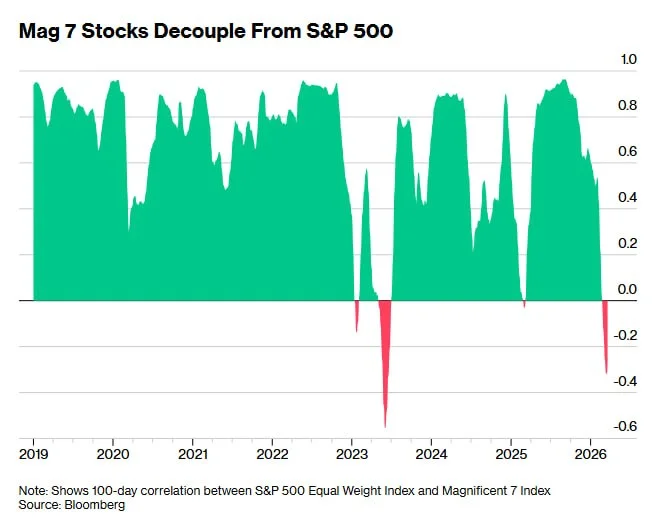
I was staring at my screen this morning, coffee in hand, watching my position in $GOOGL trade completely flat while the rest of the S&P 500 was trying to rally. A few years ago, that would have been impossible. If the S&P was green, the giants were green. Period. But as Bloomberg's data confirmed today, the tight, positive correlation between the Magnificent Seven and the $SPY has vanished again. This isn't just a statistical quirk; it's a fundamental shift in market structure that most retail traders are going to miss.
The Mag 7's decoupling isn't a bug; it's a feature of a maturing, and frankly, healthier market cycle. It's time to hunt for value outside of mega-cap tech.
For the better part of three years, you could essentially buy an ETF of the seven largest tech companies and outperform almost any active manager. Their weight in the S&P 500 became so extreme—peaking at over 33% of the index in late 2025—that their direction *was* the market's direction. When that link breaks, it tells me two things. First, the rest of the market (the 'other 493' companies) finally has its own story to tell. Second, the monolithic growth story of the Mag 7 is fracturing, with individual company fundamentals starting to matter more than the macro tailwind. This is where my background in deep fundamental analysis, reading the 10-K footnotes, really provides an edge.
Yes and no. It's a warning sign for anyone still running a 2023 playbook. The market is no longer a one-trick pony. This divergence means money is moving, not necessarily leaving. It's the classic sign of a maturing bull market and the beginning of a sector rotation strategy 2026. Capital is flowing from over-valued, crowded trades into sectors with better risk-adjusted return profiles. Ignoring this is like trying to drive while looking only in the rearview mirror.
To capitalize, you need to be proactive. My process for identifying this shift is methodical and data-driven:
- Correlation Tracking: I monitor the 30-day rolling correlation between a Mag 7 proxy like the $QQQ and the $SPY. Once it drops below 0.6 and stays there, the regime has shifted.
- Relative Strength Analysis: I pit sector ETFs against the S&P 500. Right now, the relative strength charts for Industrials ($XLI) and Financials ($XLF) are breaking out of long-term downtrends versus the $SPY.
- Earnings Revisions: I keep a massive spreadsheet tracking earnings surprises, but more importantly, forward guidance revisions. The real story is that estimate revisions for S&P 493 companies are now outpacing those of the Mag 7 for the first time in nearly two years.
So, where am I putting my capital? I'm moving away from market-cap-weighted exposure and getting specific. While many traders, like my colleague Jake Morrison, are still brilliant at finding momentum in tech, my models are screaming that the value is elsewhere. I've been building a position in select industrial names that stand to benefit from the multi-trillion-dollar infrastructure and onshoring initiatives. A company like Deere & Co. ($DE) is a prime example. It's trading at a forward P/E of just 13x with a solid dividend, while its precision agriculture technology is essentially an applied-AI story that the market is overlooking.
This leads to a crucial point. Everyone is searching for 'AI stocks to buy now', but they're looking in the wrong place. The first wave was about the enablers—the chip makers and cloud providers. The second, more profitable wave, will be about the *implementers*. These are the boring, established companies in healthcare, manufacturing, and logistics that are using AI to radically improve their margins. My focus is on companies where AI isn't the product, but a tool that drives tangible free cash flow growth. This is a more nuanced view than just chasing the highest-flyers, a perspective I know macro specialists like Alex Volkov would appreciate when looking at the bigger economic picture.
The most common mistake I see is panic. Traders either dump everything because 'the leaders are failing' or they blindly buy the dip on the Mag 7, assuming a quick reversion to the mean. Both are wrong. A proper stock market crash protection strategy isn't about market timing; it's about de-risking from concentration. Your biggest risk right now isn't a crash, it's holding a 2023 portfolio in a 2026 market. My thesis is invalidated if we see a significant macro shock—a true black swan event—that causes a flight to perceived safety, which could ironically mean money floods back into mega-cap tech like $AAPL and $MSFT, crushing the relative value trade. Until then, the rotation is the play.
Stop chasing last year's winners. The market is telling you where the puck is going, and it's not towards the seven most crowded stocks on the planet. The real alpha is now in the 'Forgotten 493'.
I'm methodically building my positions in industrials and applied-AI healthcare names for the next 6-12 months. What unloved sector are you finding real, fundamental value in right now that the rest of the market seems to be completely ignoring?