

📣 Create Blog for Traders!
Stop Watching news - Start Making it.
START


BTC Below $50K? I'm Farming Yield, Not Buying Dips
While everyone waits for the long-term holder zone to hit, I'm using DeFi to generate double-digit returns on my Bitcoin. Here's my strategy compared to a simple spot hold.
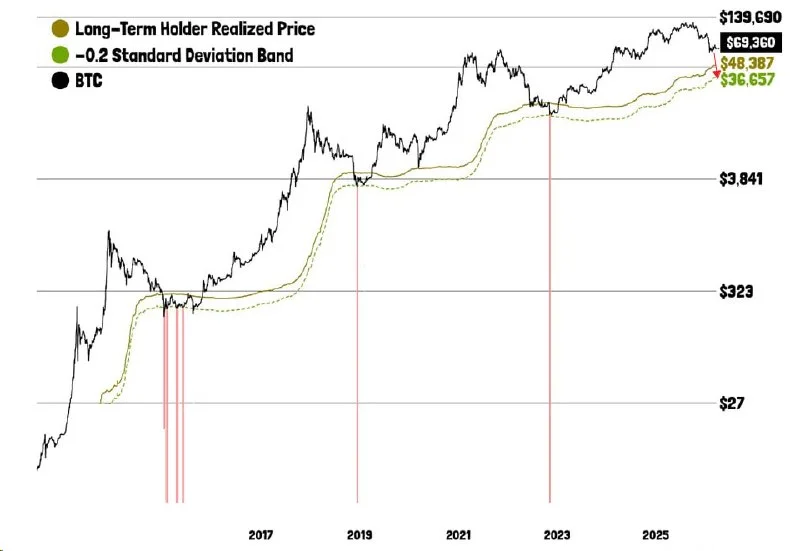
Everyone is watching the on-chain data, pointing to the long-term holder (LTH) cost basis between $48,500 and $36,500 as the next generational buy zone for $BTC. It's a sound thesis, historically. But here's my take: simply waiting to buy that dip is leaving a massive amount of alpha on the table. While traders like Marcus Cole are probably setting spot bids, I'm looking at the bigger picture. The real opportunity isn't just buying Bitcoin; it's putting it to work.
Let's break down the logic here, because it is compelling. The LTH cost basis represents the average price at which long-term, high-conviction holders acquired their coins. In past bear markets, when the spot price has fallen into this zone, it has signaled capitulation and has often marked a major bottom. It's a strategy of patience. You wait for the market to come to you, buy into a zone of historical strength, and hold. Simple.
The primary advantage is its simplicity and security. Your $BTC sits in your cold wallet, immune to smart contract bugs, protocol hacks, or the impermanent loss that haunts liquidity providers. From my own experience getting burned by three rug pulls back in the early days, I can tell you the appeal of zero counterparty risk is very real. You're making a pure, directional bet on Bitcoin's long-term appreciation from a historically undervalued level.
Now for my preferred approach. Why would I let a multi-trillion dollar asset sit idle when I can earn yield on it? By using tokenized versions like $wBTC or native BTC on emerging L2s, I can deploy it across the DeFi ecosystem. This isn't the degen 1,000% APY nonsense from 2020; this is about sustainable, real yield on a blue-chip asset.
- Lending: Depositing $wBTC on Aave V3 currently yields a modest but safe 1-2%.
- Structured Products: Selling covered calls through vaults on protocols like Aevo can generate anywhere from 8-15% APY, especially in a choppy market.
- Liquidity Providing: A more advanced strategy, providing liquidity to a $wBTC/$ETH pool on Uniswap V3 can be very profitable if you manage your range actively.
Of course, this path requires due diligence. I read audit reports for fun, and you absolutely must vet the protocols. Check the TVL on DefiLlama, understand the contract ownership, and look for timelocks. I'm currently exploring some of the best DeFi protocols 2026 has to offer, particularly those bridging real-world assets with crypto yields.
So, spot hold or DeFi yield? For an active market participant, the answer is unequivocally DeFi yield. While a spot strategy is waiting for one specific condition to be met (a price drop), a yield strategy generates returns today, tomorrow, and next week, regardless of whether the price hits $40,000 or stays pinned at $68,000. Finding a DeFi yield farming strategy safe enough for your risk tolerance is key.
In practice, I don't go all-in on one side. My current allocation for my Bitcoin exposure is a 60/40 split. 60% sits in cold storage, acting as my core long-term position. The other 40% is actively deployed in DeFi. Right now, a significant portion of that is in a covered call vault, collecting weekly premiums. This gives me income and lowers my overall cost basis. It's a strategy that adapts to volatility, something I'm expecting given the macro uncertainty that Alex Volkov often covers.
My hybrid thesis gets invalidated by extreme, sudden moves. If $BTC rockets to $150,000 in two months, the spot-only holders will outperform my yield-generating portion due to the capped upside of covered calls. Conversely, a black swan event in DeFi—a major hack on a core protocol like Aave or a bridge exploit—could severely damage the yield strategy and make the simplicity of cold storage look genius. This is the risk we take for alpha.
Waiting for a dip to $40k is a valid, if uninspired, strategy. The real alpha is earning 10-15% on your stack while everyone else is just watching charts.
Ultimately, your strategy depends on your activity level. Passively waiting for the LTH zone is fine. But for those of us who live and breathe this stuff, actively managing our assets in DeFi is how you build real wealth in crypto. So I have to ask: are you content letting your Bitcoin collect dust, or are you willing to take on calculated smart contract risk for a yield that could double your stack in 5 years?