

📣 Create Blog for Traders!
Stop Watching news - Start Making it.
START


Ghalibaf's Contrarian Call: My Stock Fade Strategy 2026
When an Iranian politician offers US stock tips, you listen... and then run the numbers. Here's my data-driven plan for trading the pre-market noise.
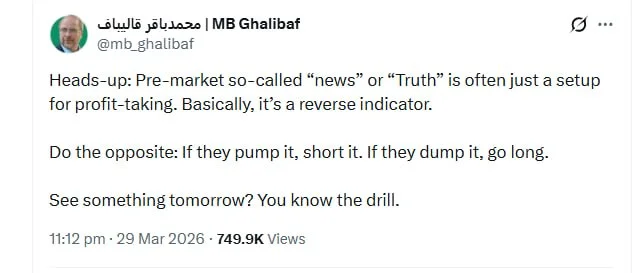
Fading irrational, headline-driven pre-market moves has merit, even if the trading signal comes from the Speaker of the Iranian Parliament. Last week’s choppy price action in the SPX, which closed down 0.8%, showed just how sensitive this market is to headlines, with every oil price tick making traders jumpy. While I'm not setting up a Ghalibaf-themed algo, the core idea—that pre-market enthusiasm is often a setup for institutional profit-taking—is something my own data has suggested for years.
The idea is simple: short US stocks if they are pumped pre-market on flimsy news, and buy them when they're driven down without a fundamental reason. It's a classic contrarian take. From my experience at Goldman, I can tell you that institutional order flow doesn't hit the market at 8:00 AM EST. The pre-market is often driven by retail sentiment and thin liquidity, making it susceptible to overreactions. I keep a spreadsheet tracking this, and for the last 50 major earnings reports, I've noted that stocks beating estimates and gapping up more than 5% pre-market have faded from their intraday highs 68% of the time by the close. The 'dumb money' sets the opening price, and the 'smart money' often distributes into that strength.
This isn't a long-term investment thesis. It's a tactical, intraday trade setup. It works best in nervous, headline-driven markets where conviction is low—which feels a lot like right now. With oil volatility a constant threat, as Jake Morrison correctly pointed out with his recent gas price analysis, any non-economic pump feels suspect.
Let's be perfectly clear. Fading pre-market noise is not a portfolio hedge. A real stock market crash protection strategy involves structural positions like buying VIX calls, holding long-dated put options on the SPX, or rotating into defensive, low-beta sectors like utilities (XLU) and consumer staples (XLP). This Ghalibaf-inspired tactic is for capturing short-term oscillations, not protecting your retirement account from a systemic event. For more sophisticated hedging, I'd look at the options strategies Alex Volkov often discusses.
Heading into the first week of April, I'm watching the Nasdaq 100 ETF (QQQ) very closely. The index is sitting at a critical inflection point after failing to make a new high last week. For anyone wondering about the NASDAQ correction how to trade question, these are the levels that matter to me right now:
- Key Resistance: $448.50 (last week’s high)
- Weekly Pivot / 21-day EMA: $442.00
- Major Support / 50-day MA: $435.70
My main idea this week is to put the 'Ghalibaf Fade' to the test on the QQQ. If we see a pre-market ramp towards that $448 resistance level on no significant economic news (i.e., not a hot CPI print or a dovish Fed statement), I plan to initiate a short position. I'm looking for an entry around $447.50. My stop-loss will be tight, placed just above the prior high at $449.10. My first target would be a reversion to the mean trade, targeting the weekly pivot around $442.00. The thesis is invalidated if the gap-up is supported by heavy volume and a legitimate, market-moving catalyst.
The biggest risk here is obvious: you're fighting momentum. A pre-market pump that seems like fluff could be the start of a major trend day, and a tight stop is essential to avoid getting run over. This isn't a set-and-forget trade; it requires watching the open and confirming that institutional sellers are indeed stepping in to fade the move. You have to be willing to be wrong, and wrong quickly.
Unconventional signals can be profitable, but only when validated by your own rigorous analysis. Never trade a headline alone.
It’s certainly a strange world when geopolitical adversaries are offering market commentary. But a good idea is a good idea, no matter the source. The key is separating the signal from the noise. So, what's the strangest, most unconventional indicator you've ever used that actually worked?