

📣 Create Blog for Traders!
Stop Watching news - Start Making it.
START


Oil in Transit Plunges: The Real Supply Shock Is Weeks Away
Inventories look fine on paper, but the physical market is screaming. Goldman is right, but late to the party. I'm already positioned for the pop.
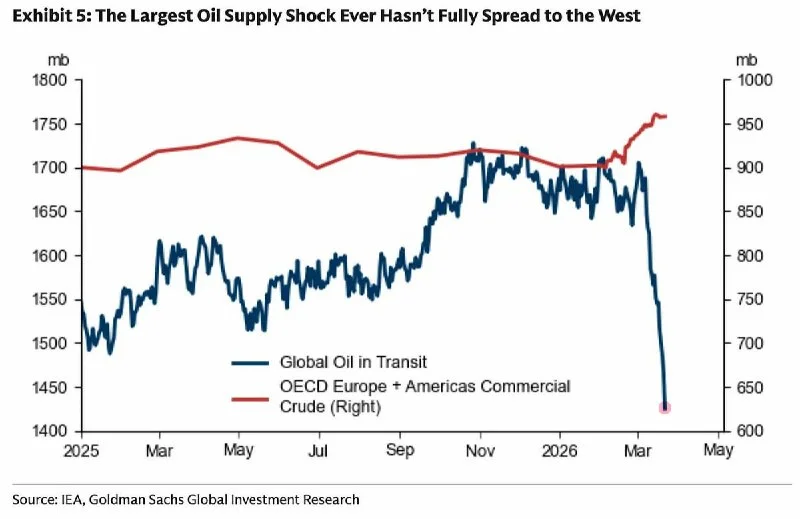
Think you have time to get long oil? Think again. The headlines are flashing warnings from Goldman about a 'historic supply shock,' and the chart-watchers are pointing to acceptable Western inventory levels as a reason not to panic. They are dangerously wrong. The panic hasn't started because the market is staring at the wrong data. This isn't a spreadsheet problem yet; it's a physical, ships-on-the-water problem. And it's about to become everyone's problem. I've been long WTI crude for over a week, and I'm adding. This isn't just a trade; it's the beginning of the real commodities supercycle 2026.
Every analyst is circulating the same chart this morning. It shows Western inventories (the red line) looking relatively stable. Comforting, right? This is a classic trap. It creates a false sense of security that allows the big money to build positions quietly. The chart that matters is the blue line: oil in transit. It hasn't just dipped; it has fallen off a cliff. The last tanker from the Strait of Hormuz hit a European port earlier this week. There are no more behind it.
This isn't theoretical. My contacts in Rotterdam are telling me the inbound schedules for the next 30 days are looking barren. It’s an eerie quiet. Traders looking at weekly EIA data are driving while looking in the rearview mirror. The physical market is telling you there's a brick wall a few miles ahead. The lag between a tanker leaving the Gulf and arriving in Texas or Rotterdam is about 4-6 weeks. The supply chain has been severed, but the patient hasn't realized the artery is cut. The drawdown on those 'acceptable' inventories is about to go exponential.
Complacency is a function of memory. The market has been trained to buy dips on geopolitical scares that blow over in 48 hours. This isn't that. This is a hard logistical reality, not just OPEC jawboning. As my colleague Jake Morrison noted with the Abu Dhabi gas outage, a single point of failure can cause a violent repricing. Now, apply that logic to the most critical oil chokepoint on the planet. The market is treating this like a temporary outage when it's behaving like a full-blown blockade.
Furthermore, the market is distracted. I see people like Emma Blackwood covering the latest institutional moves into digital assets, and that's fine for her world. But while everyone is chasing shiny new things, the foundational asset of the global economy—crude oil—is being ignored. When the price at the pump doubles, that's all anyone will be talking about. Hard assets are king when supply chains break. This is a lesson I learned the hard way when I blew up my first account on a nat gas trade years ago. You don't bet against physical scarcity.
I'm not just watching this; I'm trading it. Talk is cheap. Here's my position in WTI Crude (CL1!):
- Entry: My core position is long from an average price of $92.50.
- First Target: Taking partial profits at $115.00, which I expect we'll see within the next 2-3 weeks.
- Shock Target: If Hormuz remains closed for over a month, $140.00 is my conservative target. It could go vertical.
- Stop-Loss: I've already moved my stop up to $98.00. This is now a risk-free trade for me.
For those looking for futures trading strategies for beginners, this is a textbook example of a catalyst-driven trade. The key is managing your size. The volatility will be insane. Use a smaller position than you think you need. I checked the COT report that just dropped this afternoon—the Managed Money (speculator) long position is still relatively light. There is a mountain of dry powder on the sidelines waiting to chase this higher. The pain trade is up.
No trade is a sure thing. My thesis gets incinerated if a diplomatic breakthrough happens this weekend and the Strait of Hormuz reopens. If that happens, oil will gap down Sunday night, and my trailing stop at $98.00 will likely get hit. It's a risk I'm paid to take, and given the geopolitical situation, I assess the probability as low. The other risk is a sudden, sharp global recession that crushes demand, but that's a much slower-moving threat. The supply shock is immediate. The biggest risk isn't being wrong on the direction; it's being under-capitalized for the volatility that's coming.
The market is pricing oil for a world with open shipping lanes. That world ended last week. The repricing will be violent and unforgiving.
The consensus is wrong. The data they're watching is old news. The physical market is screaming a warning, and almost no one is listening. They will be soon. So, I'll leave you with this question: Everyone is focused on the supply shock, but what about the demand destruction that follows? With energy prices set to double, which major economy breaks first: Europe or China?