

📣 Create Blog for Traders!
Stop Watching news - Start Making it.
START


S&P 500 Dip: Buy Now or Wait for Confirmation? (2026)
Geopolitical dips are historically short-lived, but history isn't a trading strategy. Here's a head-to-head breakdown of buying now versus waiting for a clear signal.
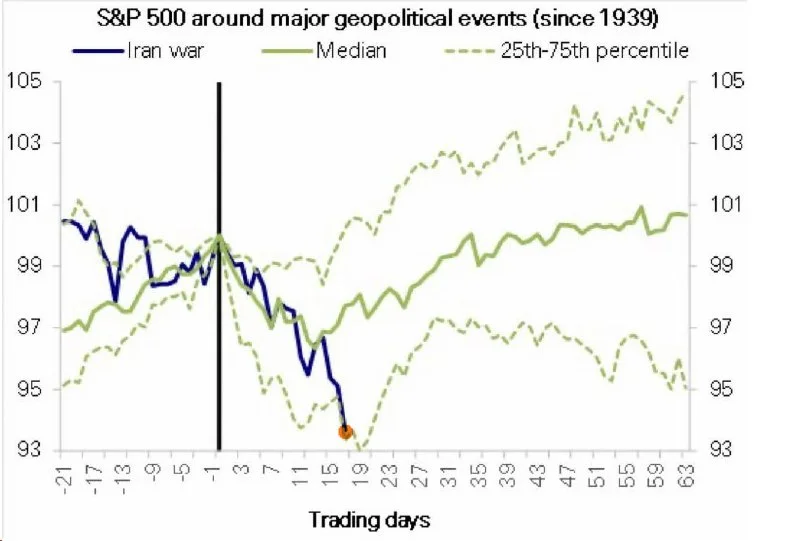
The screens were a sea of red this morning. The S&P 500 opened down another 1.2%, pushing its drawdown from the recent highs to nearly -7% on the back of escalating tensions in the South China Sea. Immediately, the classic Wall Street adage started making the rounds, backed by research notes from Deutsche and Morgan Stanley: 'geopolitical dips are buying opportunities.' While my old Goldman Sachs colleagues are probably sharpening their pencils to model the historical V-shaped recoveries, I’m pumping the brakes. This brings us to the ultimate trader's dilemma: do you act as the aggressive dip-buyer, or the patient strategist who waits for confirmation? Let's break it down.
The argument for buying now is straightforward and historically compelling. Data shows that since WWII, the average market drawdown from a geopolitical event is about -6% to -8%, with a recovery time of just under two months. The logic is that these events, while tragic, rarely derail the fundamental earnings power of U.S. corporations in the long run. The market is a forward-looking mechanism, and it tends to price in the worst-case scenario quickly, creating a coiled spring for a rebound.
From a fundamental perspective, this pullback has brought the S&P 500's forward P/E ratio down to a much more palatable 19.5x from its recent peak above 21x. For a patient investor, this is the moment to start looking for the best value stocks undervalued by the panic. Think of strong free-cash-flow generating companies in the industrial or tech sectors whose long-term theses are completely unaffected by the current headlines. The dip-buyer isn't just gambling; they are betting that fundamentals will win out over short-term fear.
This is the camp I'm in. 'History' is not a ticker symbol you can buy. While the past is a useful guide, it's not a guarantee, especially when the macro backdrop is different. Unlike past dips, we're still contending with a Fed that is hesitant to cut rates, with core PCE inflation stubbornly holding around 2.8%. As my friend Alex Volkov often notes in his macro deep dives, the context of these conflicts is everything. A protracted naval standoff is not the same as a swift, contained event. My primary concern is that the market hasn't fully priced in the potential for supply chain disruptions if this escalates.
Instead of buying blindly, I'm watching price action. I left Wall Street so I could trade my own book, not just write reports, and that means respecting risk. I need to see the market prove to me that the bottom is in. My charts are simpler than what Jake Morrison probably uses, but they focus on what matters.
- Key Support: The $485 level on the SPY. This was a consolidation zone from early February, and I need to see it hold on a closing basis.
- Confirmation Signal: A daily close back above the 21-day EMA, currently sitting near $498. This would signal that buyers have regained short-term control.
- Invalidation Point: A weekly close below the 200-day simple moving average at $471. If we lose that, this isn't a 'dip' anymore; it's the start of a new downtrend.
The aggressive dip-buyer who nails the bottom will see the best returns, no question. But they also risk catching a falling knife and suffering significant further drawdown if support breaks. The patient strategist, by waiting for a close above $498, gives up the first 2-3% of the rally. What they gain, however, is a much higher probability of success and a clearly defined risk level. This is less about being right on the direction and more about structuring a trade with a positive expectancy.
Waiting also allows for a more effective sector rotation strategy 2026. As the market finds its footing, you can observe which sectors are leading the charge. Are financials rallying on the assumption the Fed will have to turn dovish? Is tech snapping back the hardest? Waiting gives you that critical data, whereas buying the whole index now means buying the laggards along with the leaders.
My capital is staying on the sidelines for now. I haven't shorted this market, but I certainly haven't bought into this weakness yet. The risk/reward of buying today at SPY $488, with my invalidation level down at $471, just doesn't meet my criteria. I need to see the market reclaim that 21-day EMA before I start deploying capital. My fundamental work still supports a year-end S&P 500 price target 2026 of around 5,400, but the path to that target is what defines our profitability as traders. I'd rather be a little late to the party than arrive just in time for the floor to collapse.
Buying a geopolitical dip feels smart because it has worked in the past. But blindly following historical data without respecting current price action and macro context is how you turn a small dip into a portfolio disaster.
I'm choosing patience over heroics. The market will still be here next week. Will the current support level? That's the question. So, for those of you also waiting for confirmation, what's the one signal that will get you to pull the trigger: a moving average crossover, a break of a trendline, or something else entirely?